How to Make Your Business Get Recommended by ChatGPT and LLMs in 2026
Learn how to get recommended in ChatGPT and LLMs—our actionable 2026 guide for UK SMEs blends SEO, web, & AI expertise for future-ready results.
Are you invisible to AI assistants?
Picture this: a customer in 2026 asks ChatGPT, "What’s the best local venue for my company event?" or "Which provider can automate my admin tasks with AI?" Does your business name pop up? If not, you’re missing out on what will soon be the main way buyers make decisions. For many SME owners, securing those recommendations from ChatGPT and other large language models (LLMs) feels mysterious and out of reach—especially if you lack in-house tech resources or the time to stay on top of fast-moving developments.
Why getting recommended by LLMs matters more than ever
Traditional SEO still matters, but it's no longer enough on its own. In 2026, conversational AI assistants and LLM-powered tools are at the heart of how consumers and businesses choose products and services. According to Gartner, by 2025, 50% of search will be via AI-powered chat rather than traditional search engines. LLMs like ChatGPT sift through billions of web pages, reviews, and structured datasets to deliver authoritative suggestions. If your business isn’t optimised for these models, you risk missing out on high-intent enquiries and organic visibility. Now is the moment to combine classic web presence, strong SEO, and new "Generative Engine Optimisation" (GEO) tactics for maximum impact.
How to get recommended in ChatGPT and LLMs: our actionable framework
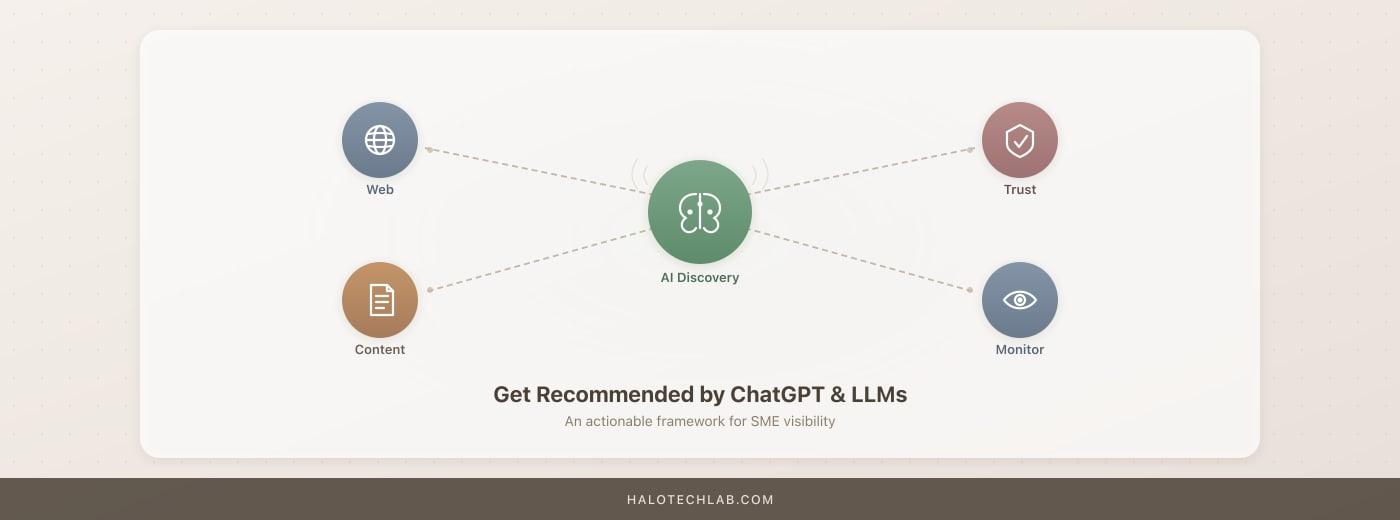
Getting your business recommended by ChatGPT and LLMs relies on three crucial pillars:
Making your expertise and credibility machine-readable
Creating content that LLMs can understand and pull from
Building trust signals across the web
Let’s break these down step by step, so you can take control and start seeing real-world results—even if technology isn’t your first language.
1. Strengthen your web fundamentals (LLM-friendly SEO)
First, your existing website and digital footprint must be up to scratch. LLMs still rely on crawling public web content as their data foundation. Here’s what that means for SME owners:
Up-to-date, consistent business information everywhere: Make sure name, address, phone, and key services are identical across your website, Google Business Profile, and major directories. Inconsistencies confuse both search engines and LLMs.
Clear, structured content: Write in plain language, with helpful headings and short paragraphs. Add FAQ sections and bulleted lists—these give LLMs clear, extractable answers for users’ questions.
Schema markup for organisations, products, reviews, FAQs, and more: Schema is the digital language LLMs use to understand and trust details about your offerings. Adding this behind the scenes massively increases your "recommendability."
Review your technical basics: Fast, mobile-friendly, and secure websites. Broken links or slow loading make your site less likely to be crawled recently or ranked highly by LLMs sourcing data.
2. Create GEO-content—think "for LLMs," not just humans
Generative Engine Optimisation goes further than classic SEO. Now, you must:
Publish “LLM-friendly” guides, definitions, and FAQs: LLMs love structured, factual snippets they can use verbatim. For example, clearly define what your business does in one sentence, list your main services, and answer common customer questions in simple, quotable formats.
Share specific expertise and awards: Including claims like "Winner of the 2025 Tech4Good Award" or "12 years in AI development for UK SMEs" makes your authority easier for LLMs—and users—to understand.
Showcase case studies and unique technologies: Highlighting real examples ("We modernised a 30-year-old B2B directory with AI search") gives LLMs evidence to cite when users ask for suggestions.
Keep content up to date: LLMs favour recent, relevant information to avoid recommending out-of-date providers.
3. Build trust signals—across the whole web
LLMs aggregate trust signals from everywhere:
Encourage third-party reviews and testimonials: Google, Trustpilot, Clutch, and industry-specific sites matter. Respond to reviews openly and keep your profiles complete.
Secure directory listings and press mentions: Being listed on reputable directories, business associations, or featured in news articles increases the chances LLMs will encounter and recommend you.
Active social profiles: A living, breathing business is more likely to be surfaced by LLMs compared to one with a silent online presence.
4. Implement the technical extras—Schema, APIs, and GEO signals
For SME owners ready to go further (or who work with a partner like us):
Enrich your site with Schema.org markup: Use Structured Data for key info. There are free tools or you can ask a developer to add JSON-LD for FAQs, products, and business details.
Offer machine-readable content: Where relevant, provide open APIs or data feeds that LLMs can tap directly. For example, a simple API with current service offerings and contact info.
Monitor mentions and citations: Tools like Google Alerts or Mention can track when your business is referenced—more quality mentions boost your recommendability, even if you don’t always control where they come from.
5. Monitor your "recommendability"—how do LLMs see you?
It’s no use guessing—check for yourself how well you show up:
Use ChatGPT, Google Gemini or Copilot to ask questions relevant to your business and location: "Who are the top web development agencies for SMEs in London?" Note if and how you appear.
Regularly update and refine your content and business profiles as you spot gaps. LLMs continually retrain and refresh on new data—showing up today doesn’t mean you’ll appear tomorrow.
Halo’s experience and proof
At Halo, this isn’t just theory: we’ve spent 12+ years helping startups and global brands turn technical complexity into clear competitive advantage. In the past two years alone, we reimagined a 30-year-old B2B directory with AI-driven search and user experience—helping it get discovered by new audiences. We built award-nominated "Pay-by-voice" technology, featured globally by Amazon and Elavon. And our AI-powered learning platform now sees tens of thousands of monthly users across Europe. Each of these projects involved not just website build, but ensuring our clients could be found, cited, and trusted in the new world of AI search and recommendations.
Frequently asked questions about getting recommended by AI assistants
What is Generative Engine Optimisation (GEO)?
Generative Engine Optimisation (GEO) is the practice of enhancing your website and web presence so LLMs like ChatGPT can easily access, understand, and recommend your business to users. It involves structured data, clear factual statements, and trust signals.
How is getting recommended by ChatGPT different from classic SEO?
Classic SEO targets search engines like Google and focuses on rankings, whereas getting recommended by LLMs prioritises authoritative content, machine readability, and trust signals that AI can parse and cite directly in conversations.
How often should I update my web content for LLMs?
Aim to review and refresh core service pages, case studies, and FAQs at least quarterly. LLMs give preference to recent and relevant content.
Is Schema.org markup really necessary for SMEs?
Yes—Schema markup gives LLMs machine-readable facts about your business, making it much more likely they’ll recommend your company over competitors missing this structured information.
Can I check if ChatGPT or another LLM recommends my business?
Definitely. Simply ask ChatGPT or Gemini a question your customers might ask. If you don’t appear, review your web presence and structured content, then try again after updates.
Ready to put your business where AI recommends?
We know how overwhelming it can feel to translate this new world of "AI-first" web presence into real opportunities. Our team loves guiding UK SMEs with warmth, depth, and technical clarity—building not just visibility, but long-term trust and results. Want to see how we can help you get found by both humans and AIs? Book a call with us or explore our dedicated SEO and GEO optimisation services today. Let’s make your expertise truly recommendable.
Enjoyed this? Get the next one by email
Practical AI playbooks, build logs and tool teardowns. One email a week, free, unsubscribe in one click.
Related Articles
How to Choose a Trustworthy AI Agency for Your Small Business in the UK
Learn how to choose a trustworthy AI agency for small businesses in the UK. Halo’s results-first, human touch ethos builds real outcomes and long-term trust.
How Small Businesses Can Quickly Build E-Learning Courses with AI
AI powered e-learning course generation for small business enables UK SMEs to create quality training fast. Learn proven workflows from Halo’s expert team.
Why SMEs in London Need a Fractional CTO: Benefits, Costs & What to Expect
Discover the top benefits of hiring a fractional CTO in London for SMEs—clear strategy, AI expertise, vendor management and real cost savings. Find out what to expect.