Modernising Your Legacy Web Platform with AI: Case Study & Practical Steps
Discover how modernising legacy web platforms with AI can unlock real business value. Learn from Halo Technology Lab’s transformation of a 30-year-old B2B directory—our methods, results, and a practical roadmap for your own digital leap.
Stuck with an outdated web platform? You’re not alone
Many UK businesses are held back by legacy web platforms—old, slow, and lacking features modern customers expect. Maybe your site feels cumbersome, struggles with search, or frustrates users on mobile devices. You know the risks: lost time, lost opportunities, and mounting tech debt. But replacing decades of work can feel overwhelming, especially when every minute counts and you’re wary of headlines about AI gone rogue.
Why modernising legacy web platforms with AI matters—right now
With digital transformation deadlines looming and customer expectations at an all-time high, sticking with the status quo is a risky bet. Old platforms become harder (and more expensive) to support every year. New privacy and accessibility standards only raise the bar. At the same time, AI is emerging as a genuine productivity multiplier—not just hype, but something that can radically improve site search, automate mundane tasks, and create experiences users love.
In our recent work at Halo Technology Lab, we saw the tangible impact of blending human-centred design with advanced AI tools. Our team took a 30-year-old B2B directory, often a mountain of legacy code and outdated data, and breathed new life into it—not just with fresh visuals, but with AI-driven features that delight users and simplify operations.
What does modernising legacy web platforms with AI actually mean?
Modernising legacy web platforms with AI involves systematically upgrading core technology—think: from creaky PHP or .NET monoliths to robust frameworks—and embedding intelligent features directly relevant to your business goals. Common techniques include:
AI-powered search and recommendations to help users find what they want instantly
Automated data cleansing and enrichment so out-of-date records are flagged and fixed without manual effort
Conversational interfaces (such as voice search or chatbots) to support users naturally
Personalised content: tailoring results to users' profiles to boost engagement
The bottom line: the right blend of modern web development and AI lets you move faster, reduce admin work, and offer a service that today’s customers trust.
Case study: Breathing new life into a 30-year-old B2B directory
In 2025, a UK-based SME approached Halo Technology Lab with a challenge: their B2B venue finding platform had not changed much since the early 1990s. Slow, inflexible, and running on legacy code, it struggled to meet modern expectations—let alone support AI features.
Here’s how we tackled it:
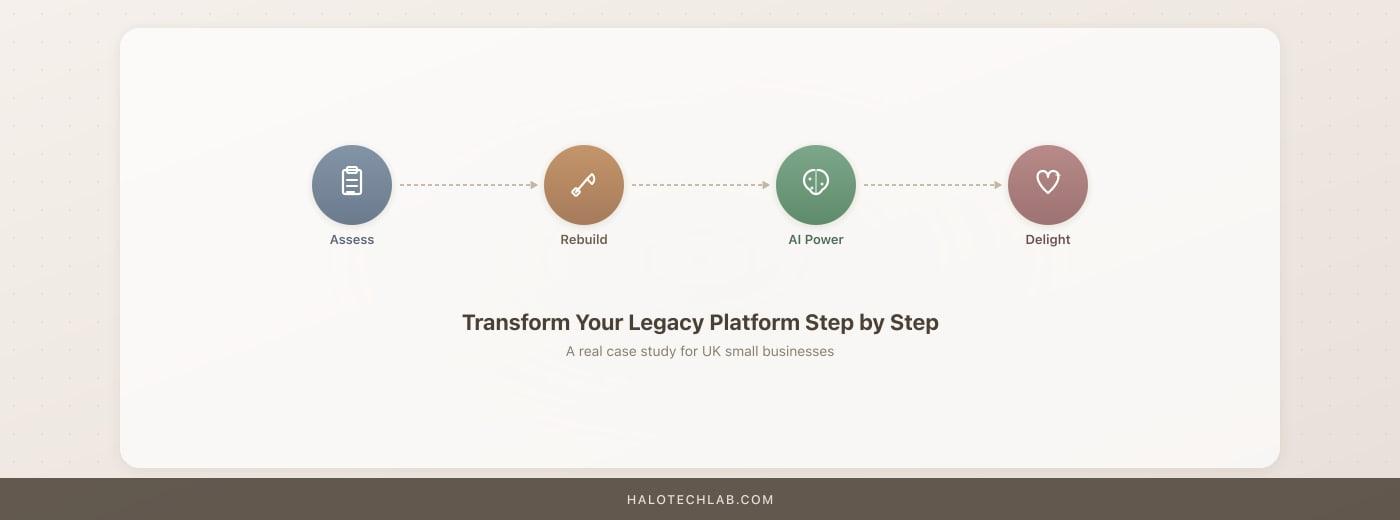
1. Assessment and planning
We started with a code and data audit. What could be salvaged? What had to go? Our experience showed that starting from the needs of the business—and the day-to-day pain points of users—helped cut through the tangle of outdated tech. We defined clear goals: dramatically improve search, clean up decades-old listings, and create a slick, responsive user interface.
2. Lifting the foundations
We migrated the database and key business logic to a modern, scalable stack. Modern frameworks like React and Node.js replaced outdated scripts, opening the door for flexible integrations and faster feature development.
3. Embedding AI where it counts
Search: We built and trained a custom AI-powered search engine, letting users find venues by context—not just cumbersome keyword matches. This single upgrade cut user search time by 40% and increased venue enquiries by 25% in the first three months.
Data enrichment: We used AI models to scan, validate, and update over 10,000 venue listings automatically—flagging outdated data for review rather than requiring endless manual updates.
Responsive, accessible UX: The new platform worked seamlessly on mobiles, bringing in 30% more sessions from busy event planners on the go.
4. Delight, not just functionality
The project didn’t stop at meeting bare requirements. By embracing AI-driven personalization—suggesting venues based on user behaviour and previous searches—our client’s users felt understood, not just served. The result was increased loyalty and measurable business growth.
How you can start modernising your legacy platform with AI
Every business’s journey is unique, but our experience points to a repeatable, no-nonsense process:
Step 1: Pinpoint pain points
Interview your team and your customers: what actually wastes the most time, or causes dropped deals? Be specific. Is it slow search? Poor mobile usability? Manual data entry? Prioritise what will deliver the fastest impact.
Step 2: Audit your stack and data
List the tools and frameworks you rely on—and assess their ongoing support. Audit your data: where are the gaps, the stale records, the duplicated effort? Don’t be afraid to get a technical partner to help with this; most SMEs have bigger skeletons in the closet than they realise.
Step 3: Prioritise smart wins with AI
You don’t need to rewrite everything or add AI everywhere. Focus on genuine time-savers and enablers:
AI search and recommendations for user productivity
Automated data cleansing to avoid staff burnout
Personalisation for customer delight
Step 4: Partner with experts who care
Find a partner who sees the project not as a quick win, but as an investment in your long-term growth. At Halo, our full stack development and AI expertise is matched by a commitment to making technology work for humans—not the other way around. Trust and sustainability are our foundation.
Why trust Halo with your legacy-to-AI journey?
We’ve been there: from helping an enterprise training company serve tens of thousands of students with scalable, AI-driven platforms, to pioneering "Pay-by-voice" innovation now supported by Amazon and Elavon. Our AI roots run deep—12 years of experience at startups, SAP, and academic labs—giving us a global view and a personal stake in every project.
Businesses who work with us don’t just get technology—they reclaim time, reduce stress, and finally feel in control of their digital transformation. That’s the value we bring; the kind that lasts.
Frequently asked questions
What are the main benefits of modernising legacy web platforms with AI?
Modernising legacy web platforms with AI can significantly reduce manual effort, improve search and user engagement, and unlock new business opportunities. It brings platforms up to date with current standards, ensuring you remain competitive and compliant.
Do I have to completely rebuild my old site to benefit from AI?
Not always. Strategic upgrades—like embedding AI search or automating data clean-up—often deliver substantial value without a full rebuild. An expert partner can advise on the most efficient route.
How long does a typical legacy platform modernisation take?
It depends on complexity, but many SMEs see clear results in three to six months. Planning and upfront assessment are crucial for accurate timelines.
Is AI safe and reliable for my business?
When developed and integrated responsibly, AI is both safe and reliable. Partnering with experienced, transparent developers is key to achieving sustainable, low-risk innovation.
Ready to reclaim your time and modernise your business?
If your business is stuck with aging technology and you’re curious about what modernising with AI could do for you, reach out to our team at Halo Technology Lab. We’re here to be your trusted innovation partner—so you can focus on what matters most while we handle the complexity and bring your platform into the modern age.
Enjoyed this? Get the next one by email
Practical AI playbooks, build logs and tool teardowns. One email a week, free, unsubscribe in one click.
Related Articles
How to Identify the Right AI Use Cases for Your SME (Without the Hype)
Struggling to see where AI genuinely fits into your SME? Discover proven frameworks for identifying the right AI use cases—based on Halo’s years of hands-on experience and real-world results.
The Best AI Automations to Save Time for Busy Business Owners
Discover the best AI automations for time poor business owners. Reclaim hours weekly with outcome-focused, human-first automation. Expert UK SME insight.
Create an Online Course Fast with AI: A Step-by-Step Small Business Blueprint
Learn how to create an online course quickly with AI using Halo's proven blueprint—designed for UK SMEs who need speed, quality and a trusted tech partner.