How Much Does an AI Project Actually Cost? A UK SME Breakdown
A transparent breakdown of AI project costs for UK small businesses — from quick integrations to custom-built solutions.
You have read the articles. You have seen the demos. You are fairly convinced that AI could help your business. But the moment you start looking at costs, the picture gets murky fast. One agency quotes £3,000, another quotes £60,000, and you have no idea whether either figure is reasonable.
This is not your fault. The AI services market is immature, pricing is inconsistent, and too many providers have an incentive to keep things vague. So let us do what they will not: give you actual numbers, explain what drives them, and help you budget with confidence.
This article is part of our complete guide to AI for UK small businesses, which covers use cases, implementation steps, and compliance alongside costs.
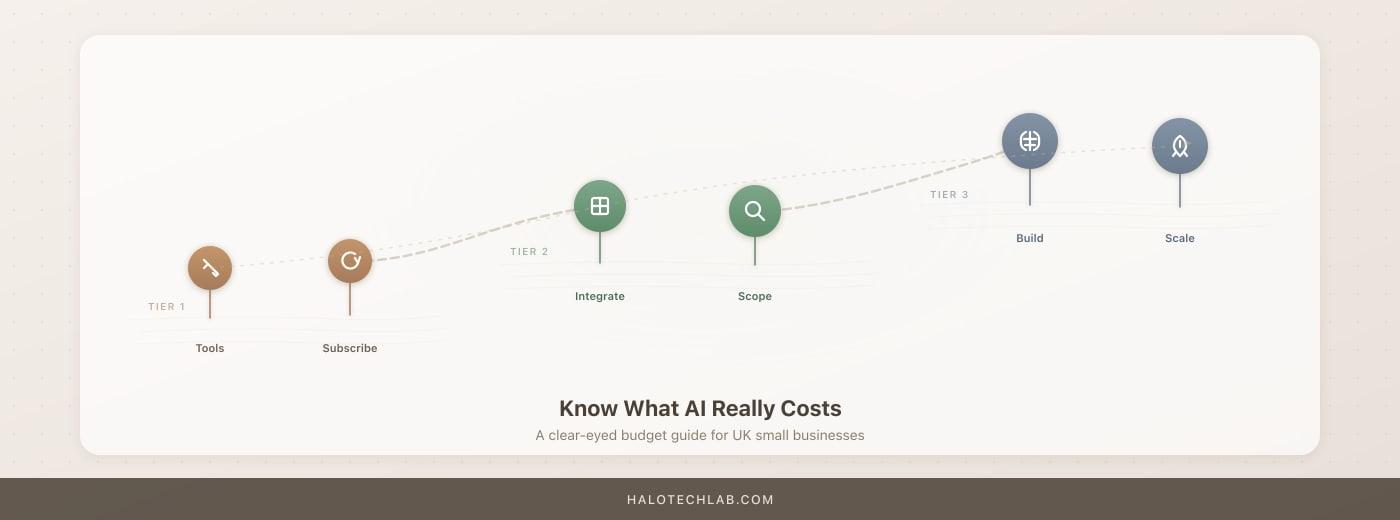
Tier 1: Off-the-Shelf AI Tools (£0-500 per month)
This is where most small businesses should start. These are ready-made products you subscribe to, configure to your needs, and start using immediately. No developer required.
Examples and typical pricing:
- AI writing assistants (ChatGPT Plus, Claude Pro, Jasper): £20-80/month
- Customer service chatbots (Tidio, Intercom Fin): £50-200/month
- Transcription and meeting notes (Otter.ai, Fireflies): £10-25/user/month
- Document processing (Dext, AutoEntry): £20-100/month based on volume
- Email and CRM intelligence (HubSpot AI, Salesforce Einstein): included in higher-tier subscriptions at £80-300/month
- Design and image tools (Canva AI, Midjourney): £10-50/month
The total for a typical small business using 3-4 of these tools lands between £100-400 per month. That is roughly the cost of one day's freelance admin support per month.
What you get: Immediate productivity gains on specific tasks. Easy to trial, easy to cancel.
What you do not get: Integration with your existing systems, customisation to your specific workflows, or competitive differentiation. Everyone has access to the same tools.
Tier 2: Custom Integrations (£5,000-20,000)
This is the sweet spot for most SMEs ready to go beyond generic tools. A custom integration connects AI capabilities to your existing business systems -- your CRM, your website, your internal databases -- so it works with your data and your processes.
What this typically includes:
- Discovery and scoping (2-5 days): understanding your process, data, and goals
- Development (2-6 weeks): building the integration, training on your data if needed
- Testing and refinement (1-2 weeks): making sure it works reliably
- Deployment and training: getting it live and teaching your team to use it
Real examples at this tier:
- An AI chatbot for your website that accesses your product catalogue and answers customer questions with accurate, specific information: £5,000-10,000
- Automated invoice processing that extracts data from supplier invoices and feeds it into Xero or QuickBooks: £8,000-15,000
- An AI-powered email triage system that categorises, prioritises, and drafts responses for incoming enquiries: £7,000-12,000
- Intelligent document search across your internal knowledge base: £10,000-18,000
At Halo, our strategy and scoping process is specifically designed for this tier. We spend time upfront defining exactly what will be built, what data is needed, and what success looks like before any development begins. This prevents the most common cause of budget overruns: unclear requirements.
The concept of a minimum viable product is particularly relevant here. You do not need to build the complete vision on day one. Start with the core functionality, prove it works, and expand from there.
Tier 3: Full Custom AI Solutions (£20,000-75,000+)
This tier is for businesses with a unique competitive advantage locked in their data or a genuinely novel use case that off-the-shelf tools cannot address. You are building a bespoke AI system, potentially with custom model training, sophisticated data pipelines, and complex integrations.
What this looks like:
- Comprehensive discovery and strategy phase (1-3 weeks)
- Data engineering and preparation (2-6 weeks)
- Custom model development or fine-tuning (2-8 weeks)
- Application development and integration (4-12 weeks)
- Testing, refinement, and deployment (2-4 weeks)
- Training and handover
Examples at this tier:
- A proprietary recommendation engine trained on your customer behaviour data: £25,000-45,000
- An AI-powered quality control system using computer vision for manufacturing: £30,000-60,000
- A custom natural language processing system for analysing industry-specific documents: £20,000-50,000
- An end-to-end AI platform integrating multiple capabilities across your business: £50,000-75,000+
Our work on Biosense, an AI-driven biotech analysis platform, falls into this tier. The investment is substantial, but the competitive advantage it creates is equally significant.
The Costs Everyone Forgets
The initial build is only part of the picture. Budget for these ongoing costs from the start.
AI Service Fees
Most AI capabilities run on cloud services from providers like OpenAI, Anthropic, Google, or AWS. These charge based on usage -- typically per API call or per thousand tokens processed. For a chatbot handling 1,000 conversations per month, expect £50-200 in API costs. For heavy document processing, this could reach £500+ monthly.
Maintenance and Updates
AI models and the platforms they run on update frequently. Your integration needs to keep pace. Budget 10-15% of the initial build cost annually for maintenance. A £10,000 integration should have roughly £1,000-1,500 per year allocated for upkeep.
Data Storage and Processing
If your AI system processes significant volumes of data, cloud storage and computing costs add up. For most SME use cases, this is £20-100 per month, but data-intensive applications can be higher.
Training and Change Management
Your team needs to learn the new system, and that takes time away from their regular work. For a team of 10, budget 2-3 days of reduced productivity during rollout, plus ongoing time for the internal champion to manage and optimise the system.
Iteration and Improvement
The first version of any AI system is rarely the best version. Budget for at least one round of refinement after the initial launch, typically 15-25% of the original build cost. This is not a failure -- it is how good AI systems are built. Real-world usage reveals optimisation opportunities that testing cannot.
How to Budget Wisely
Start With the Problem, Not the Budget
Work backwards from the business case. If a manual process costs you £2,000 per month in staff time and errors, and an AI solution costs £10,000 to build with £200 per month in ongoing costs, the payback period is roughly six months. That is a clear decision. Our guide on how to calculate automation ROI walks through this framework in detail.
Phase Your Investment
You do not need to spend your entire budget upfront. A sensible phased approach might look like:
- Month 1-2: Trial off-the-shelf tools (£100-300/month) to validate the use case
- Month 3-4: Commission a scoping study (£2,000-4,000) to design the right solution
- Month 5-8: Build and pilot the custom integration (£5,000-15,000)
- Month 9+: Measure results and decide whether to scale
This approach limits your risk at each stage and ensures you only invest more when the evidence supports it.
Get Multiple Quotes, But Compare Fairly
When evaluating proposals from AI development partners, make sure you are comparing like for like. A £5,000 quote that excludes scoping, testing, and training is not cheaper than a £10,000 quote that includes everything. Ask every provider to break down their quote into: discovery/scoping, development, testing, deployment, training, and ongoing support.
Consider Funding Options
Several UK funding programmes can offset AI project costs:
- Innovate UK Smart Grants: competitive funding for innovative projects, typically covering 25-70% of costs
- UKRI grants: various programmes supporting technology adoption in SMEs
- Growth Hubs: regional support with free or subsidised digital adoption advice
- R&D Tax Credits: claim back up to 27% of qualifying AI development expenditure (for SMEs) through HMRC
- British Business Bank: loans and equity finance for technology investment
Your accountant or a specialist grant consultant can help identify which programmes suit your project. The application process takes time, so factor this into your timeline.
The Bottom Line on AI Costs
Here is a realistic summary for a UK small business considering its first AI project:
| Approach | Initial Cost | Monthly Ongoing | Best For |
|---|---|---|---|
| Off-the-shelf tools | £0 | £100-500 | Testing ideas, individual productivity |
| Custom integration | £5,000-20,000 | £200-500 | Specific process improvements with clear ROI |
| Full custom solution | £20,000-75,000+ | £500-2,000 | Unique competitive advantages, complex needs |
Most SMEs we work with start in Tier 1, move to Tier 2 within 3-6 months, and only consider Tier 3 when they have proven the value of AI in their business and identified a use case that genuinely requires custom development.
The most expensive AI project is the one that solves the wrong problem. Invest in scoping and strategy before you invest in development, and you will spend less overall while getting better results.
Key Takeaways
- Off-the-shelf AI tools (£0-500/month) are the best starting point for most UK SMEs
- Custom integrations (£5,000-20,000) offer the best value when you have a clear, specific use case
- Always budget for ongoing costs: API fees, maintenance (10-15% of build cost annually), and iteration
- Phase your investment to limit risk -- start small and scale based on evidence
- UK funding options like Innovate UK grants and R&D tax credits can significantly reduce your net cost
- The cheapest quote is rarely the best value -- compare proposals on total cost including scoping, testing, and support
Frequently Asked Questions
Can I build an AI solution for under £5,000?
Yes, if you are using off-the-shelf tools or have very simple integration needs. A basic chatbot using a platform like Tidio with some customisation can be set up for £1,000-3,000. However, anything involving custom data integration or bespoke functionality will typically start at £5,000. Be wary of providers promising complex custom work at very low prices -- the result often requires expensive rework.
How do I know if I am being overcharged?
Get at least three quotes and ask each provider to itemise their costs. Compare the hours allocated to each phase. If one quote is dramatically higher or lower than the others, ask why. A good provider will explain exactly what you are paying for and why each element is necessary.
What ongoing costs should I budget for after launch?
Plan for AI API/service fees (£50-500/month depending on usage), maintenance and updates (10-15% of build cost per year), and at least one round of post-launch refinement (15-25% of build cost). For a £10,000 project, that means roughly £3,000-5,000 in first-year ongoing costs on top of the initial investment.
Want a clear-eyed assessment of what AI would cost for your specific business? Get in touch for a free initial consultation. We will scope the opportunity, estimate the investment, and help you build a business case -- whether you work with us or not.
Enjoyed this? Get the next one by email
Practical AI playbooks, build logs and tool teardowns. One email a week, free, unsubscribe in one click.
Related Articles
How to Measure Whether AI Training Actually Worked
Attendance and satisfaction scores tell you nothing. Four measures that do, how to capture a baseline before you start, and what a realistic return looks like.
Training a Team That Thinks AI Is Coming for Their Job
Resistance is usually a reasonable response to a badly handled rollout. How to run AI training when people are worried, and why pretending nothing will change makes it worse.
Workshop, Programme or Course? Choosing the Right Shape of AI Training
A half-day workshop, an ongoing programme and a self-serve course solve different problems. What each is good at, what each costs, and how to tell which one your team needs.