AI for Small Business: The Complete UK Guide (2026)
Everything UK small business owners need to know about AI — what it is, what it costs, where to start, and how to avoid common pitfalls.
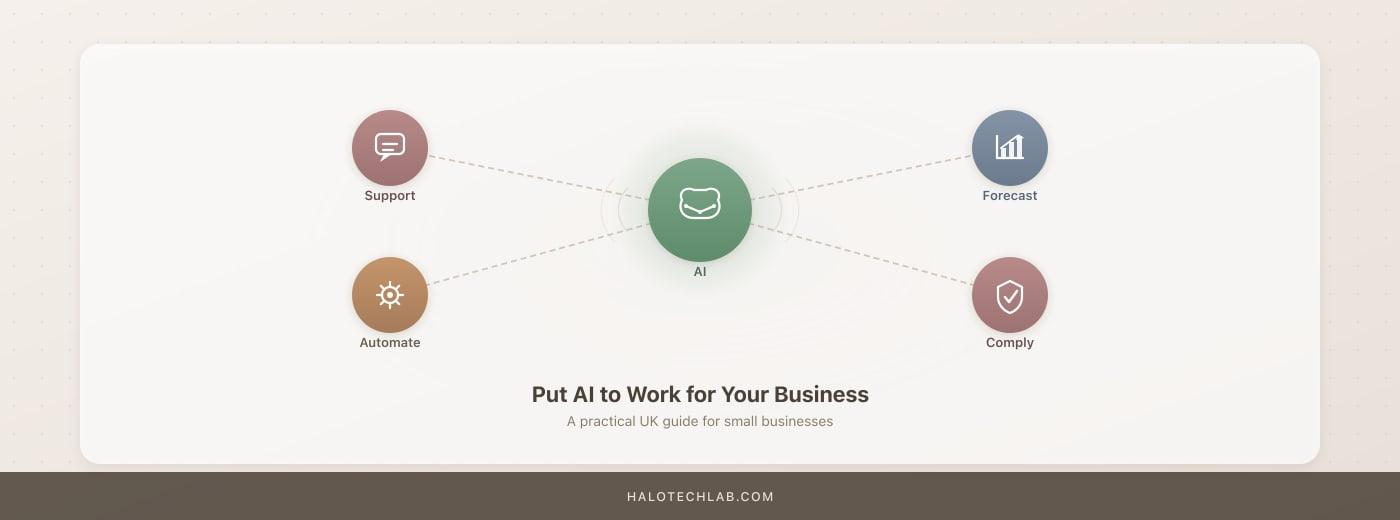
Are you tired of hearing that AI will "revolutionise everything" while having absolutely no idea what that means for your actual business? You are not alone. According to the Federation of Small Businesses, fewer than 15% of UK SMEs have adopted any form of AI, yet nearly 70% say they feel pressure to "do something with it."
Here is the truth: most of the AI hype is aimed at enterprise companies with massive budgets and dedicated data teams. But that does not mean AI has nothing to offer your small business. It just means you need a different playbook.
This guide is that playbook. We will cut through the jargon, show you where AI genuinely saves time and money for businesses like yours, and help you avoid the expensive mistakes that catch so many first-timers. Whether you run a retail shop in Manchester, a professional services firm in London, or a manufacturing operation in the Midlands, there is something here for you.
If you are looking for a quick definition of any technical term in this article, our AI jargon glossary for business owners has you covered.
What AI Actually Means for Your Business
Forget the science fiction. At its core, artificial intelligence is software that can learn patterns from data and make decisions or predictions based on those patterns. That is it.
Think of it like hiring a very fast, very consistent intern. This intern can read through thousands of customer emails and sort them by urgency. It can look at your last three years of sales data and tell you which products will sell best next quarter. It can draft a first version of your marketing copy. But it cannot run your business, it makes mistakes, and it needs supervision.
The key distinction for small businesses is this: you are almost certainly not going to build your own AI. What you will do is use AI-powered tools and services, or integrate pre-built AI capabilities into your existing systems. The difference matters because it dramatically changes the cost, complexity, and timeline involved.
A large language model like the ones powering ChatGPT or Claude is trained on billions of words of text. You do not need to understand how it works any more than you need to understand how a combustion engine works to drive a car. What you need to understand is what it can do, what it cannot do, and what it costs.
For a deeper look at the technology behind these tools, visit our AI solutions overview.
The Most Valuable AI Use Cases for UK Small Businesses
Not every AI application is worth your time. Here are the use cases that consistently deliver measurable returns for SMEs, ranked roughly by accessibility and impact.
Customer Support and Communication
This is where most small businesses should start. AI-powered chatbots and email assistants can handle 40-60% of routine customer queries without human intervention. We are not talking about the clunky chatbots of five years ago that frustrated everyone. Modern conversational AI understands context, remembers previous interactions, and knows when to hand off to a human.
A professional services firm we worked with reduced their email response time from 4 hours to 12 minutes by implementing an AI assistant that drafted replies for their team to review and send. The team spent roughly 30 minutes each day reviewing AI-drafted responses instead of 3 hours writing them from scratch.
The cost is remarkably accessible. Off-the-shelf solutions like Intercom, Tidio, or Zendesk AI start from £50-200 per month. For something more tailored to your business, a custom integration typically runs £5,000-15,000 -- a fraction of hiring an additional support person at £25,000+ per year.
Document Processing and Data Entry
If your team spends hours each week manually entering data from invoices, receipts, forms, or contracts, AI can reclaim that time almost immediately. Optical character recognition combined with natural language processing can extract structured data from documents with 95%+ accuracy.
Think about your accounts payable process. Instead of someone manually keying invoice details into your accounting software, an AI tool reads the invoice, extracts the supplier name, amount, VAT, line items, and due date, then populates your system automatically. Your team reviews exceptions rather than processing every single document.
Tools like Dext (formerly Receipt Bank), AutoEntry, and Rossum handle this for £20-100 per month depending on volume. For businesses processing hundreds of documents weekly, the ROI is typically measured in weeks, not months.
Content Generation and Marketing
AI writing tools have matured significantly. They will not replace your marketing team or your unique brand voice, but they can dramatically speed up first drafts, generate variations for A/B testing, and help you maintain a consistent content schedule without burning out.
Where this works best: product descriptions, social media posts, email newsletter drafts, blog outlines, and meta descriptions. Where it still struggles: thought leadership, highly technical content, and anything requiring deep knowledge of your specific customers.
Our project with Audico, an AI-powered voice platform, demonstrated how AI can transform content creation workflows. By combining voice synthesis with intelligent content generation, the platform reduced production time by over 60%.
Budget roughly £20-80 per month for tools like Jasper, Copy.ai, or a ChatGPT Plus subscription. The real cost is the time your team spends learning to write effective prompts and reviewing output.
AI productivity tools are also emerging for individual knowledge workers. Wisdom AI, a Chrome extension we built, summarises web content into bitesize insights and shareable learning boards — a practical example of how AI can save hours of reading and research time. For startups, platforms like Bizplan.ai, a Techstars 2024-backed generative AI tool, are helping founders produce investor-ready business plans in a fraction of the time. And in mental health, Igloo uses custom AI pipelines to provide practitioners with patient insights from journaling data, showing how even sensitive sectors can benefit from thoughtful AI adoption.
Predictive Analytics and Forecasting
This is where AI starts to feel genuinely powerful. Instead of looking at last month's sales and guessing what next month will bring, predictive analytics examines patterns across years of data, factors in seasonality, market trends, and external variables, and gives you forecasts you can actually plan around.
For retail businesses, this means better inventory forecasting -- ordering the right stock at the right time instead of tying up cash in products that sit on shelves. For service businesses, it means predicting busy periods and staffing accordingly.
The barrier here is data. You need at least 12-24 months of clean, digital data for most predictive tools to deliver meaningful results. If your records are scattered across spreadsheets, paper files, and someone's memory, you will need to sort that out first. Our AI readiness assessment can help you work out where you stand.
Workflow Automation
Strictly speaking, not all automation requires AI. Simple rule-based automation -- "when a new order comes in, send a confirmation email" -- uses tools like Zapier or Make without any AI involvement. But AI-enhanced automation can handle the grey areas that rule-based systems cannot.
For example, an AI-enhanced automation might read incoming emails, determine whether they are sales enquiries, support requests, or spam, and route them to the right person with a suggested priority level. A rule-based system could only do this if every email followed a predictable format, which they never do.
The combination of AI classification with traditional automation is where many small businesses find their biggest efficiency gains. A typical implementation costs £5,000-15,000 for custom workflows, or £50-300 per month for platform-based solutions.
How Much Does AI Really Cost?
This is the question that matters most, and the one that gets the vaguest answers. Let us be specific.
Tier 1: Off-the-Shelf AI Tools (£0-500 per month)
These are subscription-based products you can start using today. ChatGPT Plus (£20/month), Grammarly Business (£15/user/month), Otter.ai for meeting transcription (£10/user/month), and dozens of others. No technical setup required, minimal training, and you can cancel any time.
Best for: testing the waters, individual productivity gains, and specific narrow tasks.
Tier 2: Custom Integrations (£5,000-20,000)
This is where you connect AI capabilities to your existing business systems. Perhaps you want an AI chatbot that can access your product catalogue and order history, or an automated document processing pipeline that feeds into your accounting software.
You will need a development partner for this. The cost covers scoping, development, testing, and deployment. At Halo, our strategy and scoping service is designed to make sure you invest in the right solution before writing a single line of code.
Tier 3: Full Custom AI Solutions (£20,000-75,000+)
Custom-built AI systems trained on your specific data for your specific use case. This is where projects like Biosense, our AI-powered biotech analysis platform, sit. These are genuinely transformative but require significant investment in both money and organisational commitment.
Most small businesses do not need this tier. But if you have a unique competitive advantage locked in your data, this is how you unlock it.
For a detailed cost breakdown with budgeting advice and funding options, read our dedicated article on AI project costs for UK SMEs.
The Step-by-Step Path to Your First AI Project
Do not start with the technology. Start with the problem.
Step 1: Identify a Specific, Measurable Problem
"We want to use AI" is not a project brief. "Our team spends 15 hours per week manually processing invoices and the error rate is 8%" is a project brief. The more specific you are about the problem, the easier it is to evaluate whether AI is the right solution and whether the investment paid off.
Write down the problem, how much it currently costs you (in time, money, or both), and what "success" would look like. If you cannot do this, you are not ready to start.
Step 2: Assess Your Data
AI needs data to work with. Before committing budget, honestly assess what data you have, where it lives, and how clean it is. If your customer records are split between a CRM, three spreadsheets, and a stack of business cards, you have a data problem that needs solving first.
This is one of the most common reasons AI projects stall. Not because the technology does not work, but because the data is not ready. Our AI readiness assessment walks you through this evaluation in about 20 minutes.
Step 3: Start With a Pilot
Never roll out AI across your entire operation on day one. Pick one department, one process, or one team. Set a 30-60 day pilot period with clear success metrics. This limits your risk and gives you real data to make decisions with.
For our work on The Munch Map, an AI-powered food discovery platform, we started with a focused recommendation engine before expanding to broader features. The pilot validated the approach before larger investment.
Step 4: Measure Ruthlessly
Track the metrics you defined in Step 1. Compare them honestly against the baseline. AI projects that cannot demonstrate clear ROI within 90 days of going live should be re-evaluated, not expanded.
Common metrics include: time saved per week, error rate reduction, customer satisfaction scores, response times, and conversion rates. Put a pound figure on each one where possible. Our guide on how to calculate automation ROI has the frameworks you need.
Step 5: Scale What Works
Once your pilot proves value, expand methodically. Document what worked, train additional team members, and gradually increase the scope. This is also the point where you might upgrade from an off-the-shelf tool to a custom integration, or from a single-process integration to a broader workflow.
Common Mistakes to Avoid
We have seen these patterns repeat across dozens of AI projects with UK businesses. Learn from others' expensive lessons.
Chasing Shiny Objects
"Our competitor is using AI, so we need AI too" is not a strategy. Neither is "I saw a demo of ChatGPT and now I want one for our website." Start with business problems, not technology solutions. The most successful AI adopters we work with cannot even tell you what model their system uses -- they just know it saves them 20 hours a week.
Ignoring Data Quality
Garbage in, garbage out. This cliche exists because it is devastatingly true. An AI system trained on inaccurate, incomplete, or biased data will produce inaccurate, incomplete, or biased results. Budget time and money for data cleaning before you budget for AI. In many projects, data preparation accounts for 60-70% of the total effort.
No Clear ROI Target
If you cannot articulate how you will measure success before the project starts, you will not be able to prove it worked afterwards. Every AI project should have a financial target: "save £X per month" or "increase revenue by Y%." Vague goals like "improve efficiency" are not measurable and lead to projects that drift indefinitely.
Overcomplicating the First Project
Your first AI project should be boring. Pick the most straightforward, well-defined process with clean data and clear metrics. Save the ambitious, transformative projects for when you have experience and confidence. A successful small project teaches you more than a failed ambitious one.
Underestimating Change Management
Technology is the easy part. Getting your team to actually use it, trust it, and integrate it into their daily workflows is the hard part. Budget time for training, expect resistance, and appoint an internal champion who can drive adoption. Without this, even the best AI system ends up unused.
AI Compliance and Data Privacy in the UK
The regulatory landscape for AI in the UK is evolving, but there are clear rules you need to follow today.
GDPR Still Applies
If your AI system processes personal data -- customer names, email addresses, purchase histories, browsing behaviour -- it falls under GDPR. This means you need a lawful basis for processing, you must be transparent about how data is used, and individuals retain their rights to access, correct, and delete their data.
Automated decision-making gets extra scrutiny under Article 22 of GDPR. If your AI makes decisions that significantly affect individuals (approving loans, screening job applicants, setting insurance premiums), you must provide human oversight, explain the logic, and offer a right to contest.
The ICO's Position
The Information Commissioner's Office has published detailed guidance on AI and data protection. The key principles are: be transparent about AI use, conduct Data Protection Impact Assessments for high-risk processing, ensure fairness and avoid discrimination, and maintain meaningful human oversight.
In practice, this means your privacy policy should mention AI processing, you should document your AI systems and their purposes, and you should regularly audit outputs for bias or errors.
The AI Safety Institute
The UK's AI Safety Institute, established in 2023, focuses primarily on frontier AI models rather than business applications. However, its work informs the broader regulatory direction. The UK government has signalled a "pro-innovation" approach to AI regulation, favouring sector-specific guidance over sweeping legislation.
For most small businesses, the practical compliance steps are: follow GDPR, be transparent with customers, keep humans in the loop for important decisions, and document what you are doing and why. If you are unsure, the ICO's SME hub has free resources tailored to smaller organisations.
When AI Is Not the Right Answer
This might be the most valuable section in this guide. Not every problem needs AI, and recognising when simpler solutions will do saves you significant time and money.
When Basic Automation Is Enough
If your process follows clear, predictable rules with no ambiguity, you probably do not need AI. Sending automated email confirmations, scheduling social media posts, syncing data between two systems -- these are automation tasks, not AI tasks. Tools like Zapier, Make, or even simple spreadsheet macros can handle them at a fraction of the cost.
When the Volume Does Not Justify It
AI makes economic sense when you are processing things at scale. If you receive five customer enquiries per day, a chatbot is overkill -- just reply to them. If you receive 500, that is a different conversation. Before investing in AI, honestly assess whether the volume of work justifies the investment.
When Your Data Is Not Ready
We keep coming back to this because it is that important. If your business runs on paper records, tribal knowledge, and ad hoc spreadsheets, you need to digitise and organise before you automate. Jumping straight to AI without clean data is like trying to build the roof before the walls.
Check the signs your business is ready for AI to see whether the foundations are in place.
When the Stakes Are Too High
For decisions with serious consequences -- medical diagnoses, legal advice, financial assessments affecting individuals -- AI should assist, not decide. The technology is not reliable enough to operate without human oversight in high-stakes domains, and the regulatory and reputational risks of getting it wrong are substantial.
Key Takeaways
- AI for small businesses means using AI-powered tools and integrations, not building your own models
- Start with a specific, measurable business problem -- not with the technology
- Customer support, document processing, and content generation offer the fastest ROI for most SMEs
- Budget realistically: £0-500/month for tools, £5-20k for integrations, £20-75k+ for custom solutions
- Data quality is the single biggest factor in AI project success
- Follow GDPR, be transparent with customers, and keep humans in the loop
- Not every problem needs AI -- sometimes basic automation or manual processes are the better answer
- Pilot small, measure ruthlessly, and scale what works
Frequently Asked Questions
Is AI affordable for a small business with fewer than 20 employees?
Absolutely. Many AI tools cost less than £100 per month and require no technical expertise to set up. Start with a single tool that addresses your biggest time drain -- perhaps an AI writing assistant for marketing or an automated transcription service for meetings. You do not need a large team or a large budget to see real benefits.
How long does it take to see ROI from an AI project?
For off-the-shelf tools, you can see productivity gains within the first week. For custom integrations, expect 2-4 weeks of implementation followed by a 30-60 day pilot period. Most well-scoped AI projects demonstrate clear ROI within 90 days. If yours has not after that period, something needs to change.
Will AI replace my employees?
In the vast majority of small business use cases, no. AI handles repetitive, time-consuming tasks so your team can focus on work that requires human judgement, creativity, and relationship-building. Think of it as giving each employee a very capable assistant, not as replacing them. The businesses that get the most from AI are the ones that invest in training their existing team to use it effectively.
Do I need a data scientist or technical team to use AI?
Not for off-the-shelf tools and many integrations. For custom AI solutions, you will need a development partner (like Halo Technology Lab) rather than a permanent hire. As AI tools become more accessible, the technical bar continues to drop. What you do need is someone in your organisation who understands your processes well enough to identify where AI can help and who can champion adoption internally.
What are the biggest risks of AI for small businesses?
The biggest risk is wasting money on a solution that does not match a real business problem. Beyond that: poor data quality leading to unreliable results, over-reliance on AI without human oversight, data privacy violations if personal data is mishandled, and vendor lock-in if you build critical processes around a single provider. All of these are manageable with proper planning. Read our full guide on AI risks for small businesses for mitigation strategies.
Ready to explore what AI could do for your business? Book a free strategy call with our team. We will help you identify the highest-impact opportunities and build a realistic roadmap -- no jargon, no pressure, and no commitment. Or start with our free AI readiness assessment to see where you stand today.
Enjoyed this? Get the next one by email
Practical AI playbooks, build logs and tool teardowns. One email a week, free, unsubscribe in one click.
Related Articles
The Data You Already Own: How UK SMEs Turn Decades of Records into Revenue
Your archive is not just history, it is the raw material for products you could sell. A complete guide to finding, valuing, cleaning and commercialising the data your business already holds.
AI Training for UK Businesses: What Your Team Actually Needs to Learn
Most AI training teaches tools. Tools change every six months. A complete guide to what to teach, who to teach it to, which format suits which team, and how to tell whether it worked.
The EU AI Act and UK Businesses: What Actually Applies to You
The UK has not adopted the EU AI Act, and it can still reach your business. A complete guide to which duties apply, when, what the penalties are, and what a sensible response looks like.