AI Jargon Glossary: Every Term a Business Owner Needs to Know
LLM, RAG, fine-tuning, prompt engineering — AI jargon explained in plain English for non-technical business owners.
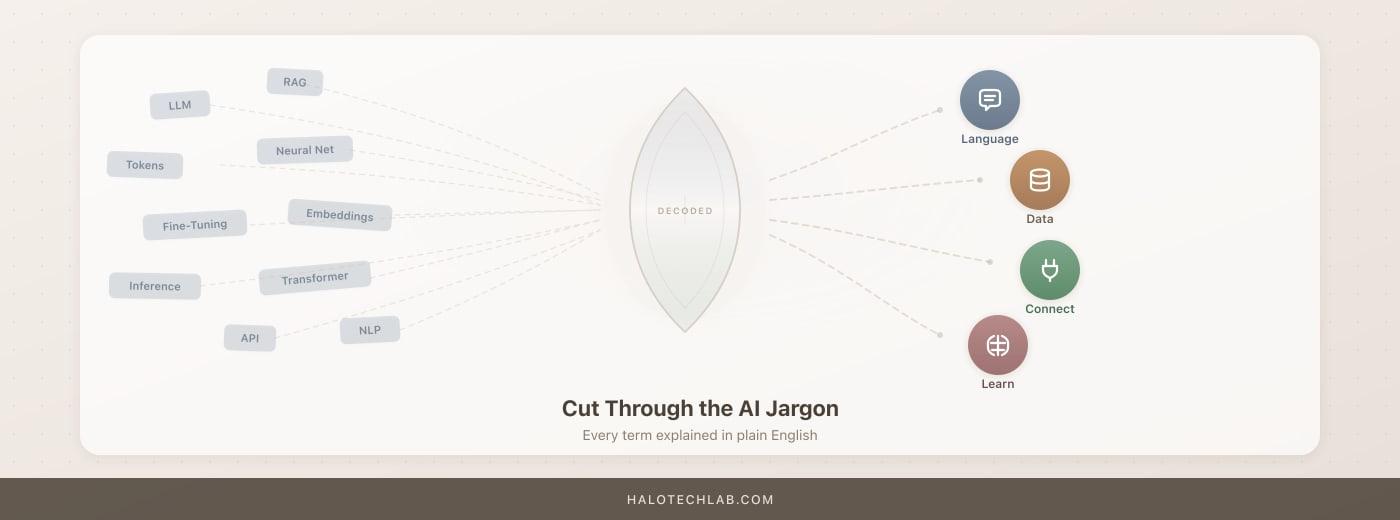
You are in a meeting with a technology provider, and they have just used the phrases "RAG pipeline," "fine-tuned LLM," and "vector embeddings" in the same sentence. You nod along politely, but internally you are wondering whether they are explaining your project or reciting a spell from Harry Potter.
AI has a jargon problem. The industry uses complex terminology that makes simple concepts sound impenetrable, and this creates an unhealthy power imbalance between businesses and the people selling them AI solutions. If you do not understand what someone is proposing, you cannot evaluate whether it is the right approach or a fair price.
This glossary fixes that. Every term is defined in plain English with a practical business context. Bookmark it, share it with your team, and refer back to it whenever you encounter unfamiliar AI vocabulary.
This article is part of our complete guide to AI for UK small businesses.
The Core Concepts
Artificial Intelligence (AI)
Software that can perform tasks that typically require human intelligence -- understanding language, recognising images, making predictions, or generating content. In a business context, AI almost always means software that learns patterns from data and applies them to new situations. It is not conscious, it does not "think," and it is not going to take over the world. It is a powerful tool with specific strengths and limitations. Learn more about AI in business.
Machine Learning (ML)
The most common type of AI. Instead of being explicitly programmed with rules ("if the customer spent over £100, send a discount code"), machine learning systems learn patterns from historical data and make predictions about new data. Your email spam filter is machine learning -- it learned what spam looks like by studying millions of examples. For your business, ML powers recommendations, fraud detection, demand forecasting, and similar prediction tasks.
Deep Learning
A subset of machine learning that uses neural networks with many layers (hence "deep") to learn very complex patterns. Deep learning is what made the current AI boom possible -- it is behind image recognition, voice assistants, language translation, and generative AI. As a business owner, you rarely need to know whether a solution uses deep learning specifically. What matters is whether it solves your problem.
Neural Network
A computing system loosely inspired by the human brain. It consists of layers of interconnected nodes that process information. Think of it as a very sophisticated filter: data goes in one end, passes through multiple layers of analysis, and a result comes out the other end. Each layer learns to detect increasingly complex patterns. You do not need to understand how neural networks work to use AI effectively, just as you do not need to understand transistors to use a laptop.
Language and Text AI
Large Language Model (LLM)
The technology behind ChatGPT, Claude, Gemini, and similar tools. An LLM is an AI system trained on enormous amounts of text data that can understand and generate human-like language. "Large" refers to both the amount of training data (billions of documents) and the size of the model itself (billions of parameters). For businesses, LLMs power chatbots, content generation, document summarisation, email drafting, and much more.
GPT (Generative Pre-trained Transformer)
A specific type of LLM created by OpenAI. "Generative" means it creates new content. "Pre-trained" means it was trained on a massive dataset before being made available. "Transformer" is the underlying architecture (see below). GPT is a brand name that has become somewhat generic -- people say "GPT" when they mean any large language model, like saying "Hoover" when they mean vacuum cleaner.
Transformer
The neural network architecture that powers most modern AI language models. Introduced in 2017, transformers revolutionised how AI processes language by using an "attention" mechanism that helps the model understand context and relationships between words. As a business owner, you will almost never need this term. But if a vendor mentions it, they are describing the engine under the bonnet, not a feature you can evaluate.
Natural Language Processing (NLP)
The branch of AI focused on enabling computers to understand, interpret, and generate human language. NLP is what makes chatbots understand your questions, sentiment analysis tools gauge customer feedback, and translation services work. When someone says an AI system uses NLP, they mean it can work with text or speech in a human-like way. For a real-world example of NLP in production, Inference Cloud uses advanced NLP to build semantic knowledge graphs and conversational search systems, turning large document collections into queryable, intelligent knowledge bases.
Tokens
The units that language models use to process text. A token is roughly three-quarters of a word in English. "Artificial intelligence" is two words but three tokens. This matters because AI services charge by the token and have maximum token limits per request. When a provider quotes costs in "tokens per month," multiply the token count by 0.75 to get an approximate word count.
Prompt Engineering
The art of writing effective instructions for AI systems. Just as the quality of a brief determines the quality of work from a freelancer, the quality of your prompt determines the quality of AI output. Good prompt engineering means being specific, providing context, giving examples of what you want, and iterating based on results. It is not a mystical skill -- it is clear communication applied to a new medium.
Hallucination
When an AI generates information that sounds confident and plausible but is factually wrong. LLMs do not actually "know" things -- they predict what text is most likely to come next based on patterns. Sometimes those predictions are incorrect. This is why human review of AI output is essential, especially for anything factual. Common hallucinations include invented statistics, fabricated quotes, and incorrect dates or names.
Data and Training
Training Data
The dataset used to teach an AI model. A language model might be trained on books, websites, academic papers, and public code repositories. An image recognition model might be trained on millions of labelled photographs. The quality and composition of training data directly affect how well the model performs. Bias in training data leads to biased outputs -- an important consideration for any business application.
Fine-Tuning
Taking a pre-trained AI model and training it further on your specific data to improve its performance on your particular use case. Think of it like hiring a qualified accountant (pre-trained on general accounting) and then training them on your industry's specific regulations and your company's particular processes (fine-tuning). It is more affordable than training a model from scratch but more customised than using an off-the-shelf model.
RAG (Retrieval-Augmented Generation)
A technique that gives AI access to a specific knowledge base -- your documents, product catalogue, FAQ database -- and has it retrieve relevant information before generating a response. Instead of relying solely on its training data (which might be outdated or lacking your specific information), the AI searches your data first and bases its answer on what it finds.
This is how most business AI chatbots work. Rather than fine-tuning a model on your data (expensive, time-consuming), RAG lets you connect your existing documents to an AI system relatively quickly. When a customer asks about your return policy, the AI retrieves your actual return policy document and answers based on that.
Embeddings
A way of representing text, images, or other data as lists of numbers that capture meaning. Words or phrases with similar meanings end up with similar number patterns, which allows AI systems to understand relationships and find relevant content. When your AI-powered search finds documents related to "employee absence policy" even when you searched for "staff sick leave," embeddings are the reason.
Vector Database
A database specifically designed to store and search embeddings efficiently. Traditional databases search for exact matches. Vector databases search for similarity -- finding the stored items most closely related to a query. They are the backbone of RAG systems and semantic search. If a provider mentions a vector database, they are describing how your AI system will store and retrieve knowledge.
How AI Works in Practice
API (Application Programming Interface)
A way for software systems to communicate with each other. When your website sends a customer question to an AI service and receives an answer back, it does so via an API. APIs are how AI capabilities get integrated into your existing systems. They are the plumbing that connects your business applications to AI services like OpenAI, Anthropic, or Google.
Inference
The process of an AI model producing an output -- answering a question, classifying an image, generating text. "Training" is when the model learns; "inference" is when it applies what it learned. This distinction matters for costs: training is expensive and happens once (or rarely); inference happens every time someone uses the system and is what you pay for on an ongoing basis.
Model
The trained AI system itself. When someone says "we will deploy a model," they mean they will set up an AI system that has been trained and is ready to process inputs and produce outputs. Models vary enormously in size, capability, and cost. Choosing the right model for your use case is an important architectural decision -- you do not always need the biggest or most expensive one.
Chatbot
An AI-powered conversational interface that can answer questions, complete tasks, or guide users through processes via text or voice. Modern chatbots powered by LLMs are vastly more capable than the rigid, menu-driven chatbots of the past. They can understand nuance, remember context within a conversation, and handle unexpected questions. For most businesses, a well-implemented chatbot is the most visible and immediately valuable AI application.
Computer Vision
AI that can analyse and understand images or video. Applications include quality inspection in manufacturing, inventory counting in retail, security monitoring, document scanning, and medical imaging. If your business deals with visual information at scale, computer vision might be relevant. It is more specialised than language AI but equally mature.
Types of Learning
Supervised Learning
Training an AI model by showing it labelled examples. "Here are 10,000 emails. These 5,000 are spam, these 5,000 are not. Learn the difference." The model learns to predict labels for new, unseen data. Most business AI applications use supervised learning because you typically know what you want the model to identify or predict.
Unsupervised Learning
Training a model on data without labels, letting it discover patterns on its own. Useful for customer segmentation (grouping customers with similar behaviour without predefined categories), anomaly detection (finding unusual transactions without specifying what "unusual" looks like), and exploratory data analysis. Less common in direct business applications but valuable for discovering insights you did not know to look for.
Generative AI
AI that creates new content -- text, images, audio, video, or code -- rather than simply analysing or classifying existing content. ChatGPT generating a marketing email, Midjourney creating an image, or Suno producing music are all generative AI. This is the category driving most of the current AI excitement and the area with the most accessible business applications.
Terms You Might Encounter in Sales Pitches
Agentic AI
AI systems that can take autonomous actions to complete multi-step tasks, rather than simply responding to individual prompts. An agentic AI might research a topic, draft a report, check it against your brand guidelines, and send it for review -- all from a single instruction. This is an emerging capability in 2026, and while genuinely useful, be cautious of providers overpromising what agentic systems can reliably do today.
Multimodal AI
AI that can process and generate multiple types of content -- text, images, audio, and video -- within a single system. Modern models like GPT-4o and Claude can analyse images, understand documents that mix text and graphics, and respond in various formats. For businesses, this means AI can work with your data regardless of format: photos, PDFs, spreadsheets, voice recordings, or plain text.
Edge AI
AI that runs locally on a device (a phone, a camera, a machine) rather than in the cloud. This matters when you need real-time processing (factory quality control), cannot rely on internet connectivity, or have data privacy requirements that prevent sending information to external servers. Most SME AI applications run in the cloud, but edge AI is relevant for manufacturing, retail, and field operations.
AI Orchestration
Coordinating multiple AI models or services to complete a complex workflow. Rather than one AI doing everything, an orchestration system might use one model to understand a customer query, another to search your knowledge base, a third to generate a response, and a fourth to check the response for accuracy. When a provider talks about orchestration, they are describing the system that manages these moving parts.
Key Takeaways
- AI jargon is simpler than it sounds -- most terms describe straightforward concepts wrapped in technical language
- LLMs, RAG, and APIs are the three terms you will encounter most often in business AI discussions
- Understanding the difference between training and inference helps you understand ongoing costs
- Hallucination is a real risk -- always maintain human oversight of AI-generated content
- You do not need to understand every technical term to make good decisions about AI -- focus on whether a solution solves your problem at a fair price
- Bookmark this glossary and refer back to it whenever you encounter unfamiliar terminology
Frequently Asked Questions
Do I need to understand these terms to use AI in my business?
No. You need to understand enough to ask good questions and evaluate proposals, but you do not need to become a technical expert. Focus on the business terms (ROI, use case, data quality) and learn the technical terms as they come up in your specific context. This glossary is a reference, not a curriculum.
What is the difference between AI, machine learning, and deep learning?
Think of them as nesting dolls. AI is the broadest term -- any software that performs human-like tasks. Machine learning is the most common approach to AI -- systems that learn from data. Deep learning is a specific type of machine learning that uses neural networks with many layers. In practice, the distinctions rarely matter for business decisions. Providers use the terms somewhat interchangeably.
How do I know if a vendor is using jargon to oversell?
Red flags include: using multiple technical terms without explaining what they mean for your business, claiming their approach is uniquely complex (most business AI uses standard, well-established techniques), and being unable to explain their solution in plain English when asked. A good technology partner should be able to describe what their system does, why it is the right approach for your problem, and how much it will cost -- all in language you understand.
What should I ask when a vendor proposes an AI solution?
Five essential questions: (1) What specific business problem does this solve? (2) What data does it need and where will that come from? (3) How will we measure success? (4) What are the total costs including ongoing fees? (5) Can you show me a working example or case study? Any credible provider should answer all five clearly. Visit our AI solutions page to see how we approach these conversations.
Still feeling overwhelmed by AI terminology? Book a free consultation with our team. We speak plain English and we will explain exactly what is -- and is not -- relevant to your business. No jargon, no hard sell, just honest advice.
Enjoyed this? Get the next one by email
Practical AI playbooks, build logs and tool teardowns. One email a week, free, unsubscribe in one click.
Related Articles
How to Measure Whether AI Training Actually Worked
Attendance and satisfaction scores tell you nothing. Four measures that do, how to capture a baseline before you start, and what a realistic return looks like.
Training a Team That Thinks AI Is Coming for Their Job
Resistance is usually a reasonable response to a badly handled rollout. How to run AI training when people are worried, and why pretending nothing will change makes it worse.
Workshop, Programme or Course? Choosing the Right Shape of AI Training
A half-day workshop, an ongoing programme and a self-serve course solve different problems. What each is good at, what each costs, and how to tell which one your team needs.