5 Signs Your Business Is Ready for AI (And 3 Signs It Isn't)
Not every business is ready for AI right now. Here are the honest signals that tell you whether it's the right time.
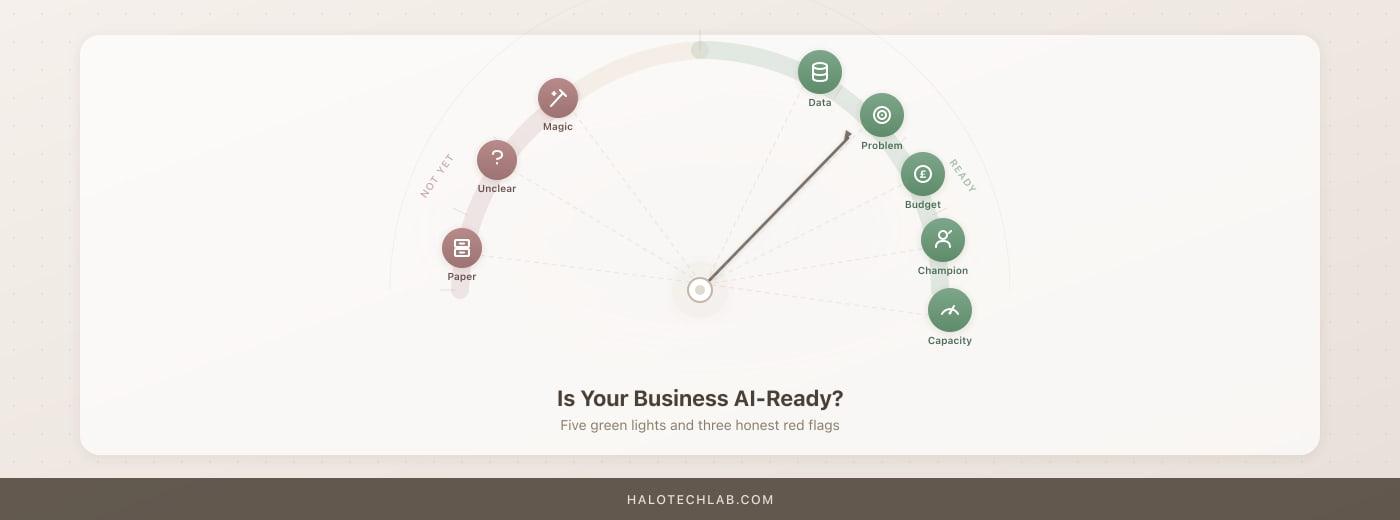
You keep hearing that AI is transforming businesses. Your LinkedIn feed is full of success stories. A competitor just announced they are "leveraging AI" for something or other. And you are wondering: should we be doing this too?
The honest answer is not always yes. Some businesses are perfectly positioned to benefit from AI right now. Others would be throwing money at a problem they have not properly defined yet. The difference is not about company size, sector, or technical sophistication. It is about whether the foundations are in place.
This article will help you figure out which camp you are in -- honestly and without the hype. It is part of our complete guide to AI for UK small businesses.
The 5 Signs You Are Ready
1. Your Data Already Lives in Digital Systems
This is the single most important prerequisite. AI needs data to work with, and that data needs to be digital, structured, and accessible. If your customer records are in a CRM, your finances are in cloud accounting software, your sales are tracked in a POS system, and your communications flow through email and messaging platforms, you have raw material that AI can work with.
You do not need perfect data. But you need digital data. If the information AI would need to do its job currently exists in your systems -- even if it is a bit messy -- you have cleared the biggest hurdle.
2. You Can Point to a Specific, Expensive Problem
"We want to use AI" is not a starting point. "Our team spends 20 hours a week manually processing customer enquiries, and our average response time is 6 hours" is a starting point. The businesses that get the most from AI are the ones that can describe a specific process that costs them real time or money.
The ideal first AI project has these characteristics: it is repetitive, it follows broadly predictable patterns, it happens at sufficient volume to justify investment, and you can measure the current cost in hours or pounds. If you can tick all four boxes for at least one process in your business, you have a strong candidate.
3. You Have Budget for Ongoing Costs, Not Just a One-Off Build
AI is not a set-and-forget purchase. It requires monthly service fees, periodic maintenance, and occasional refinement. A business that can afford a £10,000 build but has no budget for £200-500 per month in ongoing costs will end up with a system that degrades over time.
Think of it like a car. The purchase price is the obvious cost, but fuel, insurance, servicing, and MOTs are what keep it running. Before you commit to an AI project, make sure your budget covers the whole lifecycle, not just the build. Our cost breakdown guide has the specific numbers.
4. Someone on Your Team Champions the Idea
Every successful AI adoption we have seen has an internal champion -- someone who understands the problem, believes in the solution, and will drive adoption across the team. This person does not need to be technical. They need to be curious, persistent, and respected enough by their colleagues to bring people along.
Without a champion, AI projects stall. The system gets built, the team gets a brief demo, and then everyone quietly goes back to doing things the old way. Change management is not glamorous, but it is the difference between a tool that transforms your operations and one that gathers digital dust.
5. You Have Outgrown Manual Processes
There is a natural inflection point where manual processes start holding your business back. You are turning down work because you cannot process enquiries fast enough. Errors are creeping in because your team is stretched too thin. You are spending more time on admin than on the work that actually generates revenue.
If you recognise this pattern, AI is not a luxury -- it is a competitive necessity. The businesses that automate at this stage free up capacity to grow. The ones that do not end up trapped in a cycle of hiring to handle volume, which rarely scales as efficiently.
Our AI readiness assessment tool can help you evaluate these signals in the context of your specific business. It takes about 20 minutes and gives you a personalised recommendation.
The 3 Signs You Are Not Ready Yet
These are not permanent disqualifications. They are signals that you need to sort some foundations before AI investment makes sense.
1. Your Critical Data Lives on Paper or in People's Heads
If your customer records are in a filing cabinet, your pricing is "whatever Dave thinks is right," and your process documentation is "ask Sarah, she knows how it works," you have a digitisation challenge, not an AI opportunity.
AI cannot read your paper files (well, it can with OCR, but the point is broader). It cannot replicate tribal knowledge that has never been written down. Before investing in AI, invest in getting your critical business information into digital systems. This might mean implementing a CRM, digitising paper records, or simply documenting your core processes.
This is not wasted effort. Digitising and documenting your operations delivers value on its own, and it creates the foundation for automation and AI adoption down the line.
2. You Cannot Describe a Clear Problem to Solve
If your motivation for exploring AI is "because everyone else is doing it" or "it seems like the future," you are not ready. AI adopted without a clear problem to solve almost always results in wasted money and organisational cynicism that makes future adoption harder.
Go back to basics. Map your core business processes. Identify the bottlenecks, the time sinks, and the error-prone steps. Talk to your team about what frustrates them most. The right AI use case will emerge from this analysis -- or it will not, and you will have saved yourself a significant investment.
There is no shame in concluding that basic automation tools like Zapier or Make would solve your problems at a tenth of the cost. Sometimes the unsexy solution is the right one.
3. You Are Expecting Magic
If you believe AI will instantly fix deep-seated business problems, eliminate the need for certain roles, or deliver transformative results without any effort from your team, you will be disappointed. AI is a powerful tool, but it is still a tool. It requires setup, management, and human oversight.
The businesses that struggle most with AI are the ones that expected it to work perfectly from day one with no adjustment period. In reality, the first version of any AI system needs refinement based on real-world usage. Your team needs time to learn how to work with it. And there will always be edge cases that require human judgement.
Set realistic expectations. A good first AI project should save your team meaningful time on a specific task within 30-60 days of going live. It should not require a leap of faith or a suspension of critical thinking.
What to Do If You Are Not Ready Yet
Being "not ready" is not a dead end. It is a starting point. Here is a practical path forward:
Months 1-3: Digitise your critical data. Get customer records into a CRM, financial data into cloud accounting, and core processes documented in writing.
Months 4-6: Trial off-the-shelf AI tools for individual tasks. Give your team access to ChatGPT or Claude for drafting communications, or try an AI transcription tool for meetings. This builds familiarity and helps identify use cases.
Months 7-9: Commission a strategy and scoping exercise to evaluate your AI readiness properly and identify the highest-value opportunity.
Month 10+: Launch your first focused AI project with clear goals and metrics.
This timeline is not rigid. Some businesses move faster, others need longer. The point is that readiness is something you build, not something you either have or lack.
Key Takeaways
- Digital data is the non-negotiable prerequisite for AI adoption
- A specific, measurable problem to solve matters more than technical capability
- Budget for ongoing costs (maintenance, API fees, refinement), not just the initial build
- An internal champion is essential for driving adoption across your team
- If your data is on paper, your processes are undocumented, or you cannot name a clear problem, focus on those foundations first
- Readiness is buildable -- start digitising, experimenting with off-the-shelf tools, and identifying problems today
Frequently Asked Questions
How do I assess our data quality before investing in AI?
Start with a simple audit. For each major business process, ask: where does the data live, how complete is it, how accurate is it, and who can access it? If your data is in digital systems, reasonably complete, and accessible via exports or APIs, you are in good shape. Our AI readiness assessment includes a data quality evaluation.
What if we are ready in some areas but not others?
That is perfectly normal and actually ideal. Focus your first AI project on the area where readiness is highest -- where you have clean digital data, a clear problem, and an enthusiastic team member. Success there builds the confidence and evidence to expand into less mature areas.
Is it worth hiring someone specifically for AI?
For most SMEs, no. A full-time AI specialist is expensive (£50,000-80,000+ per year) and may not have enough work to justify the role. A better approach is to partner with an external team like Halo for the build and train an existing team member to manage the system day-to-day. Consider a dedicated hire only when AI becomes a core, ongoing function rather than a series of projects.
Not sure where you stand? Take our free AI readiness assessment for a personalised evaluation. Or book a call with our team to talk through your specific situation -- we will give you an honest answer about whether AI is the right move for your business right now.
Enjoyed this? Get the next one by email
Practical AI playbooks, build logs and tool teardowns. One email a week, free, unsubscribe in one click.
Related Articles
How to Measure Whether AI Training Actually Worked
Attendance and satisfaction scores tell you nothing. Four measures that do, how to capture a baseline before you start, and what a realistic return looks like.
Training a Team That Thinks AI Is Coming for Their Job
Resistance is usually a reasonable response to a badly handled rollout. How to run AI training when people are worried, and why pretending nothing will change makes it worse.
Workshop, Programme or Course? Choosing the Right Shape of AI Training
A half-day workshop, an ongoing programme and a self-serve course solve different problems. What each is good at, what each costs, and how to tell which one your team needs.