AI for Retail Businesses: Practical Use Cases That Actually Work
Real, practical ways UK retail businesses are using AI today — from personalisation to inventory management.
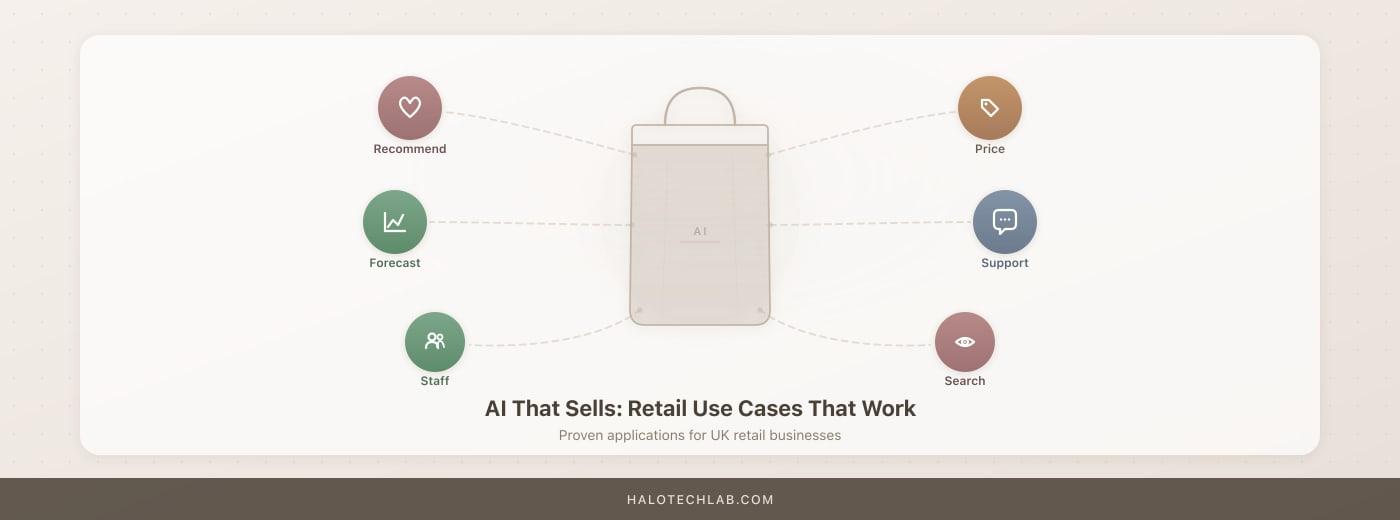
Your customers expect personalised experiences. Your margins are being squeezed. Your competitors seem to be everywhere at once. And someone keeps telling you that AI is the answer.
But which AI? For what? And will it actually work for a UK retail business that is not Amazon?
The good news is that several AI applications have moved well beyond the experimental phase for retailers. They are proven, accessible, and delivering measurable results for businesses of all sizes. The not-so-good news is that the market is flooded with overhyped solutions that promise transformation and deliver disappointment.
This guide focuses exclusively on the use cases that work -- the ones where UK retail businesses are seeing genuine returns on their investment. It is part of our complete guide to AI for UK small businesses.
Personalised Product Recommendations
This is the use case that Amazon built an empire on, and it is now accessible to retailers of every size. AI analyses customer browsing behaviour, purchase history, and product attributes to suggest items each customer is most likely to buy.
The numbers are compelling. Personalised recommendations typically increase average order value by 10-30% and conversion rates by 5-15%. For an online retailer turning over £500,000 annually, even a modest 10% lift in average order value translates to £50,000 in additional revenue.
Modern recommendation engines go far beyond "customers who bought X also bought Y." They understand seasonal patterns, detect emerging preferences, and can factor in real-time behaviour -- adjusting suggestions as a customer browses. They can also handle the "cold start" problem for new customers by using demographic data and first-click behaviour to make educated initial suggestions.
For smaller retailers, platforms like Shopify, WooCommerce, and BigCommerce offer built-in or plug-in recommendation engines starting from £30-100 per month. For mid-market retailers wanting more sophistication, tools like Nosto, Clerk.io, or Dynamic Yield offer advanced personalisation at £200-500+ per month depending on traffic volume.
Our work on The Munch Map, an AI-powered food discovery platform, demonstrates how intelligent recommendation systems can transform the browsing experience. The platform uses AI to match users with relevant options based on their preferences and behaviour -- the same fundamental approach that works for any retail context. You can explore similar concepts on our ecommerce personalisation use case page.
Inventory Forecasting and Demand Prediction
Getting stock levels right is one of retail's oldest and most expensive challenges. Too much inventory ties up cash and leads to markdowns. Too little means lost sales and frustrated customers. AI-powered demand forecasting analyses historical sales data, seasonal trends, weather patterns, local events, and market conditions to predict what will sell, when, and in what quantities.
The impact is significant. UK retailers using AI forecasting report 20-40% reductions in overstock and 15-25% reductions in stockouts. For a retailer carrying £200,000 in inventory, a 25% reduction in overstock frees up £50,000 in working capital. That is money you can invest in growth rather than warehouse space.
AI forecasting is particularly valuable for:
- Seasonal businesses where demand patterns are complex and weather-dependent
- Multi-channel retailers needing to allocate stock across physical stores and online
- Perishable goods retailers where overstocking leads to waste, not just markdowns
- Fashion and trend-driven categories where demand shifts quickly
Tools like Inventory Planner, Lokad, and Singuli offer AI-powered forecasting for SME retailers starting from £100-300 per month. Integration with your existing POS and inventory management system is typically straightforward.
For larger or more complex operations, custom forecasting models can be built for £15,000-40,000, trained specifically on your historical data and business variables. The ROI typically justifies the investment within 6-12 months for retailers with annual turnover above £1 million.
Dynamic Pricing
AI-powered pricing adjusts your prices in response to demand, competition, inventory levels, and market conditions -- automatically and in real time. This is standard practice for airlines and hotels, and it is increasingly accessible to retail businesses.
Dynamic pricing does not mean simply undercutting competitors. A well-configured system considers your margin targets, brand positioning, stock levels, and competitive landscape. It might increase prices on high-demand, low-stock items while reducing prices on overstocked products approaching their sell-by date.
For online retailers, tools like Prisync, Competera, and BlackCurve monitor competitor prices and adjust your pricing within rules you define. Pricing starts at £100-400 per month depending on your catalogue size.
The ethical dimension matters here, particularly in the UK market. Customers who feel manipulated by aggressive dynamic pricing will take their business elsewhere. The most successful implementations are transparent: "price matched," "clearance -- last few in stock," or "early bird offer" framing helps customers understand why prices change.
For brick-and-mortar retailers, electronic shelf labels combined with AI pricing are becoming practical. The hardware cost has dropped significantly -- to roughly £3-5 per label -- making them viable for medium-sized stores with 1,000+ SKUs.
Customer Service Chatbots
Retail customer service follows predictable patterns: "where is my order," "how do I return this," "do you have this in a different size," "what are your opening hours." AI chatbots handle these routine queries instantly, 24 hours a day, freeing your team for complex issues that require human judgement.
Modern retail chatbots are a world apart from the menu-driven bots that frustrated customers five years ago. They understand natural language, access your order management system to give real-time updates, and can process simple transactions like initiating returns or modifying orders. Critically, they know when they are out of their depth and hand off to a human seamlessly.
The economics are straightforward. A chatbot handling 500 customer conversations per month replaces approximately 40-60 hours of human time. At even a modest £12 per hour, that is £480-720 per month in staff time. Platform chatbots from Tidio, Gorgias, or Zendesk cost £100-300 per month, making the ROI immediate.
For retailers with more complex needs -- integration with custom order management systems, multi-language support, or handling product recommendations within conversations -- a custom chatbot implementation runs £5,000-15,000 with ongoing costs of £200-500 per month.
The key to success is setting customer expectations correctly. Make it clear when they are chatting with an AI, provide an easy escalation path to a human, and continuously improve the system based on conversations it struggles with.
Visual Search and Product Discovery
"I want something like this" -- a customer holds up their phone showing a photo of a dress they saw on Instagram. Visual search AI analyses the image and finds similar products in your catalogue. This technology has matured significantly and is now practical for mid-market retailers.
Visual search addresses a real customer frustration: knowing what you want but not knowing what it is called. Searching for "blue floral midi dress with puff sleeves and a square neckline" is tedious and often yields poor results. Uploading a photo is instant and intuitive.
Platforms like Syte, ViSenze, and Google Lens for Commerce offer visual search capabilities that integrate with major ecommerce platforms. Costs range from £200-800 per month depending on catalogue size and search volume. Implementation is typically a matter of adding a code snippet and feeding your product images into the system.
The technology works best for visually distinctive product categories: fashion, home decor, furniture, and accessories. It is less useful for commoditised products where visual differences are minimal (cables, screws, plain t-shirts).
For physical retailers, visual search can power in-store experiences too. Customers scan items with their phone to see styling suggestions, availability in other sizes, or similar products at different price points.
Demand-Based Staffing and Operations
AI does not just optimise what you sell -- it can optimise how you operate. Demand prediction models can forecast foot traffic and transaction volumes hour by hour, enabling you to staff your store or warehouse with the right number of people at the right times.
UK retailers using AI-driven scheduling report 10-20% reductions in labour costs without reducing service levels. The system predicts busy periods based on historical patterns, weather forecasts, local events, marketing campaigns, and even social media sentiment. It then recommends staffing levels and shift patterns.
Tools like Legion, Quinyx, and Deputy offer AI-enhanced workforce management starting from £2-4 per employee per month. For a retailer with 30 staff, that is £60-120 per month -- a fraction of the potential savings.
This use case also extends to warehouse and fulfilment operations. AI can predict order volumes and recommend picking schedules, restock timing, and delivery route optimisation. The principles of automation apply here: remove the guesswork, reduce the waste, and let your team focus on customer-facing work.
Getting Started: A Practical Roadmap
If you are a UK retailer considering AI, here is how to prioritise:
Quick wins (implement this month): Start with an off-the-shelf recommendation engine on your ecommerce platform and a basic customer service chatbot. Combined cost: £150-400 per month. Expected impact: 5-15% increase in average order value, 30-50% reduction in routine support queries.
Medium-term projects (next quarter): Implement AI-powered demand forecasting and integrate it with your inventory management. Cost: £200-500 per month for tools, or £15,000-30,000 for a custom solution. Expected impact: 20-30% reduction in overstock, improved cash flow.
Strategic investments (this year): Dynamic pricing, visual search, or a fully integrated AI customer experience. Cost: £10,000-50,000+ depending on scope. Expected impact: competitive differentiation and operational transformation.
The most important step is the first one. Pick one use case, implement it with clear metrics, and let the results guide your next investment. Our AI solutions page outlines how we help retailers through this process.
Key Takeaways
- Personalised recommendations offer the fastest ROI for most online retailers (10-30% average order value increase)
- AI inventory forecasting can reduce overstock by 20-40%, freeing up significant working capital
- Customer service chatbots pay for themselves within weeks by handling routine queries
- Dynamic pricing is powerful but requires careful implementation to maintain customer trust
- Start with one use case, measure results, and expand based on evidence
- Most AI retail tools are accessible at £100-500 per month -- you do not need enterprise budgets
Frequently Asked Questions
Is AI only useful for online retailers?
Not at all. Physical retailers benefit from demand forecasting for stock allocation across stores, AI-driven staffing optimisation, electronic shelf labels with dynamic pricing, and in-store analytics using computer vision. Many of the most impactful retail AI applications work across channels or are specifically designed for brick-and-mortar operations.
How much data do I need before AI forecasting works?
Most forecasting tools need a minimum of 12 months of sales history to produce useful predictions. Two to three years is ideal, as it allows the system to learn seasonal patterns. If you have less data, start with simpler forecasting approaches and let the AI system accumulate data over time. Clean, consistent data matters more than volume.
Will AI recommendations feel creepy to my customers?
Only if implemented poorly. The key is relevance without overreach. Recommending products based on browsing behaviour on your site is expected and welcomed by most customers. Using data in ways that feel invasive -- "we noticed you searched for this on Google" -- erodes trust. Stay within data you have collected transparently and offer customers control over their preferences.
What is the minimum budget to start using AI in retail?
You can start for under £200 per month by adding a recommendation engine plug-in to your ecommerce platform and trialling a basic chatbot. This is enough to validate the value for your specific business before investing more. The cost breakdown in our AI project cost guide has detailed figures across all budget levels.
Ready to explore AI for your retail business? Get in touch for a free consultation. We will help you identify the highest-impact use case for your specific situation and build a practical implementation plan. No obligation, no jargon -- just clear advice from a team that has built AI-powered platforms for businesses across the UK.
Enjoyed this? Get the next one by email
Practical AI playbooks, build logs and tool teardowns. One email a week, free, unsubscribe in one click.
Related Articles
How to Measure Whether AI Training Actually Worked
Attendance and satisfaction scores tell you nothing. Four measures that do, how to capture a baseline before you start, and what a realistic return looks like.
Training a Team That Thinks AI Is Coming for Their Job
Resistance is usually a reasonable response to a badly handled rollout. How to run AI training when people are worried, and why pretending nothing will change makes it worse.
Workshop, Programme or Course? Choosing the Right Shape of AI Training
A half-day workshop, an ongoing programme and a self-serve course solve different problems. What each is good at, what each costs, and how to tell which one your team needs.