Do You Need a CTO, a Dev Agency, or Both?
Understanding whether you need strategic technology leadership, execution capacity, or both.
You know you need help with technology. But what kind of help, exactly? Should you hire a CTO to lead your technical strategy? Engage a development agency to build your product? Or do you need both?
This question trips up more business owners than almost any other technology decision. Get it wrong and you either overspend on leadership you do not need yet, or you invest in execution without anyone steering it in the right direction.
Let us break this down clearly. This article is part of our complete guide to hiring a fractional CTO.
Understanding the Fundamental Difference
The distinction is simple but critical:
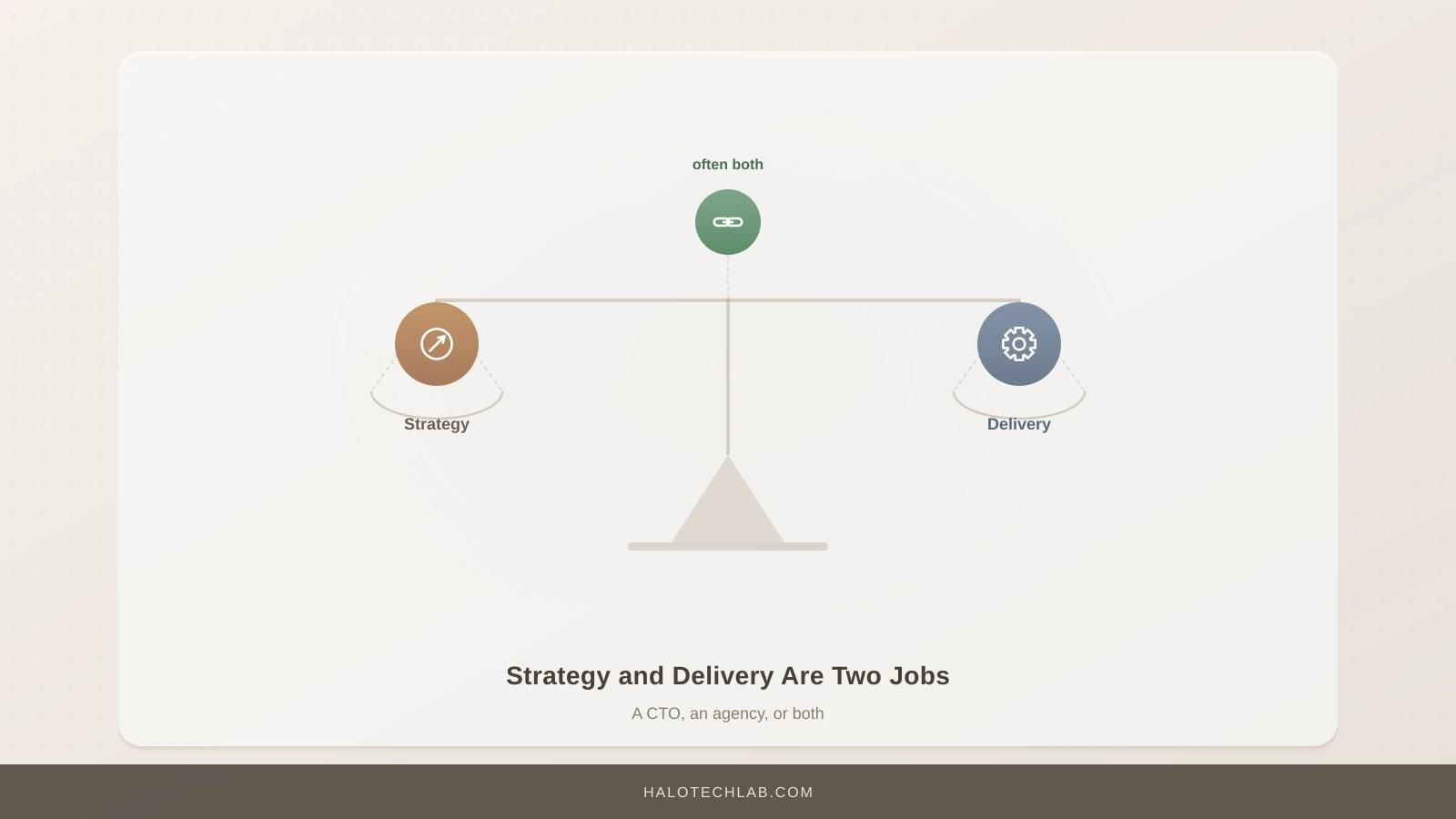
A CTO provides strategy and oversight. They decide what to build, in what order, using which technologies, and to what standard. They evaluate vendors, manage technical risk, hire and lead developers, and translate between business goals and technical execution.
A development agency provides execution and delivery. They take a defined brief and turn it into working software. They bring development talent, project management, design skills, and technical implementation expertise.
One decides. The other builds. Both are essential. The question is whether you need them at the same time, or whether one can wait.
When You Need Just a CTO
A CTO without an agency makes sense when:
You already have an internal development team. If you have developers but they lack senior leadership, a fractional CTO can provide the strategic direction, code review, and process improvement they need. The execution capability already exists — it just needs steering.
You are in the planning phase. Before you write a line of code, someone needs to define the architecture, choose the tech stack, and create a realistic roadmap. A CTO does this work. Bringing in an agency before this strategic groundwork is done often leads to expensive course corrections later.
You need to evaluate what already exists. If you have inherited a technology platform — through acquisition, a previous developer, or an outsourced build that may or may not be sound — a CTO can audit it and tell you whether to build on it, refactor it, or start fresh. You do not need an agency until that decision is made.
You need investor-facing technical leadership. Investors want to see a technology strategy, not just a product. A CTO creates the roadmap, leads the technical due diligence, and provides credibility in fundraising conversations. An agency cannot fill this role.
When You Need Just an Agency
An agency without a CTO makes sense when:
Your requirements are well-defined and straightforward. If you know exactly what you need — a marketing website, a standard e-commerce build, a mobile app with clear specifications — a competent agency can deliver without CTO oversight. The strategy is inherent in the brief.
You have a technical co-founder or CTO already. If someone on your team can define requirements, review code, and manage the technical relationship, an agency is the execution layer you need. The strategic oversight is already in place.
It is a one-off project, not an ongoing technology need. Agencies are excellent for defined projects with clear start and end dates. If you need a website built and then maintained, but you do not have ongoing technology strategy needs, an agency alone is the right choice. We cover the broader build-versus-hire decision in our guide to hiring an agency versus in-house developers.
Your budget is very tight. If you can only afford one, and you need something built now, the agency delivers the tangible output. A CTO without a development budget is a strategist with no tools. Prioritise execution when resources force a choice.
When You Need Both
The combined model — CTO plus agency — is often the most effective approach, particularly for growing businesses. Here is when it makes sense:
You are a non-technical founder building a technology product. This is the classic case. You need a CTO to define the strategy and oversee quality, and an agency to execute the build. Without the CTO, you cannot evaluate whether the agency is building the right thing to the right standard. Without the agency, the CTO has a strategy but no one to execute it.
We wrote about the challenge of managing a development team as a non-technical founder. A fractional CTO plus agency combination solves many of the problems outlined in that guide.
You are scaling beyond your internal team's capacity. Your CTO (fractional or otherwise) manages the overall technical direction, while the agency handles overflow work, specialist projects, or accelerated delivery timelines. The CTO ensures the agency's work integrates cleanly with your internal systems.
You need speed. A CTO can define the architecture and a roadmap in weeks. An agency can start building immediately. Together, they compress the timeline from idea to launch dramatically. Neither could achieve the same speed alone.
You want accountability on both sides. The CTO holds the agency accountable for quality and delivery. The agency holds the CTO accountable for clear requirements and timely decisions. This creative tension produces better outcomes than either party working alone.
The Decision Framework
Here is a simple framework to guide your choice:
| Your Situation | What You Need |
|---|---|
| No product, no technical staff, need to plan before building | CTO first, agency later |
| Clear requirements, technical founder can oversee | Agency only |
| Non-technical founder building first product | Both: CTO + agency |
| Have developers, but no technical leader | CTO only (fractional) |
| Scaling fast, need more development capacity | Both: CTO oversees, agency delivers |
| One-off project, no ongoing tech needs | Agency only |
| Preparing for fundraising, need technical credibility | CTO first |
| Inherited a platform, unsure of its quality | CTO first to audit, then decide |
How the Combined Model Works in Practice
When a fractional CTO and development agency work together, the workflow typically looks like this:
The CTO defines requirements. Working with the business owner, the CTO translates business goals into a technical specification and prioritised roadmap.
The CTO selects or briefs the agency. If you do not already have an agency, the CTO can evaluate options and recommend the right partner. If you do, the CTO provides the agency with clear, technically sound requirements.
The agency estimates and plans. Based on the CTO's specification, the agency provides timeline and cost estimates. The CTO reviews these for reasonableness.
The agency builds, the CTO reviews. During development, the CTO conducts regular code reviews, participates in sprint planning, and ensures the build stays aligned with the strategy. The agency focuses on execution.
The CTO manages the relationship. If issues arise — scope creep, quality concerns, timeline slippage — the CTO handles the technical conversation with the agency. This is far more effective than a non-technical founder trying to challenge a technical team.
This model works because each party focuses on what they do best. The CTO is not distracted by writing code. The agency is not making strategic decisions above their remit. The business owner gets both strategy and execution without needing to understand the technical details.
Cost Considerations
The combined model costs more than either option alone, but often delivers better value per pound spent:
| Model | Typical Monthly Cost | What You Get |
|---|---|---|
| Agency only | £5,000-£20,000 | Execution, delivery, project management |
| Fractional CTO only | £3,000-£8,000 | Strategy, oversight, team leadership |
| Both | £8,000-£28,000 | Strategy + execution, with accountability |
The premium for "both" is significant, but consider what you avoid: wasted development cycles, architectural mistakes that require rebuilds, vendor lock-in, and the slow erosion of value that comes from building without strategic direction.
For a business investing £50,000 or more in a technology build, the CTO oversight typically saves more than it costs by preventing rework and ensuring the agency builds the right thing first time.
Common Mistakes to Avoid
Treating the agency as a CTO substitute. Agencies are incentivised to build what you ask for, not to challenge whether you are asking for the right thing. Do not expect strategic technology leadership from a team whose business model is billable development hours.
Treating the CTO as a developer. If your fractional CTO is spending most of their time writing code, something is wrong. Their value is in strategic thinking, oversight, and decision-making — not in being an expensive developer.
Hiring both before you need both. If you are still validating your idea, start with a CTO to define the approach. Bring in the agency when you are ready to build. Do not pay for idle development capacity.
Letting the CTO and agency operate in silos. The model only works if there is regular, structured communication between the CTO and the agency. Weekly sync meetings, shared project boards, and clear escalation paths are essential.
Key Takeaways
- A CTO provides strategy and oversight; an agency provides execution and delivery — they are complementary, not interchangeable
- Non-technical founders building technology products almost always benefit from both a fractional CTO and a development agency
- If you can only afford one, choose based on your immediate need: strategy first (CTO) or execution first (agency)
- The combined model costs more monthly but typically delivers better value by preventing wasted development and architectural mistakes
- The CTO holds the agency accountable for quality; the agency holds the CTO accountable for clear requirements
Frequently Asked Questions
Can one company provide both CTO services and development?
Yes, and this can work very well. Some agencies, including Halo Technology Lab, offer both strategic advisory and development services. The advantage is seamless communication between strategy and execution. The key is ensuring the advisory function genuinely challenges the development approach rather than simply rubber-stamping it.
What if my agency says they do not need CTO oversight?
Be cautious. A confident, capable agency should welcome oversight — it protects both parties. An agency that resists external technical review may be concerned about what that review would find. Good agencies recognise that CTO oversight improves outcomes and reduces disputes.
How do I avoid the CTO and agency blaming each other when things go wrong?
Clear accountability is the answer. Before the engagement begins, define who is responsible for what: the CTO owns strategy, architecture, and requirements; the agency owns execution, delivery, and project management. When problems arise, refer back to these boundaries. Most blame-shifting happens when responsibilities are ambiguous.
Not sure whether you need strategy, execution, or both? Our strategy and scoping service starts with an honest assessment of what your business actually needs. Get in touch and we will help you figure out the right model before you spend a penny.
Enjoyed this? Get the next one by email
Practical AI playbooks, build logs and tool teardowns. One email a week, free, unsubscribe in one click.
Related Articles
How a Fractional CTO Helped Prezien Grow Their AI Pipeline by £10m
A real case study of fractional CTO impact — strategic leadership that added £10m to the pipeline in 6 weeks.
Fractional CTO for Pre-Revenue Startups: Is It Worth It?
When you're pre-revenue, every pound counts. Here's when a fractional CTO is worth the investment.
How a Fractional CTO Saves You Money on Technology Vendors
One of the biggest ROI drivers of a fractional CTO is vendor negotiation and technology rationalisation.