How a Fractional CTO Saves You Money on Technology Vendors
One of the biggest ROI drivers of a fractional CTO is vendor negotiation and technology rationalisation.
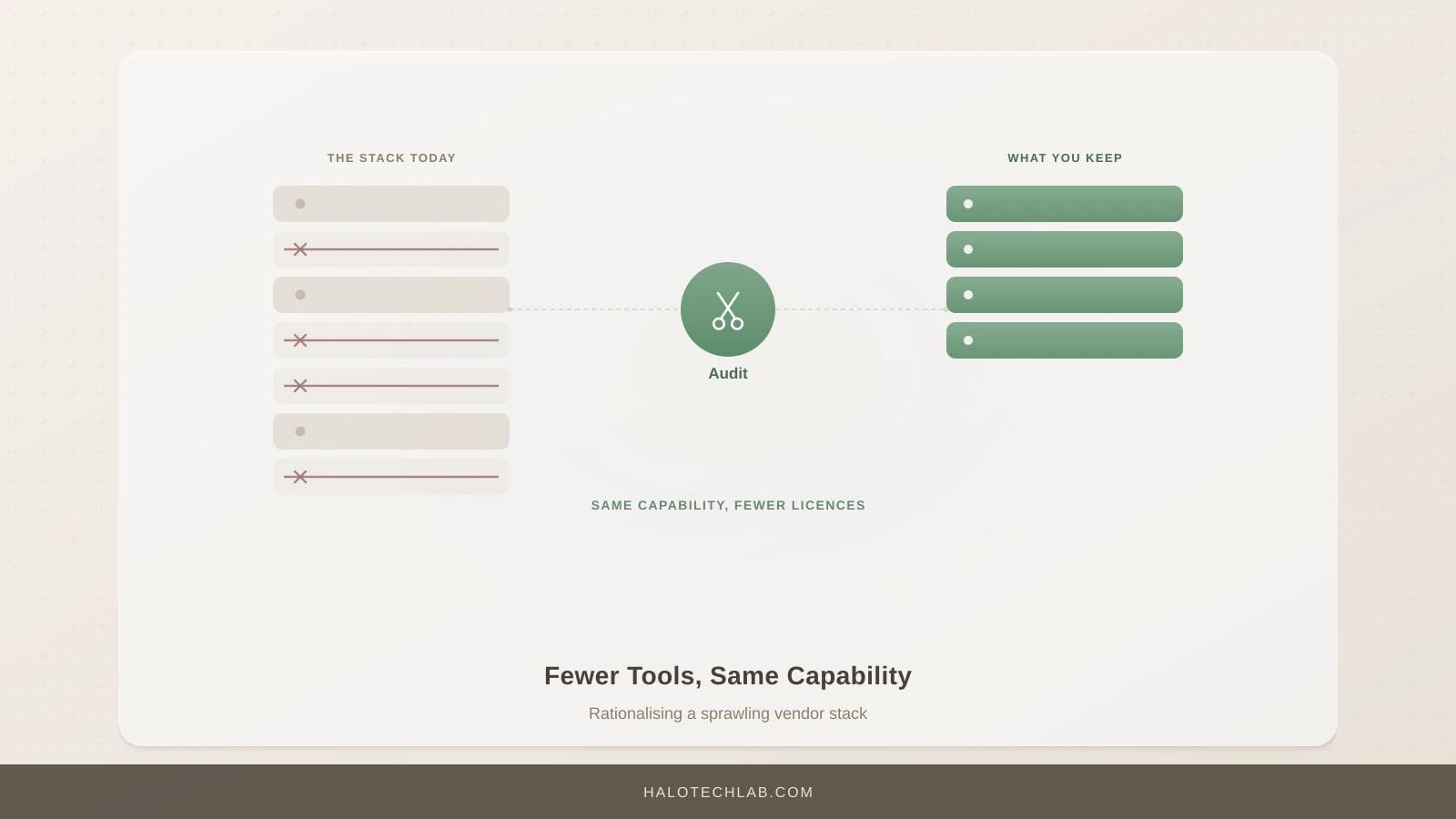
How much does your business spend on software subscriptions, hosting, and technology services each month? If you cannot answer that question confidently, you are not alone. Most SMEs have a vague sense that they are spending too much on technology, but no clear picture of where the money goes or whether they are getting fair value.
This is one of the most immediate and tangible benefits of hiring a fractional CTO. Before they get into the strategic roadmapping and team leadership, a good fractional CTO will audit your technology spend — and what they find almost always pays for their engagement within the first few months.
This article is part of our complete guide to hiring a fractional CTO.
The Problem: Death by a Thousand Subscriptions
Technology costs in modern businesses have a nasty habit of creeping up invisibly. It starts innocently enough: a project management tool here, a communication platform there, a CRM that marketing wanted, an analytics suite that seemed essential at the time.
Before you know it, you are paying for 30 or 40 different SaaS subscriptions, several of which overlap in functionality, a few of which nobody actively uses, and at least one that was meant to be a free trial but has been billing you for 18 months.
Add in hosting costs that were set up during a traffic spike and never scaled back down, a support contract you inherited from a previous developer, and a data tool that only one person knows how to use, and the waste adds up fast.
For a typical UK SME spending £5,000-£20,000 per month on technology, it is common to find 20-40% of that spend is wasteful or poorly optimised. That is £12,000-£96,000 per year that could be redirected toward technology that actually moves the business forward.
Step 1: The Full Vendor Audit
The first thing a fractional CTO does is map every technology cost in the business. Not just the big line items — everything. This means:
- Every SaaS subscription (including the ones billed to personal cards that never got moved to the company account)
- Hosting and infrastructure costs across all environments
- Support and maintenance contracts
- Freelancer and contractor retainers
- Domain registrations, SSL certificates, and CDN services
- API usage costs and overage charges
Most businesses have never done this comprehensively. The result is always illuminating and occasionally shocking. We regularly find businesses paying for duplicate tools, abandoned subscriptions, and enterprise-tier plans where a lower tier would be perfectly adequate.
Step 2: Identifying Redundancy and Overlap
Once the full picture is visible, the next step is identifying where tools overlap. This is remarkably common:
- Two or three project management tools (one from marketing, one from development, one from the founder)
- Multiple communication platforms (Slack, Teams, and email all doing the same job)
- Overlapping analytics tools (Google Analytics, Mixpanel, Hotjar, and a built-in dashboard all tracking similar metrics)
- Duplicate storage solutions (Dropbox, Google Drive, SharePoint, and an S3 bucket)
Each tool was adopted for a good reason at the time. But nobody ever consolidated. A fractional CTO brings the authority and perspective to say: "We are paying for three tools that do the same thing. We are keeping one and cancelling the other two."
This alone typically saves 10-15% of total technology spend.
Step 3: Right-Sizing Your Infrastructure
Hosting and infrastructure costs are where the biggest hidden waste often sits. Businesses frequently over-provision their infrastructure because:
- It was set up during a launch or traffic spike and never scaled back down
- The original developer chose a generous setup "just in case"
- Nobody monitors actual usage versus provisioned capacity
- Fear of downtime leads to paying for resources that sit idle 90% of the time
A fractional CTO will review your actual usage data and right-size your infrastructure. This might mean moving from dedicated servers to auto-scaling cloud resources, switching from a premium hosting provider to a more appropriate one, or simply downsizing instances that are running at 10% capacity.
For businesses spending £2,000-£5,000 per month on hosting, right-sizing commonly reduces costs by 30-50%.
Step 4: Renegotiating Contracts
Many businesses pay list price for software because nobody has ever asked for a discount. This is almost always a mistake.
A fractional CTO knows the market rates, understands the vendor's pricing psychology, and has the technical authority to negotiate credibly. Common negotiation strategies include:
- Annual payment discounts: Most SaaS vendors offer 15-25% discounts for annual versus monthly billing
- Volume commitments: Committing to a multi-year deal in exchange for a lower per-seat or per-unit price
- Competitive leverage: Presenting a genuine alternative vendor and letting the incumbent compete for your business
- Right-sizing plans: Moving from enterprise to professional tier where the enterprise features are not being used
- Bundling: Consolidating multiple products from the same vendor for a package discount
These negotiations require technical knowledge to assess whether a cheaper alternative is genuinely viable, and commercial confidence to push for better terms. Most non-technical business owners lack one or both.
Step 5: Avoiding Unnecessary Purchases
Perhaps the most valuable long-term benefit is having a fractional CTO as a filter for new technology purchases. Without one, the typical pattern is:
- Someone in the business identifies a problem
- They Google solutions and find a shiny tool that promises to fix it
- They sign up for a free trial that converts to a paid plan
- Six months later, the tool is partially used and the original problem persists
A fractional CTO interrupts this cycle. They evaluate whether a new tool is genuinely needed, whether an existing tool can be configured to solve the same problem, and whether the proposed solution is the right one at the right price. This gatekeeping function prevents waste before it starts.
Typical Savings: What the Numbers Look Like
Based on our experience across dozens of engagements, here is what realistic vendor optimisation looks like:
| Current Monthly Tech Spend | Typical Savings (%) | Annual Savings | Fractional CTO Annual Cost | Net Benefit |
|---|---|---|---|---|
| £5,000/month | 25-35% | £15,000-£21,000 | £48,000-£72,000 | Vendor savings offset a significant portion of CTO cost |
| £10,000/month | 20-35% | £24,000-£42,000 | £48,000-£72,000 | Vendor savings cover half or more of CTO cost |
| £20,000/month | 20-40% | £48,000-£96,000 | £48,000-£72,000 | Vendor savings alone can exceed the CTO cost |
| £50,000/month | 20-40% | £120,000-£240,000 | £48,000-£72,000 | Vendor savings dramatically exceed CTO cost |
The pattern is clear: the higher your current technology spend, the more likely that vendor optimisation alone will pay for the fractional CTO engagement. And this is before you count the strategic value they bring to the rest of the business.
For businesses spending more than £10,000 per month on technology, the vendor management aspect of a fractional CTO is essentially a return on investment that funds itself.
Beyond Cost Savings: Better Vendor Relationships
Cost reduction is the headline benefit, but there is a secondary advantage that is equally important: better vendor relationships.
When you have a fractional CTO managing your vendor relationships, you get:
- A single point of accountability for technology decisions, rather than ad-hoc purchases across departments
- Informed evaluations when new tools are proposed, based on technical merit rather than marketing materials
- Stronger negotiating position because your CTO understands what the vendor's technology actually does and what alternatives exist
- Planned renewals instead of auto-renewals catching you off guard
- Clear documentation of what you are paying for, why, and what the contract terms are
This discipline compounds over time. After 12 months with a fractional CTO managing your vendor relationships, your technology spending is leaner, more intentional, and better aligned with business needs.
Key Takeaways
- Most UK SMEs are overspending on technology by 20-40% due to redundant tools, over-provisioned infrastructure, and unoptimised contracts
- A comprehensive vendor audit — mapping every subscription, hosting cost, and support contract — is the essential first step
- The biggest savings typically come from consolidating overlapping tools, right-sizing infrastructure, and renegotiating contracts at renewal
- For businesses spending over £10,000/month on technology, vendor optimisation alone can pay for a fractional CTO engagement
- The long-term value is in having a gatekeeper who prevents unnecessary purchases and ensures every pound of tech spend delivers business value
Frequently Asked Questions
How long does a vendor audit take?
A thorough vendor audit typically takes two to three weeks, depending on the complexity of your technology environment. The initial mapping can be done in the first week, but tracking down every subscription — particularly those billed to personal cards or department budgets — takes time. Your fractional CTO will need cooperation from finance and department heads to get a complete picture.
Will switching vendors cause disruption?
A good fractional CTO manages vendor transitions carefully to minimise disruption. They will never recommend ripping out a working tool without a clear migration plan. Transitions are typically planned around contract renewal dates and executed gradually, with the old and new tools running in parallel during the switch.
What if my team pushes back on consolidating tools?
Pushback is normal and expected. People form attachments to their tools. A fractional CTO handles this by involving the team in the evaluation process, ensuring the consolidated toolset genuinely meets everyone's needs, and providing training on any new tools. The key is making the case in terms of business benefit rather than dictating changes from above.
Wondering how much your business could save on technology? Our strategy and scoping service includes a comprehensive technology audit as part of the engagement. Get in touch to find out where your technology budget is leaking.
Enjoyed this? Get the next one by email
Practical AI playbooks, build logs and tool teardowns. One email a week, free, unsubscribe in one click.
Related Articles
How a Fractional CTO Helped Prezien Grow Their AI Pipeline by £10m
A real case study of fractional CTO impact — strategic leadership that added £10m to the pipeline in 6 weeks.
Do You Need a CTO, a Dev Agency, or Both?
Understanding whether you need strategic technology leadership, execution capacity, or both.
Fractional CTO for Pre-Revenue Startups: Is It Worth It?
When you're pre-revenue, every pound counts. Here's when a fractional CTO is worth the investment.