How a Fractional CTO Helped Prezien Grow Their AI Pipeline by £10m
A real case study of fractional CTO impact — strategic leadership that added £10m to the pipeline in 6 weeks.
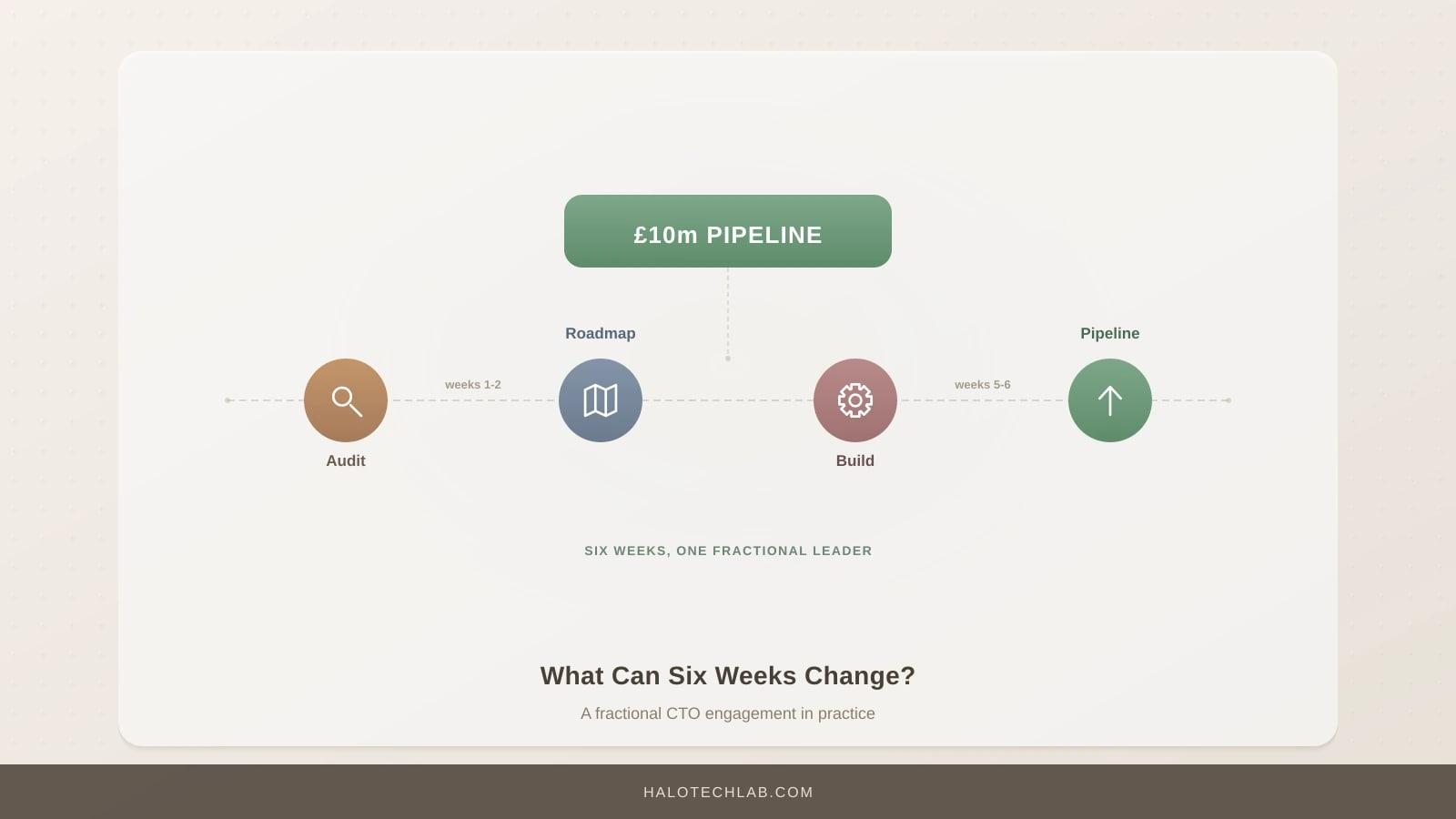
What does it look like when fractional technology leadership actually delivers? Not in theory, not in a consultant's slide deck, but in measurable business results?
This is the story of Prezien — an established IT professional services company that wanted to expand from customer experience consulting into AI. They had the client relationships, the industry reputation, and the ambition. What they lacked was the deep AI expertise and strategic leadership to make the pivot credibly.
Within six weeks of bringing in fractional CTO and AI leadership, Prezien had grown their AI pipeline by £10m. Here is how it happened. This article is part of our complete guide to hiring a fractional CTO.
The Challenge: Ambition Without a Roadmap
Prezien had built a strong reputation in customer experience. Their team understood enterprise clients, complex transformation programmes, and the consulting-led delivery model. But the market was shifting. Clients were increasingly asking about AI — not as a buzzword, but as a practical tool for improving operations, customer interactions, and decision-making.
Prezien recognised the opportunity but faced several barriers:
No internal AI expertise. The team had strong CX and consulting skills but lacked the deep technical knowledge to design, propose, and deliver AI solutions. They could talk about AI at a surface level but could not go deep enough to win enterprise contracts.
No AI strategy or roadmap. They knew they wanted to "do AI" but had not defined what that meant in practice. Which AI capabilities? For which industries? At what price points? In what order?
Credibility gap with clients. Enterprise buyers evaluating AI partners want to see genuine expertise, not repackaged consulting services with an AI label. Prezien needed someone who could stand in front of a CIO and speak credibly about large language models, computer vision, automation architectures, and AI governance.
No thought leadership presence. In a market flooded with AI claims, Prezien had no published point of view, no reference architectures, and no public-facing AI content to differentiate themselves.
These were not problems that a training course or a hire could solve quickly. They needed senior, experienced AI leadership — but they did not need it full-time, and they could not wait six months to recruit for it.
The Approach: Fractional Chief AI and Innovation Officer
Halo Technology Lab was engaged as fractional Chief AI and Innovation Officer — a role that combined CTO-level technical leadership with commercial AI strategy.
The engagement focused on three parallel workstreams:
Workstream 1: AI Strategy and Innovation Roadmap
The first priority was defining what AI meant for Prezien — specifically, not generically. This involved:
- Auditing the existing client base to identify which accounts had the highest AI potential
- Mapping Prezien's existing capabilities against the AI value chain to find natural adjacencies
- Researching the competitive landscape to identify underserved niches
- Building a comprehensive 1, 3, and 5-year AI and innovation roadmap
The roadmap was not a theoretical exercise. It was a commercially-focused plan with specific service offerings, target industries, pricing frameworks, and go-to-market sequencing. Each initiative was evaluated on market demand, delivery feasibility, and revenue potential.
The 1-year plan focused on quick-win AI services that leveraged existing CX expertise — conversational AI, sentiment analysis, and customer journey optimisation using AI. The 3-year plan expanded into operational AI for key verticals. The 5-year vision positioned Prezien as a full-spectrum AI transformation partner.
Workstream 2: Client-Facing Thought Leadership
Credibility in AI is earned, not claimed. To establish Prezien as a genuine AI authority, we developed:
- Client-facing AI perspectives and whitepapers tailored to Prezien's target industries
- Presentation materials for client workshops and executive briefings
- A framework for evaluating and communicating AI opportunities in business language, not technical jargon
- Supporting content for the sales team to use in proposals and pitches
The thought leadership was designed to do two things: demonstrate genuine expertise to prospective clients, and give the Prezien team confidence in AI conversations. Both were essential for pipeline growth.
Workstream 3: Commercial Activation
Strategy and thought leadership are worthless without commercial outcomes. The third workstream focused on turning the roadmap into revenue:
- Identifying specific opportunities within the existing client base where AI services could be proposed immediately
- Developing proposal templates and pricing models for AI engagements
- Joining client meetings as the AI authority to support the sales team in technical conversations
- Creating a qualification framework to help the sales team identify and prioritise AI opportunities
This was not about theoretical market sizing. It was about sitting in front of real clients, understanding their specific challenges, and proposing AI solutions that addressed those challenges directly.
The Results: £10m in Pipeline Growth in Six Weeks
The numbers speak for themselves:
£10m in new AI pipeline within six weeks. This was not speculative pipeline. These were qualified opportunities with specific clients, defined scopes, and realistic timelines. The pipeline grew because Prezien could suddenly have AI conversations at a depth that enterprise clients required.
A comprehensive 1, 3, and 5-year AI and innovation roadmap. This gave the business strategic clarity and a sequenced plan for capability development. The roadmap became a living document that guided hiring, partnership, and investment decisions beyond the initial engagement.
Client-facing thought leadership that differentiated Prezien in the market. The materials we developed positioned Prezien as thoughtful, experienced AI practitioners — not bandwagon jumpers. This was particularly important in an environment where every consulting firm was claiming AI expertise.
Internal capability uplift. Through working alongside the Prezien team, we transferred knowledge and confidence. The team moved from being uncomfortable in AI discussions to leading them. This multiplier effect extended the value of the engagement far beyond the engagement itself.
View the full Prezien project details.
Why Fractional Leadership Was the Right Model
Prezien could have pursued several alternative approaches. Here is why fractional leadership was the right choice:
Hiring a full-time AI leader would have taken too long. The market was moving. Clients were making AI partner decisions now. A three-to-six month recruitment process would have meant missing the window. A fractional engagement started within weeks.
The need was strategic and commercial, not operational. Prezien did not need someone writing AI code day-to-day. They needed someone who could set the strategy, develop the roadmap, and provide the commercial AI expertise for client conversations. This is precisely what the fractional model delivers.
Breadth of experience mattered more than depth in one environment. A fractional CTO working across multiple AI engagements brings pattern recognition that a single-company hire cannot match. They have seen which AI approaches work commercially, which ones clients actually buy, and which ones are technically impressive but commercially impractical.
The investment needed to prove itself quickly. With a fractional engagement, you see results in weeks, not months. If it had not worked, Prezien could have ended the arrangement with minimal sunk cost. In practice, the results were clear within the first six weeks.
Lessons for Other Businesses
The Prezien case study illustrates several principles that apply broadly:
Technology leadership unlocks commercial opportunity. Prezien did not lack ambition, client relationships, or market awareness. They lacked the technical depth to convert those assets into AI revenue. The fractional CTO filled that specific gap, and the commercial results followed immediately.
Speed matters more than perfection. The 1, 3, and 5-year roadmap was not a perfect prediction of the future. It was a structured, informed plan that gave the team direction and confidence. Acting on an 80% right strategy immediately beats waiting for a 100% right strategy that arrives too late.
Credibility is earned through expertise, not marketing. Clients could tell the difference between genuine AI knowledge and surface-level claims. Having a fractional AI leader who could go deep on technical questions in client meetings was the single biggest factor in pipeline growth.
Fractional does not mean part-hearted. The engagement was fractional in time commitment but full in focus and intensity. During the six-week period, the work was concentrated, purposeful, and driven by clear commercial targets. Fractional leadership works when both sides treat it with the seriousness of a full-time role.
Is This Approach Right for Your Business?
If you recognise any of these situations, a similar approach might work for you:
- You want to expand into a new technology area (AI, automation, data) but lack internal expertise
- You have strong client relationships but cannot convert them into technology-led revenue
- Your competitors are moving into AI and you risk being left behind
- You need to demonstrate technology credibility to win enterprise contracts
- You want strategic clarity before committing to full-time technology hires
The model that worked for Prezien — focused, senior, fractional technology leadership with clear commercial objectives — is repeatable. The specifics change, but the principles are consistent.
Key Takeaways
- Prezien wanted to expand from CX into AI but lacked the internal expertise and strategic roadmap to do so credibly
- Fractional CTO and AI leadership delivered a comprehensive 1, 3, and 5-year innovation roadmap, client-facing thought leadership, and commercial activation
- The result was £10m in qualified AI pipeline growth within just six weeks
- The fractional model was right because speed mattered, the need was strategic rather than operational, and breadth of AI experience was essential
- Technology leadership is not just a cost centre — it directly unlocks commercial opportunity
Frequently Asked Questions
How quickly can a fractional CTO make a commercial impact?
In Prezien's case, measurable pipeline growth happened within six weeks. This is faster than typical, but not unusual when the business already has strong client relationships and market presence. The fractional CTO's role is to add the technical capability that converts existing commercial assets into new revenue. Where those assets exist, the impact can be rapid.
Does this approach only work for consulting and professional services firms?
No, although professional services firms often see the fastest commercial results because they can sell the expertise directly. Product companies, SaaS businesses, and enterprises expanding into new technology areas also benefit from fractional technology leadership — the timeline to revenue is typically longer, but the strategic value is equally significant.
What happens when the fractional engagement ends?
The goal of a well-structured fractional engagement is to leave the business self-sufficient. In Prezien's case, the roadmap, thought leadership materials, and frameworks we developed continued to generate value after the engagement. The team was equipped to continue AI conversations and develop opportunities independently. Some businesses transition to a lighter ongoing advisory arrangement; others are fully self-sufficient.
Could fractional technology leadership unlock new revenue for your business? Our support and training service includes fractional CTO and AI leadership engagements designed for exactly this type of commercial challenge. Get in touch to discuss what is possible.
Enjoyed this? Get the next one by email
Practical AI playbooks, build logs and tool teardowns. One email a week, free, unsubscribe in one click.
Related Articles
Do You Need a CTO, a Dev Agency, or Both?
Understanding whether you need strategic technology leadership, execution capacity, or both.
Fractional CTO for Pre-Revenue Startups: Is It Worth It?
When you're pre-revenue, every pound counts. Here's when a fractional CTO is worth the investment.
How a Fractional CTO Saves You Money on Technology Vendors
One of the biggest ROI drivers of a fractional CTO is vendor negotiation and technology rationalisation.