Turning Expert Knowledge into a Product You Can Sell Twice
Service businesses sell the same thinking again and again and only get paid for the hours. How to package what you know into something with margin, without cannibalising the day job.
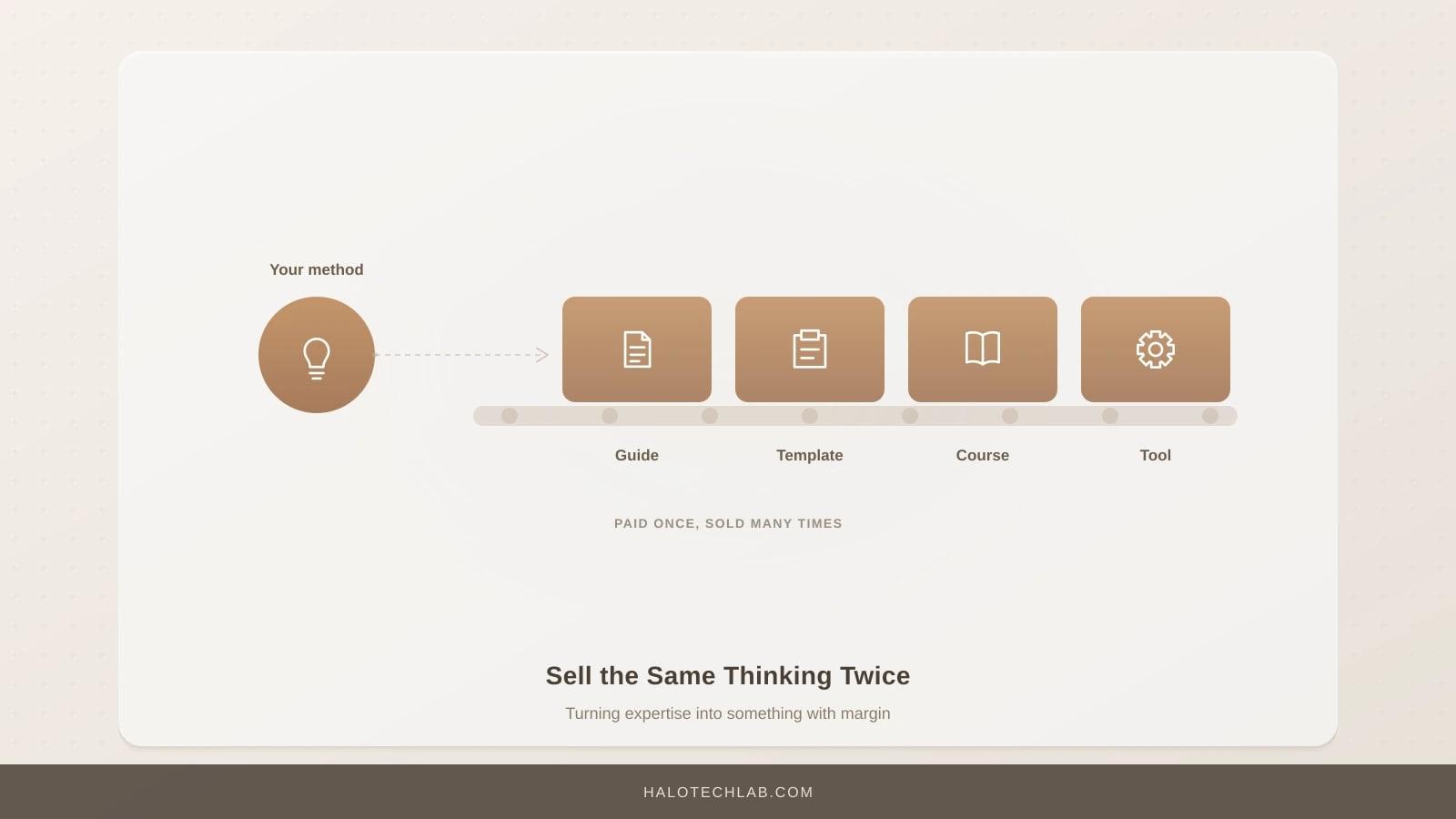
A consultancy bills for hours. The same thinking gets done for client after client, adapted at the edges, and every time it is charged as though it were the first. Growth means more people, more people means more overhead, and margin stays roughly where it was in 2018.
Productising is the way out of that, and it is harder and less glamorous than the people selling courses about it suggest. This article covers what actually works for a UK service business, what it costs, and the three ways it usually goes wrong.
This article is part of our guide to the data you already own.
What a product is, in this context
Not software, necessarily. A product here means something you can sell more than once without proportionally more of your time.
That covers a diagnostic that produces a report. A benchmark comparing a client to data they cannot obtain themselves. A fixed-scope engagement that runs the same way every time. A tool a client uses themselves. A course. A licensed methodology.
The common thread is that the expensive thinking happened once and gets sold repeatedly.
The precondition most businesses fail
You cannot productise thinking you cannot articulate.
If the answer to "how do we approach this" is "it depends, and Dave knows", there is no product yet. There is a person. The first stage of productising is always articulation, and it is the stage people want to skip because it feels like it is not building anything.
Practically: take your main service, run through three real past engagements, and write down what was the same in all three. If nothing was the same, you are doing bespoke work and productising is the wrong strategy. If 60 per cent was the same, that 60 per cent is the product.
The four shapes that work
In descending order of how often they succeed for a business under two hundred people.
1. The diagnostic
A structured assessment producing a written output. Fixed price, fixed scope, delivered in weeks rather than months.
This works because it is the easiest thing to sell to someone who has not bought from you before. It is low commitment, it has a defined end, and it produces something they can show their board. It also functions as the front of a pipeline for larger work, which is where most of the actual value is.
Typical UK pricing: £2,000 to £15,000. Build cost: mostly your time, plus £3,000 to £12,000 if you want it templated and partly automated.
2. The benchmark
You tell a client how they compare to a population only you can see. A recruiter with 400 comparable placements. A consultancy with eleven years of project data. An accountancy practice with sector cost ratios across 200 clients.
This is the strongest of the four when you have the data, because it is genuinely not replicable. It is also the one with the most significant legal constraints, since it is built on client information. Aggregation and anonymisation are usually the answer. See can you legally use your own customer data to train AI.
3. The fixed-scope engagement
The same work, done the same way, priced the same each time. Less a product than a discipline, and it improves margin more reliably than anything else on this list because it removes the scope creep that quietly eats service businesses.
Build cost is close to zero. The obstacle is organisational: it requires saying no to variations, which the people who built the business by saying yes find difficult.
4. The tool
Software the client uses themselves. The highest ceiling and by a distance the highest risk, because you become a software company with the support obligations that implies.
Worth it when the same calculation or process is being run for many clients and the underlying logic is genuinely yours. Not worth it as a first attempt at productising. Build cost realistically £25,000 to £120,000 plus ongoing maintenance at 15 to 20 per cent a year.
How to sequence it
Start with the fixed-scope engagement. No build cost, immediate margin effect, and it forces the articulation that everything else depends on.
Then the diagnostic. Uses the same articulated method, packaged for someone who has not bought from you before.
Then the benchmark, if your data supports one. This requires the archive work covered in dark data: how to audit what your business is already storing.
The tool last, if at all. And only once the first three have proved there is repeatable demand.
Businesses that start with the tool almost always build something nobody has validated demand for, which is the most expensive way to learn.
The three ways it goes wrong
Cannibalising the day job. The productised version is cheaper than the bespoke one, so existing clients buy it instead. Revenue falls. The fix is to make the product genuinely different in scope rather than a discount version of the same thing, and to be honest with yourself about which clients would have paid full price.
The founder cannot let go. Every delivery gets "improved" by the person who designed it, so it is never actually the same twice and never becomes a product. This is the most common failure and it is a management problem rather than a design one.
No route to market. A product that requires the same partner-led relationship sale as the consultancy has not reduced the cost of selling, which was half the point. Think about how it gets sold before you build it.
A worked example
A 30-person planning consultancy, £2.6m turnover, billing hourly.
They articulated their site assessment method, which turned out to be 70 per cent identical across engagements. They packaged it as a fixed-price initial assessment at £4,500, delivered in three weeks against a defined template, with the deeper work quoted separately.
Build cost: about £9,000 in internal time and £6,000 in templating and partial automation of the data-gathering.
First year: 22 assessments, £99,000 of revenue at roughly 55 per cent margin against the previous 32 per cent on equivalent hourly work. Nine of the 22 converted into larger engagements, which was the real return.
That is a realistic outcome. Not transformational, genuinely worth doing, and achieved without becoming a software company.
Key Takeaways
- A product here is anything sellable more than once without proportionally more of your time. It does not have to be software.
- You cannot productise what you cannot articulate. Compare three past engagements and find what was identical. That is the product.
- Sequence it: fixed-scope engagement, then diagnostic, then benchmark, then a tool only if the first three proved demand.
- The benchmark is the strongest where your data supports it, because it genuinely cannot be replicated. It also carries the heaviest legal constraints.
- The most common failure is the founder improving every delivery, so it never becomes the same thing twice. That is a management problem, not a design one.
Frequently Asked Questions
How much of our service needs to be repeatable before this works?
As a rough threshold, around half. Below that the product covers so little of the engagement that clients still need the bespoke version, and you have added complexity without reducing cost.
Will clients pay the same for a productised version?
Not usually the same, and often more per hour of your time, which is the number that matters. A £4,500 fixed assessment delivered in 40 hours beats £6,000 of hourly work delivered in 70.
Should we build software?
Not first, and possibly not at all. The support, security and maintenance obligations of being a software supplier are substantially underestimated by service businesses. Prove demand with the non-software versions, and if the demand is there and persistent, then consider it. See MVP vs full product.
How long does this take?
The fixed-scope work can be in place within a quarter. A diagnostic takes three to six months to design, test and price properly. A benchmark depends entirely on the state of your archive and is usually six to twelve months.
Selling hours and wondering what else you could sell? Talk to Halo Technology Lab. Our strategy and scoping service starts with the articulation work, and we will tell you if the answer is not to build software.
Enjoyed this? Get the next one by email
Practical AI playbooks, build logs and tool teardowns. One email a week, free, unsubscribe in one click.
Related Articles
Where Your Intellectual Property Actually Lives
It is rarely in the filing cabinet or the patent. It is in quotes, methods, corrections and the reasons behind decisions. How to find yours before the person holding it retires.
Dark Data: How to Audit What Your Business Is Already Storing
Fewer than 15% of organisations have catalogued even half their data. A practical one-week audit you can run yourself, and what to do with what you find.
You Are Sitting on Twenty Years of Data. What Is It Actually Worth?
Around 55% of business data is never used for anything. A quick way to work out whether yours is an asset, a liability, or simply a storage bill you have stopped noticing.