You Are Sitting on Twenty Years of Data. What Is It Actually Worth?
Around 55% of business data is never used for anything. A quick way to work out whether yours is an asset, a liability, or simply a storage bill you have stopped noticing.
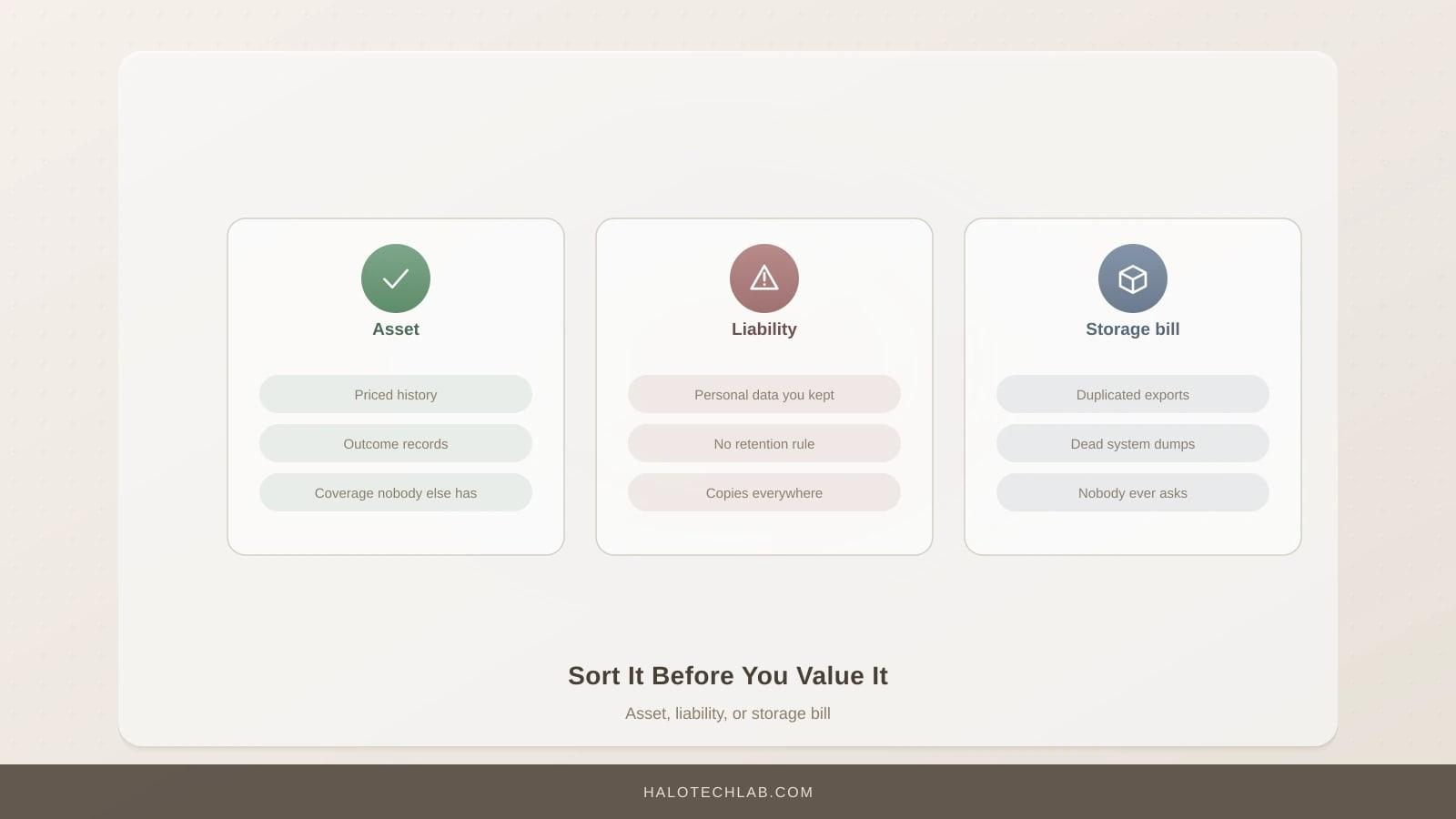
Around 55 per cent of the data businesses store is never used for analysis or decisions. Fewer than 15 per cent of organisations have catalogued even half of what they hold. Globally, companies spend an estimated 350 billion dollars a year storing information nobody looks at.
Those numbers describe most established businesses, and they are usually presented as a waste problem. They are more interesting as an inventory problem, because some of that material is genuinely valuable and nobody has checked which.
This article is a quick way to find out whether yours is an asset, a liability, or simply a storage bill you stopped noticing.
This article is part of our guide to the data you already own.
The three categories
Everything a business stores falls into one of three buckets, and the proportions matter.
Asset. Information that could support a decision, a product or a price, if it were findable and reliable. Quotes and their outcomes. Job records with what actually went wrong. See dark data: how to audit what your business is already storing. Customer histories. Correspondence explaining why something was decided.
Ballast. Information you must keep for legal or regulatory reasons and will never otherwise use. Statutory records, old correspondence, backups of backups. It costs money and creates risk and that is the whole of its contribution.
Liability. Information you should not still have. Personal data past its retention period, records of people who asked to be forgotten, copies of things a client asked you to delete. Under UK GDPR, holding data without a current purpose is a problem, as covered in AI regulation in the UK rather than a neutral state.
The usual split in an established business is roughly 10 per cent asset, 60 per cent ballast, and a genuinely uncomfortable amount of liability nobody has looked for.
The four questions that establish value
Data is valuable when it is specific, verified, exclusive and connected. Miss any one of the four and the value drops sharply.
Is it specific? General knowledge about your sector is worth nothing, because everybody has it. What you know about your own customers, jobs, failures and prices is worth something, because nobody else does.
Is it verified? Records of what actually happened beat records of what was planned. A quote is a guess. A quote plus whether it was accepted plus what the job eventually cost is evidence.
Is it exclusive? Could a competitor buy the same information? Industry data, published statistics and bought lists are not assets, they are inputs everyone has.
Is it connected? A customer list is mildly useful. A customer list joined to what they bought, when, at what price, and what went wrong is a different thing entirely. Most of the value in an archive is in the joins, and most of the joins are missing.
The twenty-minute version
You can get a rough answer this afternoon.
Pick your three most valuable business questions. The ones you would most like a reliable answer to. Usually something like: which customers are actually profitable, what should we charge for this kind of job, and which work goes wrong most often.
For each, ask whether the data exists. Not whether it is accessible. Whether the underlying facts were ever recorded anywhere at all, including on paper.
If it exists, ask what state it is in. In one system and queryable. Spread across systems but joinable. In documents but not extracted. On paper.
That gives you a grid with three questions and four possible states. Anything in the first two states is a project of weeks. Anything in the third is a project of months and often worth it. Anything on paper needs a separate decision about whether the answer justifies the digitisation.
What it is actually worth
Be careful here, because this is where a lot of nonsense gets written.
Your data is almost certainly not worth anything as a thing to sell. The market for SME datasets is thin, buyers are few, and the legal position on customer data is more restrictive than most owners assume. See licensing your data vs using it yourself.
What it is worth is the value of the decisions it improves. That is measurable and it is usually larger.
A worked example. A specialist contractor quotes around 400 jobs a year, wins roughly 30 per cent, and has twelve years of quotes in an email archive plus a spreadsheet. Nobody has ever compared quoted price with final cost.
Extracting that comparison takes maybe six weeks and £8,000 to £15,000. It reveals which job types are systematically underpriced, as set out in your pricing history is a dataset. If it corrects pricing on even 15 per cent of won work by an average of 6 per cent, on £1.8m of annual revenue that is roughly £16,000 a year, every year, with no additional sales effort.
That is what the data is worth. Not a sale price. A margin correction that compounds.
When the honest answer is that it is worth nothing
We would rather say this than have you spend money finding out.
If the records were never reliable, no amount of processing makes them reliable. If the business has changed so much that ten-year-old patterns do not apply, history is not evidence. If the volume is genuinely small, a few hundred records, you can read them yourself and do not need a project.
And if nobody can name a decision that would change based on the answer, do not start. That is the test for any data project: name the decision first.
Key Takeaways
- Around 55 per cent of stored business data is never used. In most established businesses roughly 10 per cent is genuinely an asset.
- Data is valuable when it is specific, verified, exclusive and connected. Most archives fail on connected, because the joins were never made.
- The value is almost never a sale price. It is the value of the decisions it improves, which is usually larger.
- Retained personal data with no current purpose is a liability under UK GDPR, not a neutral state. Look for it deliberately.
- Name the decision that would change before starting any data project. If you cannot, do not start.
Frequently Asked Questions
Could we sell our customer data?
Almost certainly not lawfully, and the returns would be poor even if you could. Selling personal data requires a lawful basis and transparency that most businesses never established at collection. Aggregated, anonymised, non-personal operational data is a different question and a thin market. The internal use case is nearly always the better one.
Our records are inconsistent across the years. Does that kill it?
Not necessarily. The target is never clean data, it is data clean enough for the specific question. Twelve years of inconsistent quotes may still answer "which job types do we underprice" even if they cannot answer anything more precise. See data quality before AI.
How far back is worth going?
Far enough to cover at least one full cycle of whatever you are studying, and not so far that the business was materially different. For most SMEs that is three to seven years. Going back twenty rarely adds insight and reliably adds cost.
Want to know whether your archive is an asset or a storage bill? Talk to Halo Technology Lab. Our strategy and scoping service starts by naming the decision, and we will tell you when the answer is not worth chasing.
Enjoyed this? Get the next one by email
Practical AI playbooks, build logs and tool teardowns. One email a week, free, unsubscribe in one click.
Related Articles
Turning Expert Knowledge into a Product You Can Sell Twice
Service businesses sell the same thinking again and again and only get paid for the hours. How to package what you know into something with margin, without cannibalising the day job.
Where Your Intellectual Property Actually Lives
It is rarely in the filing cabinet or the patent. It is in quotes, methods, corrections and the reasons behind decisions. How to find yours before the person holding it retires.
Dark Data: How to Audit What Your Business Is Already Storing
Fewer than 15% of organisations have catalogued even half their data. A practical one-week audit you can run yourself, and what to do with what you find.