Where Your Intellectual Property Actually Lives
It is rarely in the filing cabinet or the patent. It is in quotes, methods, corrections and the reasons behind decisions. How to find yours before the person holding it retires.
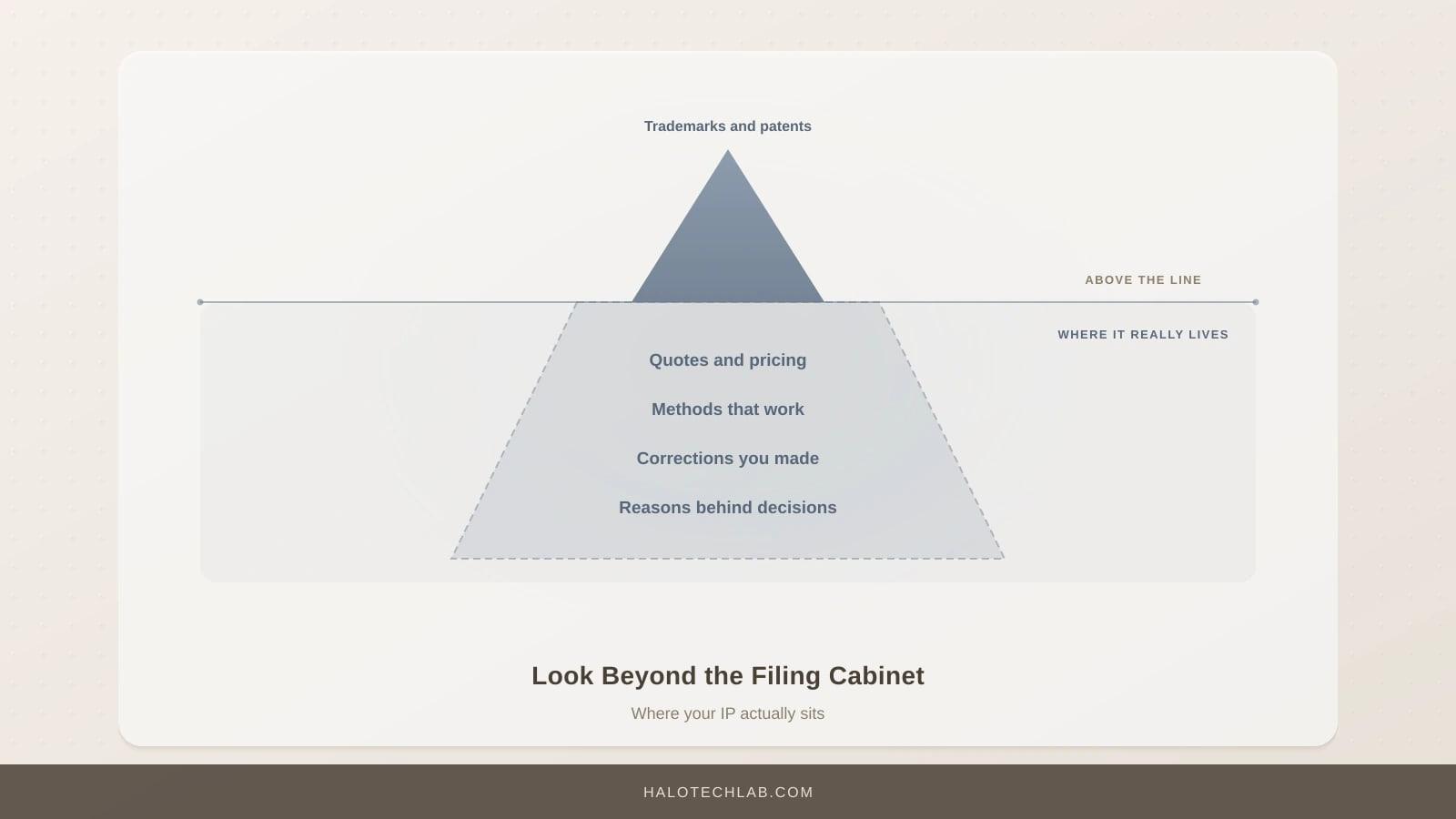
Ask a business owner where their intellectual property is and you will usually get one of two answers. A trademark and maybe a patent. Or a slightly defensive "we do not really have any".
Both answers are wrong in the same way. They are looking at the register rather than at the business. The valuable, defensible, genuinely hard-to-copy part of most established companies is not registered anywhere, and in a lot of cases it is not written down either.
This article is part of our guide to the data you already own.
The registered kind is usually the least valuable
Trademarks protect a name. Patents protect an invention, cost a great deal to obtain and defend, and are irrelevant to most service businesses. Registered designs protect appearance.
These matter, and for the majority of UK SMEs they are not the asset. The asset is the accumulated answer to questions that took years to work out, and none of it is on a register.
The five places it actually lives
1. In your pricing
The single most valuable undocumented asset in most businesses. Not the price list. The reasoning: what the real floor is on each job type, which customers absorb more time than they pay for, when to walk away, what a job actually costs once you count the things that always go wrong.
A competitor can copy your published prices in an afternoon. They cannot copy twelve years of knowing which quotes turned out to be mistakes. See your pricing history is a dataset.
2. In your exceptions
Every business has a standard process and a set of situations where the standard process does not apply. The standard process is usually documented. The exceptions almost never are, because the experienced people handle them without noticing they are exceptions.
This is the part that takes a new person three years to acquire, and it is the part that makes the difference between someone competent and someone genuinely good.
3. In your failures
What you tried that did not work, and why. Which product line looked profitable until you counted returns. Which market you entered in 2019 and left in 2021. Which supplier let you down at a critical moment.
This is negative knowledge and it is worth a great deal, because without it a successor repeats every experiment at full price. It is also the least likely thing to be recorded, because nobody enjoys writing it down.
4. In your method
Not the deliverable, the way you get to it. The order you do things in. The question you ask first that nobody else asks. The check you run that catches the thing everyone else misses.
Most service businesses have one or two of these and have never articulated them, which means they cannot sell them, train them or defend them. Articulating the method is the first step towards productising expert knowledge.
5. In your relationships and reputation
Genuinely an asset, genuinely hard to transfer, and the one most at risk in a succession. Who to call. Who owes you a conversation. Why a particular client has stayed for fifteen years.
Why this matters commercially
Three reasons, in ascending order of urgency.
It changes what your business is worth. A buyer pays more for documented capability than for a founder's reputation, because the second one may leave with the founder. This is a frequent cause of valuation disappointment in owner-managed sales.
It is what you can actually sell twice. Hours do not scale. Method does. A business that has articulated what it knows can package it. One that has not can only keep selling time.
It walks out of the door. Only around 30 per cent of family businesses survive to a second generation, and undocumented judgement is a quiet contributor. See technology and succession.
How to find yours this week
Three exercises, an hour each.
The new starter test. How long does a competent, experienced hire take to become genuinely useful? Whatever that period is, it is the length of time it takes to absorb your undocumented IP. List what they learn during it. That list is your asset register.
The "why do we do it that way" walk. Pick your main service. Walk through it with whoever knows it best and ask why at every step. Most answers will be "that is how it is done". Some will be a hard-won reason. Those are the ones.
The expensive mistake list. Ask your longest-serving people what the business has learned the hard way. You will get five to fifteen items in twenty minutes, and most of them will never have been written anywhere.
Key Takeaways
- Registered IP is usually the least valuable part. The asset is the accumulated answer to questions that took years to work out.
- It lives in five places: pricing reasoning, exception handling, recorded failures, method, and relationships.
- Negative knowledge, what did not work and why, is among the most valuable and the least likely to be written down.
- Undocumented capability depresses business valuations, because a buyer discounts what might leave with the founder.
- Find yours with three one-hour exercises: the new starter test, the "why do we do it that way" walk, and the expensive mistake list.
Frequently Asked Questions
Should we be patenting more?
Probably not. Patents are expensive to obtain, expensive to defend, and only useful for genuinely novel technical inventions you can afford to litigate over. For most UK SMEs, documenting method and pricing logic returns considerably more per pound.
How do we stop staff taking this knowledge to a competitor?
Mostly you do not, and contractual restraints are narrower in practice than employers assume. The realistic protection is that the knowledge lives in the business as well as in the person, so that a departure is a loss rather than a transfer. Documentation is a better defence than a clause.
Is documenting this risky if it makes the knowledge easier to copy?
The risk is real and much smaller than the risk of it existing in one head. Control access sensibly. But a business whose entire advantage depends on nobody writing anything down is one resignation away from losing it, which is the larger exposure by a distance.
Want help finding and capturing what your business actually knows? Talk to Halo Technology Lab. Our strategy and scoping service includes the exercises above and the work that follows them.
Enjoyed this? Get the next one by email
Practical AI playbooks, build logs and tool teardowns. One email a week, free, unsubscribe in one click.
Related Articles
Turning Expert Knowledge into a Product You Can Sell Twice
Service businesses sell the same thinking again and again and only get paid for the hours. How to package what you know into something with margin, without cannibalising the day job.
Dark Data: How to Audit What Your Business Is Already Storing
Fewer than 15% of organisations have catalogued even half their data. A practical one-week audit you can run yourself, and what to do with what you find.
You Are Sitting on Twenty Years of Data. What Is It Actually Worth?
Around 55% of business data is never used for anything. A quick way to work out whether yours is an asset, a liability, or simply a storage bill you have stopped noticing.