Technology and Succession: Handing Over a Business That Runs on One Person's Head
Only 30% of family businesses survive the move to a second generation. Much of what is lost is knowledge nobody wrote down. How to get it out of one head before the handover.
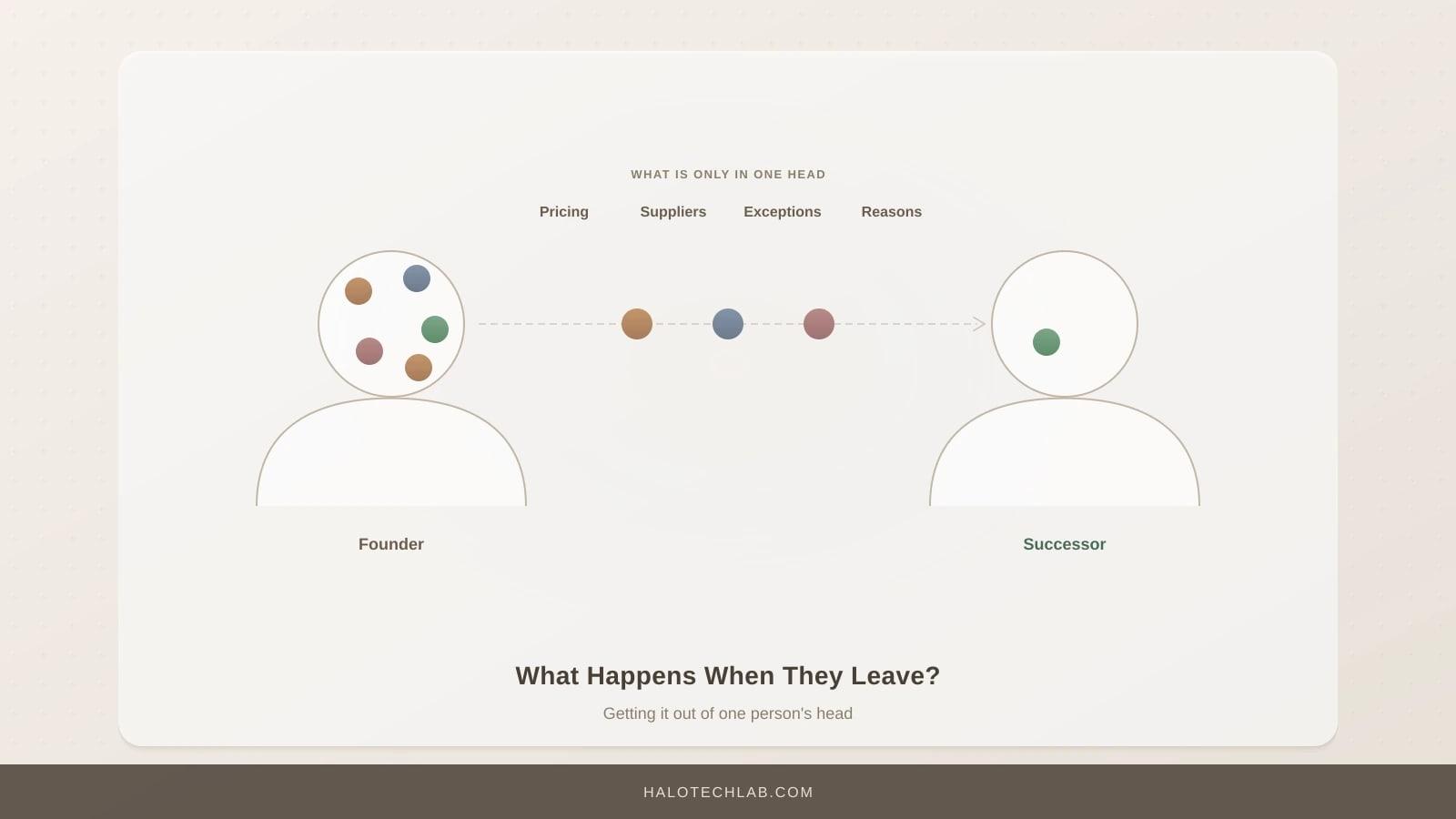
Only about 30 per cent of family businesses survive the move to a second generation. Twelve per cent reach a third. The reasons given are usually tax, family dynamics and market conditions, and those are all real. There is a quieter one that gets less attention: a great deal of what made the business work was never written down, and it left with the person who retired.
This is a technology problem in the same way that a will is a legal problem. The instrument is not the point. The point is that something valuable exists only in one place, and that place is a person.
This article is part of our guide to modernising a legacy business.
What is actually in the founder's head
When owners try to document what they know, they typically start with process, which is the least valuable part and the part most likely to be written down already. What matters is harder to see.
Judgement about people. Which customers pay on time and which need chasing before the due date. Which supplier will do you a favour in a crisis and which will not. Which of them to call rather than email.
Pricing logic. Not the price list. The reasons behind it. Why that customer is on those terms, what the real floor is on a particular job, when to walk away. This is usually the single most commercially valuable undocumented thing in a business, and your pricing history is a dataset covers how to recover it from records.
Exception handling. What to do when the usual answer does not apply. An experienced owner handles these without noticing they are exceptions, which is exactly why they never get recorded.
History. Why a thing was tried in 2009 and abandoned. Which product line looks profitable but is not, once you count the returns. See where your intellectual property actually lives. Successors without this repeat expensive experiments and have no idea they are repeating them.
Relationships. Who to ring at the bank. Who in the industry owes you a conversation. These are assets and they are not transferable by a handover document.
Why the usual approaches fail
"Write it all down." Too large to start, so it never starts. Six months later there is a folder with three documents in it. Owners are not avoiding the task out of secrecy, they simply cannot see the edges of it.
"They can shadow me for a year." Shadowing captures what happens during that year. It does not capture the annual problems, the rare customer, the thing that goes wrong every eighteen months. It also tends to stop early, because the business is busy.
"It is all in the system." It is not. The system holds what happened. It does not hold why, and why is the part that transfers skill.
An approach that works
The technique that consistently produces useful results is narrower than a documentation project and much more specific. It is built on decisions rather than processes.
Step one: list the decisions, not the tasks. Over a fortnight, have the owner note every decision they make that somebody else could not have made. Not tasks. Decisions. The list is usually between fifteen and forty items and it is the whole map.
Step two: record the reasoning out loud. For each decision, record a short conversation, five to fifteen minutes, with someone asking "why" repeatedly. Voice notes are fine. Writing is slower and produces a sanitised version. What you want is the actual reasoning, including the parts that sound unprincipled.
Step three: transcribe and structure. Transcription is now effectively free. Structure each one as: the situation, the options, what I do, why, and what would change my mind. That last field is the one that makes the difference, because it is what lets a successor handle a case the founder never saw.
Step four: make it findable. A document nobody can find is the same as no document. This is where the technology comes in, and it is the smallest part. A well-organised shared folder is enough for most businesses. For larger archives, an internal knowledge chatbot lets someone ask a question in their own words and get the founder's reasoning back.
Step five: test it while the founder is still there. Give the successor real decisions to make using only the record. Compare with what the founder would have done. The gaps show you what is missing, and there is still someone available to fill them. This step is skipped almost universally and it is the one that proves whether any of the work was worth doing.
How long it takes and what it costs
For a business of twenty to eighty people, expect the decision list to take two weeks of the owner's attention in small pieces, the recordings to take twenty to forty hours spread over two to three months, and the structuring to take somewhere between £4,000 and £15,000 if you have help with it.
Compared with the cost of a successor learning by making the same mistakes over three years, it is inexpensive. Compared with the cost of the business not surviving the handover, it is trivial.
Start before you need to
The uncomfortable part is that this work is easiest when it feels least urgent. A founder who is five years from stepping back has the time and the patience for it. A founder who is six months out is busy with the sale, the tax and the family, and the reasoning gets compressed into a handover document that captures the process and loses the judgement.
If you are reading this because a date is approaching, start with the pricing decisions. If you only get one thing out of someone's head, make it that one.
Key Takeaways
- Only around 30 per cent of family businesses survive to a second generation, and undocumented judgement is a quiet contributor to that figure.
- What matters is not process. It is pricing logic, exception handling, history, and judgement about people.
- Document decisions rather than tasks. The list is usually fifteen to forty items, and it is the whole map.
- Record reasoning out loud and transcribe it. Written accounts come out sanitised, and the unprincipled-sounding parts are often the valuable ones.
- Test the record with the successor while the founder is still available. Almost nobody does this, and it is the step that proves the rest was worth doing.
Frequently Asked Questions
Is this not just what a handover document is?
A handover document describes what to do. This describes why, and what would change the answer. The difference shows up the first time the successor meets a situation the document did not anticipate, which happens in about week three.
Our founder is not interested in doing this. Any suggestions?
Frame it as protecting the business rather than recording the person, and start with something concrete and short. The pricing conversation usually works, because most owners enjoy explaining their pricing and know perfectly well that nobody else understands it. One good session tends to make the case better than any argument.
Can AI do the documenting for us?
It can do the transcription and the structuring, which removes most of the tedium and is genuinely worth using. It cannot do the interview, because it does not know which "why" to ask next. The valuable part of this work is a person who knows the business asking good follow-up questions.
What if the knowledge is spread across several long-serving staff, not just the owner?
Then run the same process with each of them, and expect to find contradictions. Those contradictions are useful information. They are usually the places where the business has two ways of doing something and nobody has noticed.
Planning a handover and worried about what walks out of the door with it? Talk to Halo Technology Lab. Our strategy and scoping service includes knowledge capture work designed for family businesses.
Enjoyed this? Get the next one by email
Practical AI playbooks, build logs and tool teardowns. One email a week, free, unsubscribe in one click.
Related Articles
Running Your Business on Spreadsheets: When It Is Fine, and When It Becomes a Risk
Spreadsheets are underrated, right up until they are dangerous. Seven signals that yours has quietly become critical infrastructure, and what to do about it without a rebuild.
Rip and Replace vs Modernise Around the Edges
Two ways to fix an ageing system, and they suit very different businesses. How to tell which one you need, what each really costs, and why the bigger option is usually sold harder.
What a Legacy System Actually Costs You Every Year
Old systems rarely show up as a line on the P&L, which is why they survive. Here is how to put a number on what yours costs in staff time, lost work, risk and the things you cannot do.