Modernising a Legacy Business: A UK Owner's Guide to Technology That Actually Sticks
A complete guide for owners of established UK businesses. What to modernise first, what to leave alone, what it costs, and how to avoid the failed project that puts everyone off trying again.
Most guides about modernising a business are written for businesses that are already fairly modern. They assume you have a data team, a project manager, and a tolerance for the word "transformation". This one is not written for them.
This is written for the business that has been trading for fifteen, thirty or seventy years. The kind where the accounts system was chosen by someone who has since retired, where a good deal of what matters is in people's heads, and where the last technology project either went fine and nobody noticed, or went badly and nobody has wanted to try since.
Roughly half of family businesses describe themselves as only moderately or insufficiently invested in the operational technology they need. That is not a failure of ambition. It is what happens when the business works, the owner is busy, and every quote for fixing it arrives with a strategy deck attached.
This guide covers what to modernise, in what order, what it costs, and how to avoid the failed project that puts everyone off trying again for a decade.
First, what modernisation actually means
Modernisation is not buying new software. It is reducing the number of places where your business depends on something fragile.
Fragile means: one person, one spreadsheet, one machine under a desk, one supplier who has stopped answering, one process that only works if everybody remembers a step nobody wrote down. Every business has some of these. The question is whether any of them sit underneath something that matters.
A useful reframe: you are not upgrading technology, you are removing single points of failure, in order of how much damage each one would do. That framing changes what you buy, what you skip, and how you know whether it worked.
It also rules a lot of things out. A new website does not remove a single point of failure. Neither does a customer relationship management system nobody has agreed to use. Both may be worth doing. Neither is modernisation.
The five things that are actually wrong
Across established UK businesses, the same five problems come up again and again, in roughly this order of frequency.
1. The same information is entered more than once. An order arrives by email. Somebody types it into a spreadsheet. Somebody types it into the accounts package. Somebody types it again onto a delivery note. Four versions of one fact, three chances to get it wrong, and no single place that is definitely right.
2. Critical knowledge is undocumented. How pricing really works. Which customers get which terms and why. What to do when a particular supplier is late. This is the most valuable thing in the business and the least protected.
3. Nobody can answer a question without doing work. "How much did we do with that client last year?" should take thirty seconds. If it takes half a day and involves exporting something, you are running the business on recollection rather than on information.
4. The system cannot be handed over. If a specific person left, how long until a replacement could do the job properly? If the honest answer is measured in months, that is not a staffing risk, it is a structural one.
5. Something is out of support. Software that no longer receives updates, a server nobody patches, a version of Windows that stopped being maintained. This one is genuinely urgent when it appears, and it appears more often than owners expect.
Note what is not on that list: the business not being on the cloud, the website looking dated, not using AI. Those may all be true. None of them are why a business is stuck.
Where to start: the one-week audit
Before spending anything, spend a week finding out what you actually have. You can do this yourself.
Day one: map the money. Follow one sale from first enquiry to cash in the bank. Write down every system it touches, every person who handles it, and every point where information is retyped. Do this for one real order, not a hypothetical one.
Day two: map the work. Do the same for however you deliver. A job, a case, a project, a booking, a shipment. Same rules: real example, every system, every handoff.
Day three: ask three people what wastes their time. Not a survey. A conversation, individually, with the question phrased as "what part of your week would you most like to stop doing". Write down what they say without proposing solutions.
Day four: list what is out of support. Every piece of software and hardware, when it was last updated, and whether the supplier still exists. This is dull and it is the only part that is genuinely urgent.
Day five: write the dependency list. For each critical process, name the one person who could not be replaced quickly. Be honest. Include yourself.
At the end of the week you will have a one-page picture that is more useful than any consultant's report, because it is specific to your business and you believe it.
We go further into this in dark data: how to audit what your business is already storing, which covers the information side in more detail.
The order of operations
This is where most projects go wrong. Not in what they choose, but in when.
Stage one: stop the bleeding. Anything out of support, anything that is a security exposure, anything where a single failure would stop trading. This is not exciting and it is not optional. Budget for it separately and do not let it compete with improvement work.
Stage two: remove double entry. This is the highest-return, lowest-risk work in almost every business. It is cheap, the benefit is immediate and measurable, and it builds confidence for the harder stages. If a modernisation programme needs an early win, it is here.
Stage three: make information answerable. Get to the point where the five questions you ask most often can be answered in under a minute by someone who is not you. This usually means one system becoming the agreed source of truth, which is a decision rather than a purchase.
Stage four: get knowledge out of heads. The slowest and most valuable stage. Covered properly in technology and succession, because it matters most when somebody is leaving.
Stage five: build something new. Only now. A custom tool, a customer portal, an AI application. Attempting this stage first is the single most common reason modernisation projects fail, because you end up automating a process nobody understood in the first place. For a worked account of what this looks like in practice, see modernising your legacy web platform with AI.
What it costs
Real ranges for UK SMEs, with the caveat that scope moves these more than anything else.
Stage one, stopping the bleeding. £2,000 to £15,000 typically, occasionally much more if there is a server replacement or a licensing problem. Almost always worth doing immediately.
Stage two, removing double entry. £3,000 to £12,000 for a handful of integrations between systems you already pay for. Payback is usually three to nine months, and it is easy to calculate in advance. See how to calculate the ROI of automating a business process for the arithmetic.
Stage three, answerable information. £5,000 to £25,000 depending on how many systems have to agree with each other. The cost driver is data cleaning, not software.
Stage four, knowledge capture. £5,000 to £30,000. Extremely variable, because the work is mostly interviews, structuring and writing rather than engineering.
Stage five, building something. £15,000 to £80,000 and up. This is a real project with real risk and should only happen once the four stages beneath it are solid.
Add 10 to 20 per cent of any build cost annually for maintenance. An unmaintained system becomes next decade's legacy problem, which is how most businesses ended up here in the first place.
The three ways this goes wrong
It is scoped as one big programme. A two-year transformation has two years in which the sponsor can change their mind, the market can shift, or the person driving it can leave. Nothing ships, money is spent, and the organisation concludes that modernisation does not work. Break it into pieces that each deliver something on their own, ideally within a quarter.
The staff were not asked. The people doing the work know exactly where the pain is. If they are consulted only at training stage, they will be correct that the change was done to them, and they will be right to resent it. This is covered in training a team that thinks AI is coming for their job, which applies just as well to any system change.
It is built on data nobody checked. The most expensive failure mode. A system is built, the data goes in, the outputs are wrong, trust collapses, and everyone goes back to the spreadsheet. See data quality before AI. The rule holds for any system, not just AI.
Choosing who helps you
Most owners reading this have been burned before, and that fear is the single biggest reason good projects never start. It is a rational fear and it deserves its own treatment, which it gets in choosing a technology partner and in how to choose a trustworthy AI agency.
For now, three quick tests. Ask what they would advise you not to do, and be suspicious of anyone with nothing on that list. Ask what happens to the code and the data if you part ways, and get the answer in writing. Ask them to explain their proposal to someone in your business who is not technical, and watch whether they can.
A realistic first year
For a business of twenty to a hundred people starting from a standing start:
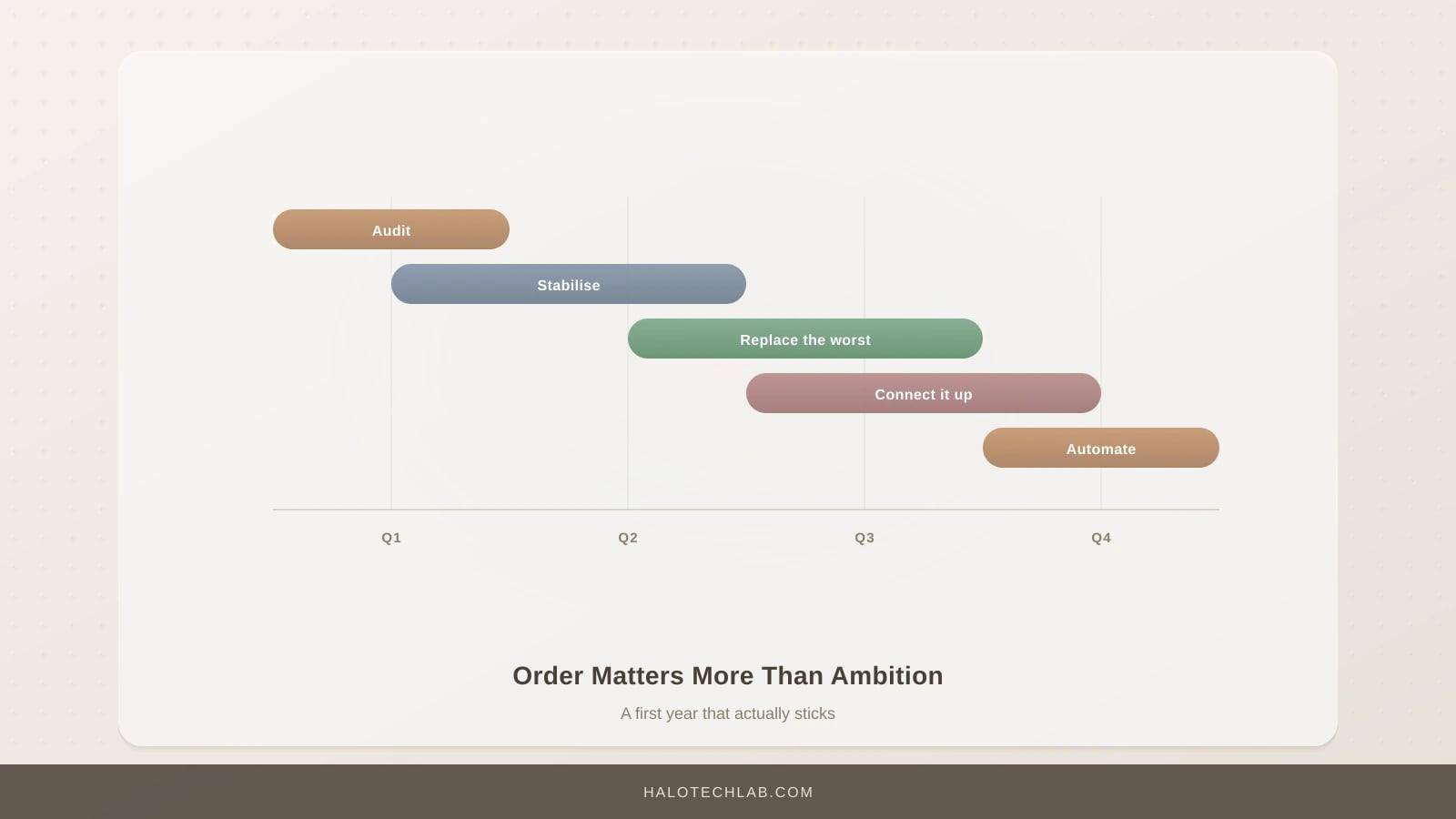
- Months one to two. Audit, plus stage one remediation. Budget £5,000 to £15,000. Nothing visible changes and the risk profile improves considerably.
- Months three to six. One double-entry problem removed, end to end. Budget £4,000 to £10,000. Staff notice. This is the project that earns permission for the rest.
- Months six to nine. Agree a source of truth and clean the data behind it. Budget £6,000 to £20,000. Tedious, and everything afterwards depends on it.
- Months nine to twelve. Knowledge capture on the two most exposed dependencies. Budget £5,000 to £15,000.
Total, roughly £20,000 to £60,000 across a year, in four pieces that each stand on their own. If any one of them fails, the others still hold. That is the point.
How to build the business case
Established businesses rarely refuse modernisation on principle. They refuse it because nobody has shown them a number they believe.
Use fully loaded staff cost, not salary. For UK employees, salary plus employer National Insurance, pension and overheads comes to roughly 1.3 to 1.5 times the headline figure. A £32,000 administrator costs about £44,000, or £22 an hour. Every hours-saved calculation should use that number.
Count the "do nothing" line. The comparison is never against zero. It is against the same process, done the same way, for three more years, with wages rising and volumes growing. Manual processes scale linearly. That is the whole argument.
Separate hard and soft benefits. Put time, error and cash flow savings in the case. Put reduced key-person risk, easier hiring and better customer experience underneath it, clearly labelled as judgement rather than arithmetic. Mixing the two is what makes finance directors distrust the whole document.
Size the downside honestly. What happens if the project half works? For stage two work the answer is usually "we are out the build cost and back where we started", which is a survivable bet. For stage five work it is considerably worse. That asymmetry is the reason for the ordering.
What to measure, and when
Pick the measures before you start, because afterwards everyone remembers the baseline as worse than it was.
Within one month. Hours spent on the specific process you changed. Count it by hand for a week before and a week after. Crude, and more convincing than anything a dashboard produces.
Within one quarter. Time to answer the five questions you ask most often. Number of places a given fact is stored. Error or rework rate on the process you touched.
Within one year. How long it takes a new starter to become useful. How long the business could run without any one individual. Whether last year's "we cannot do that" list has got shorter.
That last one is the real measure. If, twelve months in, the things you turned down because the systems would not support them are still being turned down, the money went somewhere other than modernisation.
Key Takeaways
- Modernisation is removing single points of failure, not buying software. If a change does not remove one, ask what it is for.
- The five real problems are double entry, undocumented knowledge, unanswerable questions, unhandoverable systems, and anything out of support.
- Do a one-week audit yourself before spending anything. It will be more accurate than a report you pay for.
- Order matters more than choice: stop the bleeding, remove double entry, make information answerable, capture knowledge, then build. Building first is why projects fail.
- Expect £20,000 to £60,000 over a first year, split into four independent pieces. Anything structured as one long programme should be questioned.
Frequently Asked Questions
How long does modernising a legacy business actually take?
The useful answer is that it never finishes, but it stops being painful within a year. Stage one and two work delivers visible results in three to six months. The deeper stages run alongside normal trading for a year or two. Any supplier proposing a defined end date for "modernisation" is describing a project, not the thing you asked about.
Do we need to replace our accounts system?
Usually not, and this is the most common unnecessary purchase we see. Older accounts packages are often perfectly capable and well understood by the people using them. The problem is more often that nothing else talks to it. Connecting it is far cheaper than replacing it, and carries a fraction of the risk.
What if our data is a mess?
It will be. Everybody's is. The target is not clean data, it is data clean enough for the specific decision you want to make. Cleaning everything is a project with no end. Cleaning one customer list well enough to send accurate statements is a fortnight. Start with the second kind.
We are a small team with no technical staff. Is this realistic?
Yes, and small teams often move faster because there are fewer people to convince. What you need is one person inside the business who owns the decisions, not the delivery. Without that, external help has nobody to ask, and projects stall regardless of budget.
Is AI part of this?
Eventually, and much later than most vendors suggest. AI applied to undocumented processes and unreliable data produces confident nonsense. Applied after stages one to four, it is genuinely useful. The order is the whole point. See 5 signs your business is ready for AI.
Thinking about modernising an established business and unsure where to start? Talk to Halo Technology Lab. Our strategy and scoping service begins with the audit above, and we will tell you plainly which stages you can skip.
Enjoyed this? Get the next one by email
Practical AI playbooks, build logs and tool teardowns. One email a week, free, unsubscribe in one click.
Related Articles
The Data You Already Own: How UK SMEs Turn Decades of Records into Revenue
Your archive is not just history, it is the raw material for products you could sell. A complete guide to finding, valuing, cleaning and commercialising the data your business already holds.
AI Training for UK Businesses: What Your Team Actually Needs to Learn
Most AI training teaches tools. Tools change every six months. A complete guide to what to teach, who to teach it to, which format suits which team, and how to tell whether it worked.
The EU AI Act and UK Businesses: What Actually Applies to You
The UK has not adopted the EU AI Act, and it can still reach your business. A complete guide to which duties apply, when, what the penalties are, and what a sensible response looks like.