AI Training for UK Businesses: What Your Team Actually Needs to Learn
Most AI training teaches tools. Tools change every six months. A complete guide to what to teach, who to teach it to, which format suits which team, and how to tell whether it worked.
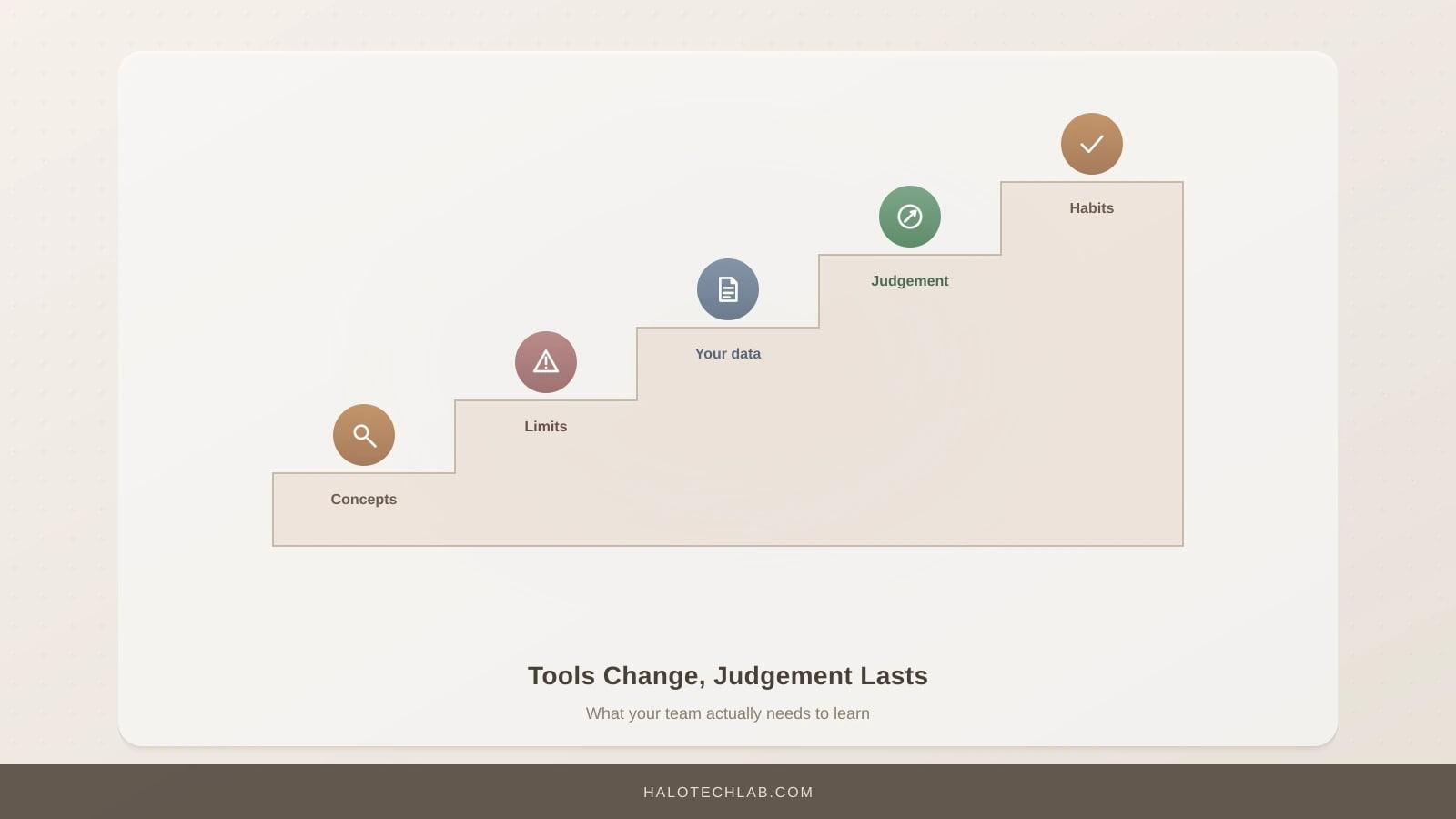
Most AI training teaches tools. It shows people where the buttons are in whichever product the trainer is familiar with, everyone leaves with a list of prompts, and within four months the product has changed and the list is useless.
That is not a training problem. It is a curriculum problem. The things that transfer are the things that do not change: what these systems are, where they fail, what happens to what you type, and when to stop and ask a person.
More than half of SMEs cite insufficient internal skills as the main barrier to using AI, and well over half say they are interested in using it. The gap between those two numbers is the whole subject of this guide.
Why this matters more than the tooling
A business with good tools and untrained people gets three things: confident wrong answers going out to customers, confidential information going into public systems, and a slow drift of quality that nobody notices until a client does.
A business with mediocre tools and trained people gets none of those, and generally finds the better tools on its own.
There is also the regulatory dimension. If you are in scope of the EU AI Act, Article 4 requires you to ensure a sufficient level of AI literacy among staff and anyone operating AI on your behalf. It has applied since February 2025, with supervision from August 2026. See Article 4. But the operational case stands on its own, which is why we recommend this work to businesses firmly outside the Act's scope.
The curriculum
Five things, in this order. The order matters, because each one makes the next one land.
1. What these systems actually are
Not architecture. One idea: these systems predict plausible continuations, they do not look things up.
Everything else follows. Why the output is fluent and sometimes wrong. Why it invents citations. Why it is excellent at rephrasing something you gave it and unreliable at recalling something you did not. Why asking it to "be accurate" does very little.
Thirty minutes, no technical background needed, and it changes how people use the tools more than any other single thing.
2. What happens to what you type
The highest-value half hour in the whole curriculum, because it prevents the most common real incident.
Cover: the difference between consumer and business tiers, what each supplier's terms actually say about retention and training, which of your tools are approved and which are not, and a plain list of what may never be pasted anywhere.
Make the list concrete. "Confidential information" means nothing. "Client names, unpublished financials, anything from the HR folder, anything covered by an NDA" means something.
3. Verification as a habit
People know in principle that AI can be wrong. They do not behave as though it is, because the output is fluent and the pressure is real.
What works is not a warning. It is a rule tied to consequence: anything that leaves the building, goes to a client, or informs a decision gets checked by a person who knows the subject. And then showing the room a real example from your own business where the output was confidently wrong. One local example beats an hour of general caution.
4. What good use looks like in your business
This is where generic training stops and yours begins, and it is why off-the-shelf courses only get you part of the way.
Take three or four real tasks people in your business actually do. Show the whole thing: the input, the output, the edit, the result. Then show a task the tools are bad at, and be explicit that the answer there is not to use them.
Telling people where AI does not help is what makes them trust you about where it does.
5. The rules and who decided them
Short. What is approved, what is not, what to do if unsure, who to ask. If you have an AI use policy, this is where it gets explained rather than circulated.
The critical part is that a named person owns it and questions are welcome. Most policy failures are not defiance, they are people guessing because asking felt awkward.
Who needs what
Three audiences, three different sessions. Running one session for everyone is the second most common mistake after teaching tools.
Everyone. Sections 1, 2 and 3. Ninety minutes to two hours. Non-negotiable, including people who insist they will never use it, because they will.
People using it daily. All five sections plus hands-on work with their own tasks. Half a day, and ideally a follow-up session three or four weeks later once they have hit real problems. The second session is where the actual learning happens and it is the one most often cut.
Leaders and decision-makers. Sections 1 and 2, plus what to ask suppliers, where the liability sits, and how to tell a real AI proposal from a repackaged one. Two to three hours. Covered in AI literacy for non-technical leaders.
Choosing a format
Three shapes, and they are not interchangeable. Full comparison in workshop, programme or course.
A workshop is a fixed session, usually half a day, delivered to a group. Best for getting a whole team to a shared baseline quickly, and for the leadership session. Typical cost for a bespoke half-day in the UK: £1,200 to £3,500 depending on preparation and group size.
A programme runs over months alongside the work: an initial session, then regular shorter touchpoints, with someone available in between. Best where AI is being genuinely adopted rather than sampled, because the questions that matter arrive in week five, not on the day. Typically £800 to £3,000 a month.
A course is self-serve material people work through at their own pace. Best for induction, for consistency across locations, and for the foundational sections that do not change. Cheapest per head and weakest at the parts specific to your business. Building a bespoke one runs £4,000 to £20,000. See how small businesses can quickly build e-learning courses with AI.
Most businesses of thirty to three hundred people are best served by a workshop for everyone, a course for induction and the fundamentals, and a light programme for the handful of people doing the real work.
What it costs, honestly
For a business of fifty people, a sensible first year:
- Half-day all-staff workshop: £1,500 to £3,000
- Leadership session: £900 to £2,000
- Deeper sessions for the ten or so heavy users, including a follow-up: £2,500 to £6,000
- Induction material for new starters: £2,000 to £8,000 to build, or considerably less if adapted from existing content
Somewhere between £7,000 and £19,000, front-loaded, with the induction material amortising over years.
Compare that with one afternoon spent unpicking a confidential document that went into a public tool, or one client discovering an invented figure in a report. The comparison is not close, and it is the only comparison that matters.
Measuring whether it worked
Attendance and satisfaction scores tell you nothing. Four things do, covered properly in how to measure whether AI training actually worked:
- time on specific named tasks, measured before and after
- number of people who can state what happens to what they type
- incidents, which should include near-misses being reported rather than hidden
- whether people can say where AI does not help, which is the clearest sign the training was honest
The mistakes that waste the budget
Teaching tools rather than principles. The tools change. Six months later you pay again.
One session for everyone. Too shallow for daily users, too much for everyone else, useful to nobody.
No follow-up. The questions that matter arrive once people have tried it properly. If there is nowhere to take them, people quietly revert.
Ignoring the sceptics. Resistance is usually a reasonable response to a badly handled rollout. Pretending nothing will change makes it worse. See training a team that thinks AI is coming for their job.
Training before deciding anything. If you have not agreed which tools are approved, training produces enthusiasm with nowhere to go, which is how shadow AI starts.
Key Takeaways
- Teach principles, not tools. Tools change every few months. Why these systems fail, and what happens to what you type, does not.
- The single highest-value session is what happens to the information people paste in. It prevents the most common real incident.
- Three audiences need three sessions: everyone, daily users, and leaders. One session for all three serves none of them.
- Budget roughly £7,000 to £19,000 in year one for a fifty-person business, front-loaded.
- Telling people where AI does not help is what makes them believe you about where it does.
Frequently Asked Questions
How long before we see a return?
On time saved, within weeks for the people using it daily. On risk reduction, immediately, though you will never be able to prove what did not happen. The measurable return comes from specific tasks, which is why capturing a baseline before you start matters so much.
Can we not just let people work it out themselves?
They will, and you will get an inconsistent result with no visibility. Some will become genuinely good, most will plateau at rephrasing emails, and a few will do something that costs you. Self-teaching produces the capability without the guardrails, and the guardrails are the cheap part.
Our team is sceptical. Should we train them anyway?
Yes, and sceptics make the sessions better if you let them. They ask the questions everyone else is thinking, and a session that survives genuine challenge is far more convincing than one where everyone nods. What does not work is running the session as though the concerns are unreasonable.
We are a ten-person business. Is this proportionate?
Scale it down, do not skip it. For ten people that is one two-hour session covering the first three curriculum sections, a one-page list of approved tools and rules, and a named person to ask. Perhaps £1,500 and an afternoon.
Should training be mandatory?
The sections on data handling and verification, yes, in the same way that any handling rule is. The tool-specific work, no, because forcing enthusiasm produces attendance rather than adoption.
Want AI training built around your tools, your rules and your actual work? Talk to Halo Technology Lab. Our support and training service covers workshops, ongoing programmes and bespoke courses, and we will tell you which of the three you need.
Enjoyed this? Get the next one by email
Practical AI playbooks, build logs and tool teardowns. One email a week, free, unsubscribe in one click.
Related Articles
The Data You Already Own: How UK SMEs Turn Decades of Records into Revenue
Your archive is not just history, it is the raw material for products you could sell. A complete guide to finding, valuing, cleaning and commercialising the data your business already holds.
The EU AI Act and UK Businesses: What Actually Applies to You
The UK has not adopted the EU AI Act, and it can still reach your business. A complete guide to which duties apply, when, what the penalties are, and what a sensible response looks like.
Modernising a Legacy Business: A UK Owner's Guide to Technology That Actually Sticks
A complete guide for owners of established UK businesses. What to modernise first, what to leave alone, what it costs, and how to avoid the failed project that puts everyone off trying again.