Training a Team That Thinks AI Is Coming for Their Job
Resistance is usually a reasonable response to a badly handled rollout. How to run AI training when people are worried, and why pretending nothing will change makes it worse.
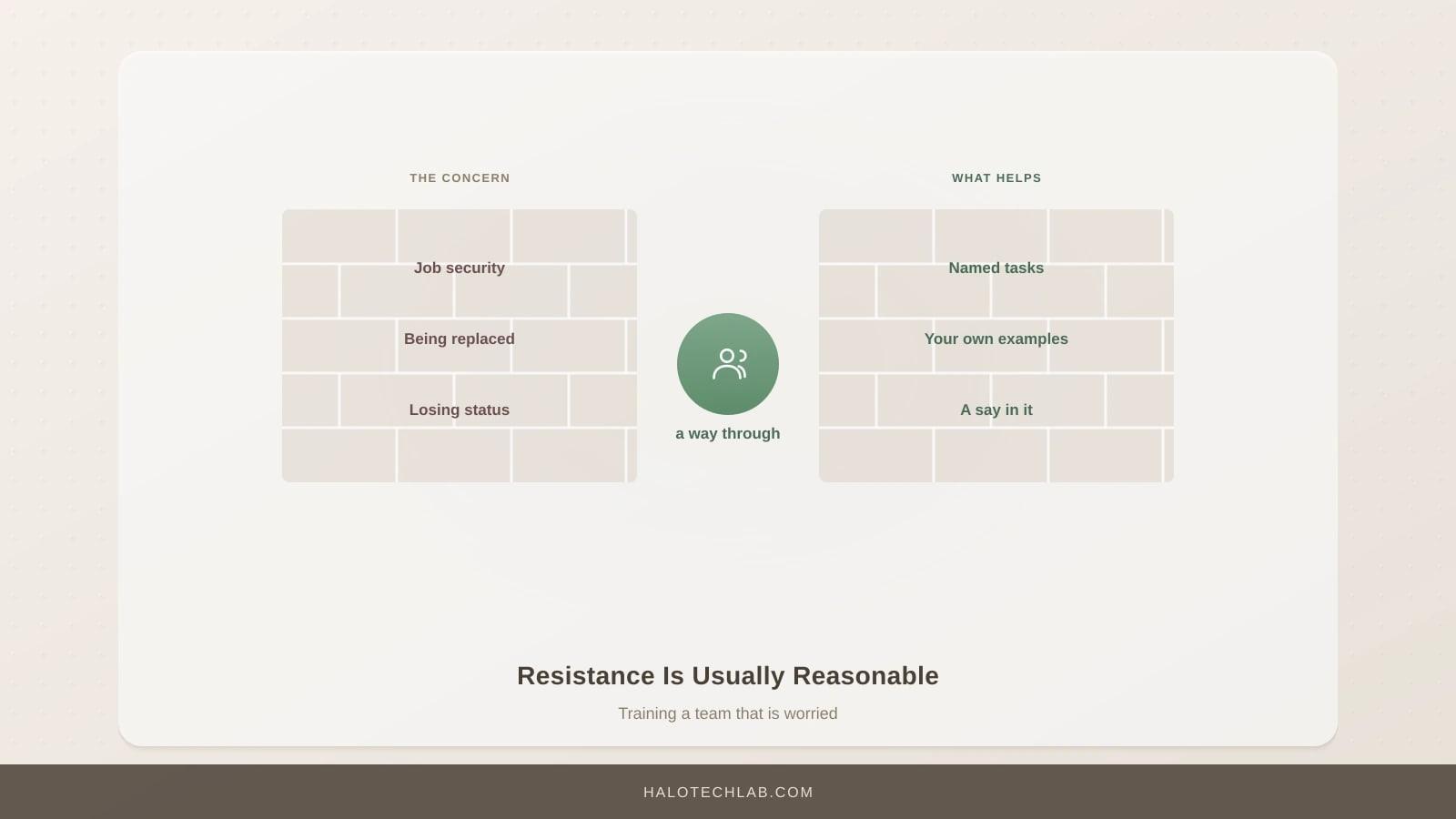
You have booked the training. Someone in the room believes the real purpose of the session is to make their role redundant, and they are not going to say so. They will be polite, they will not ask questions, and they will not use anything you show them.
This is the most common obstacle to AI adoption in established businesses, and it is almost always handled badly, because the instinct is to reassure rather than to answer.
This article is part of our guide to AI training for UK businesses.
Start by accepting the concern is reasonable
It is not paranoia. People have watched this pattern before with offshoring and with previous waves of automation, and they have seen the sequence: enthusiasm, efficiency, then a restructure eighteen months later.
Treating that as irrational is the fastest way to lose the room. Whatever you say next, they will discount it, because you have just demonstrated that you are not engaging with the actual question.
The thing that does not work
"Nobody's job is at risk, this is about freeing you up for more interesting work."
Three problems. It is often not true, and if it later proves untrue you have destroyed your credibility for everything else. It is vague, so nobody can check it. And it is exactly what someone would say if jobs were at risk, which is precisely why it fails to reassure.
Vague reassurance is read as evasion, and it is usually detected within a sentence.
What does work
Be specific about what is changing. Not "roles will evolve". Which tasks, in which roles, on what timescale. "The three hours a week you spend copying order details will stop. The customer conversations will not." People can work with that.
Say what you do not know. "I do not know what this looks like in two years. I know what we are doing this quarter, and I will tell you when that changes." This is far more credible than confidence, and it is usually true.
If headcount is affected, say so first. Before the training, not after. A restructure that emerges later turns every previous statement retrospectively into a lie, including the true ones. If the honest position is that you expect fewer people in a function over two years through natural turnover, saying that costs you less than being found out.
Be clear about what the tools cannot do. A large part of the fear is a belief that these systems are more capable than they are. The risks of AI for small businesses is a useful corrective. Twenty minutes showing where they fail, badly and visibly, does more for the room's anxiety than any amount of reassurance. It also happens to be the most useful part of the training. See AI literacy for non-technical leaders.
Let the sceptics shape the session
The most effective technique we have found is to hand the sceptics a job.
Ask the people most doubtful to try to break it. Give them a real task, tell them you want them to find where it fails, which is also how you should assess a supplier, and mean it. Three things follow. They engage, because the frame is not "learn this" but "test this". They find genuine failure modes, which is valuable and which an enthusiast will not find. And the rest of the room watches a critical examination rather than a sales pitch, which changes how they receive everything else.
A session that survives a sceptic's best effort is convincing. A session with no dissent in it convinces nobody.
Address the status question underneath
Some of the resistance is not about employment at all. It is about being the person who knew how to do something, and the worry that the knowledge is being made worthless.
The honest answer is that the judgement is the valuable part and the tools do not have it. The person who knows which customers need chasing early, why that job is priced the way it is, what to do when the usual answer does not apply, is not being replaced by a system that predicts plausible text. That knowledge is exactly what the tools lack.
Better still, give them a role in capturing it, along the lines of technology and succession. Someone who has been asked to document their expertise because it is valuable is in a different position from someone who suspects it is being extracted before disposal.
What to do afterwards
Do not measure individual usage and publish it. Usage leaderboards convert a capability question into a compliance one, and they punish the people whose work genuinely does not benefit.
Make it acceptable to say it did not help. If the only permitted feedback is positive, you will not learn where the tools are failing, and the sceptics will be proved right that the exercise was performative.
Follow up in a month. By then people have tried things. The concerns will be more specific and more answerable than they were on the day.
Key Takeaways
- The fear is reasonable and dismissing it loses the room. People have seen this pattern before.
- Vague reassurance reads as evasion. Be specific about which tasks change, on what timescale, and say plainly what you do not know.
- If headcount is affected, say so before the training rather than after. Being found out later invalidates everything true you also said.
- Showing where the tools fail does more for anxiety than reassurance does, and it is the most useful part of the session anyway.
- Give sceptics the job of breaking it. Their engagement and their findings are worth more than an enthusiast's.
Frequently Asked Questions
What if jobs genuinely are at risk?
Then say so, early, and separate the two conversations. Run the redundancy or restructuring process properly and on its own terms, and keep it separate from measuring whether the training worked, and do the training separately. Using training as cover for a restructure is both transparent and corrosive, and people work it out quickly.
One person is actively undermining it. How do we handle that?
Find out what is underneath, in a one-to-one rather than in the room. It is usually one of three things: a specific fear about their role, a previous change that went badly, or a reasonable technical objection nobody has engaged with. All three are addressable. None are addressed by pressure.
Should we make AI use mandatory to overcome resistance?
Mandate the safety rules, which are about data handling and verification. Do not mandate use of the tools. Forced adoption produces compliance theatre: people running a task through a tool and then doing it the old way anyway, which is worse than not adopting at all.
Rolling out AI to a team with reasonable doubts? Talk to Halo Technology Lab. Our support and training service is designed to survive scepticism, because sessions that do not are not worth running.
Enjoyed this? Get the next one by email
Practical AI playbooks, build logs and tool teardowns. One email a week, free, unsubscribe in one click.
Related Articles
How to Measure Whether AI Training Actually Worked
Attendance and satisfaction scores tell you nothing. Four measures that do, how to capture a baseline before you start, and what a realistic return looks like.
Workshop, Programme or Course? Choosing the Right Shape of AI Training
A half-day workshop, an ongoing programme and a self-serve course solve different problems. What each is good at, what each costs, and how to tell which one your team needs.
AI Literacy for Non-Technical Leaders: Ten Things You Actually Need to Understand
You do not need to know how a model works. You do need to know why it makes things up, what it does with your data, and when to distrust it. The ten concepts that matter.