AI Literacy for Non-Technical Leaders: Ten Things You Actually Need to Understand
You do not need to know how a model works. You do need to know why it makes things up, what it does with your data, and when to distrust it. The ten concepts that matter.
You do not need to understand how a neural network works. You are not going to build one, and nobody who matters is going to ask you about it.
What you do need is enough understanding to ask a supplier a question they cannot deflect, to know when an output should not be trusted, and to tell a real AI proposal from an ordinary piece of software with a new label on the front. That is ten things, and none of them require a technical background.
This article is part of our guide to AI training for UK businesses.
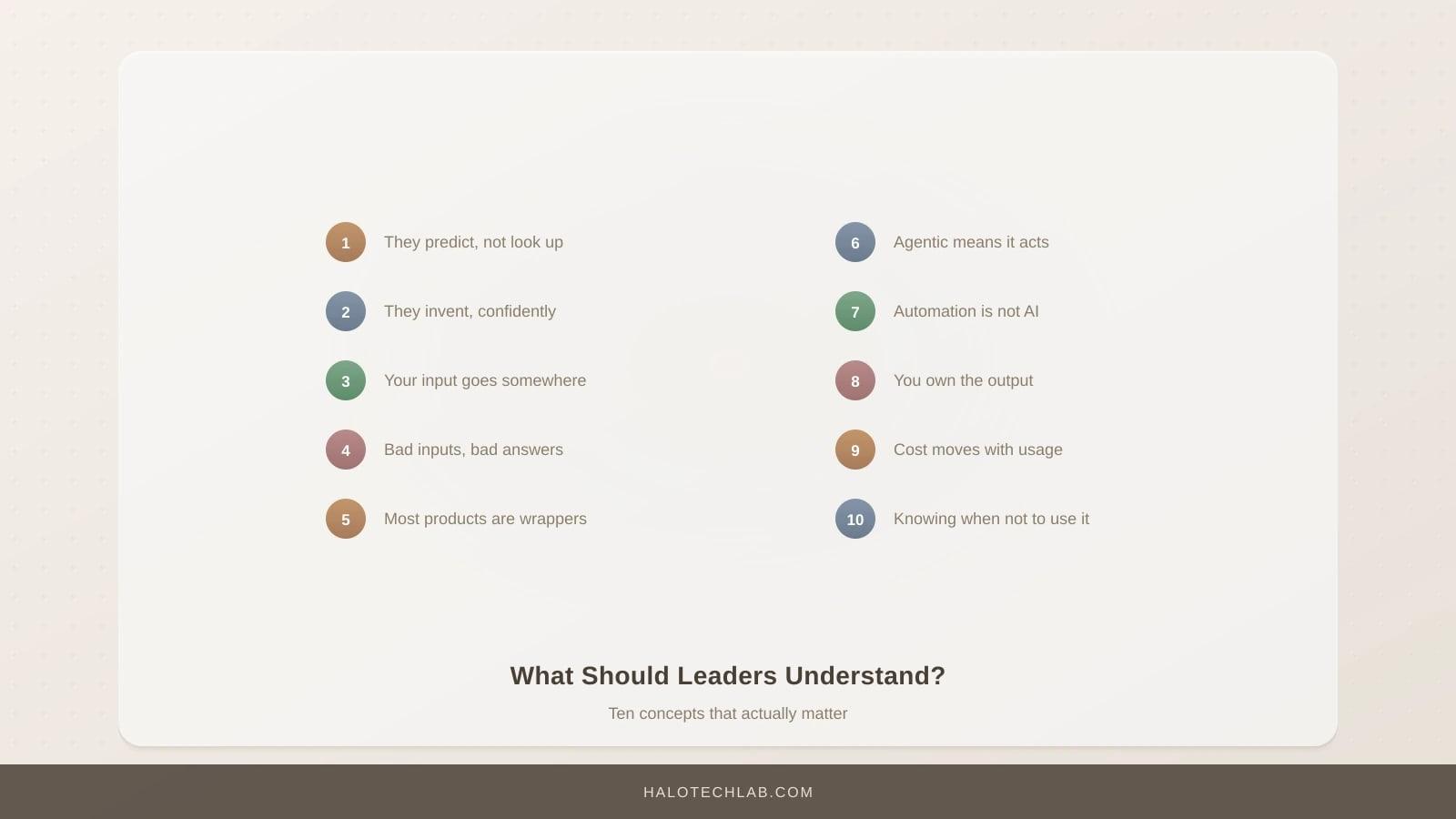
1. These systems predict, they do not look things up
This is the foundation and everything else follows from it. A large language model produces plausible continuations of text, one piece at a time, based on patterns. It is not consulting a database and reporting what it finds.
Which is why it is fluent, why it is sometimes wrong, and why it is wrong in a particularly dangerous way: the wrong answer is delivered in exactly the same confident tone as the right one. There is no tell.
2. It will invent things, and it cannot tell you when
The industry calls this hallucination, which rather undersells it. Invented case citations, invented statistics, invented product features, invented people.
Asking it to be accurate does very little, because it has no internal sense of the difference. The only reliable control is a person who knows the subject checking the output. Any supplier who tells you their system does not do this is either misinformed or hoping you are.
3. What you type goes somewhere
Every prompt is sent to a third party. What happens next depends entirely on which product and which tier: retained or not, used for training or not, visible to staff or not.
The gap between the consumer and business tiers of the same product is often the difference between a manageable arrangement and a data protection problem. Most staff have no idea this distinction exists, which is why it is the highest-value thing to explain to them.
4. Garbage in is the whole story
The output quality is determined almost entirely by the quality and relevance of what goes in. A model asked about your business without being given anything about your business will produce a generic answer with your company name in it.
This is also why AI projects fail on data rather than on modelling. See data quality before AI.
5. Most "AI products" are a model plus a wrapper
A large proportion of AI software is somebody else's model with an interface and some instructions in front of it. That is not a criticism, the wrapper is often where the value is. It does mean two things worth knowing.
The capability is usually available to you directly at a fraction of the price, so you should understand what the wrapper adds. And the supplier's product depends on a model they do not control, so ask what happens if the underlying provider changes terms, pricing or behaviour.
6. "Agentic" means it takes actions
The word appears everywhere. What it means in practice is that the system does not just produce text, it does things: sends emails, updates records, makes bookings, calls other systems.
The relevant question is not whether it is impressive. It is what it is allowed to do without a human agreeing, and what happens when it does the wrong one. Ask that. The answer tells you how seriously the supplier has thought about it.
7. Automation and AI are different things
Most business value labelled AI is actually automation: moving information between systems reliably, following rules nobody has to remember. It is unglamorous, well understood, cheap and it works.
AI is for the parts that need judgement or handle unstructured material. Paying AI prices for automation work is one of the most common ways money gets wasted. See what does automation actually mean in business.
8. You are accountable for the output
Not the vendor, in most circumstances. If your chatbot misleads a customer, your business made the statement. If your shortlisting tool disadvantages a protected group, your business discriminated.
"The AI did it" is a description of a mechanism, not a defence, in any forum that matters. This is covered in AI regulation in the UK.
9. The cost is usage-based and it moves
Unlike a licence, most AI pricing scales with how much you use it. A pilot with five people tells you very little about the bill for two hundred.
Ask for the cost per transaction, per document, per user-month at realistic volume, not the headline. And ask what happens if the underlying provider changes their pricing, because they do.
10. Knowing when not to use it is the actual skill
The valuable judgement is not prompting. It is recognising the tasks where the tools are unreliable, where being nearly right is worse than not doing it, and where a person is faster anyway.
Leaders who understand this make better buying decisions than leaders who are enthusiastic, because they ask "what happens when it is wrong" before "what could it do for us". That question, asked early, is worth more than any technical knowledge.
The four questions to ask any supplier
Everything above reduces to these.
- What does your system do when it does not know? Good answers involve saying so or escalating. Bad answers involve confidence.
- Whose model is underneath, and what happens if they change it? A supplier who will not say has told you something.
- What is it allowed to do without a human agreeing?
- What is the realistic cost at our actual volume in year two?
Key Takeaways
- These systems predict plausible text, they do not retrieve facts. Everything else about their behaviour follows from that.
- Confident wrong answers are indistinguishable from right ones. Human review by someone who knows the subject is the only reliable control.
- The consumer and business tiers of the same tool can differ enormously in what happens to your data. Most staff do not know this.
- Much of what is sold as AI is automation, and paying AI prices for it is a common and avoidable waste.
- You are accountable for the output. "The AI did it" is a mechanism, not a defence.
Frequently Asked Questions
Do I need to understand prompting?
Barely. Prompting is a skill with a fast-diminishing return that the tools are steadily absorbing. Understanding what these systems are for, where they fail and what they cost has a much longer shelf life.
How do I tell whether a supplier actually knows what they are doing?
Ask what their system is bad at. Anyone who has built something real has a ready answer and is usually pleased to give it. A supplier with nothing on that list has either not deployed it seriously or is not being straight with you.
Should I be worried about AI replacing jobs in my business?
The honest answer is that some tasks will go and some roles will change, and which ones depends on your business rather than on general predictions. What is clear is that businesses handling this well are explicit about it with staff early. Evasion is detected and it costs more than the truth would have. See training a team that thinks AI is coming for their job.
Is there a shortcut to all of this?
A two-hour session with someone who will answer questions honestly, including the ones about what not to buy. That is genuinely most of it, and it is a great deal cheaper than the alternative of learning it from a supplier with something to sell.
Want a session for your leadership team that covers the ten above and the questions to ask suppliers? Talk to Halo Technology Lab. Our support and training service includes exactly this, and we are happy to tell you what not to buy.
Enjoyed this? Get the next one by email
Practical AI playbooks, build logs and tool teardowns. One email a week, free, unsubscribe in one click.
Related Articles
How to Measure Whether AI Training Actually Worked
Attendance and satisfaction scores tell you nothing. Four measures that do, how to capture a baseline before you start, and what a realistic return looks like.
Training a Team That Thinks AI Is Coming for Their Job
Resistance is usually a reasonable response to a badly handled rollout. How to run AI training when people are worried, and why pretending nothing will change makes it worse.
Workshop, Programme or Course? Choosing the Right Shape of AI Training
A half-day workshop, an ongoing programme and a self-serve course solve different problems. What each is good at, what each costs, and how to tell which one your team needs.