Workshop, Programme or Course? Choosing the Right Shape of AI Training
A half-day workshop, an ongoing programme and a self-serve course solve different problems. What each is good at, what each costs, and how to tell which one your team needs.
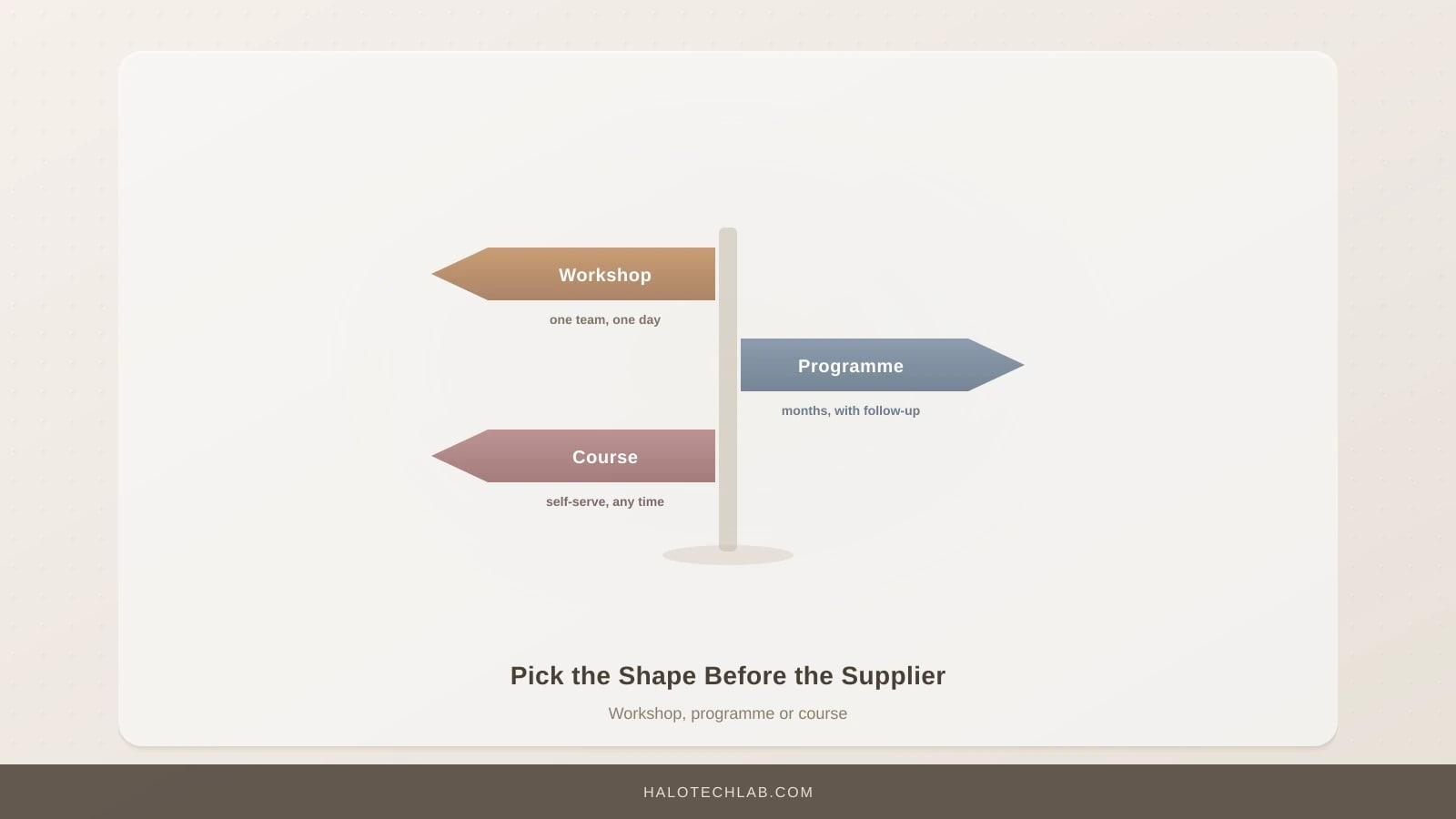
Three shapes of AI training exist, they cost very different amounts, and they solve genuinely different problems. Picking the wrong one is the most common reason a training budget produces nothing, and it usually happens because a supplier only sells one of them.
This article is part of our guide to AI training for UK businesses.
The three shapes
| Workshop | Programme | Course | |
|---|---|---|---|
| What it is | A fixed session, usually half a day | Ongoing sessions plus access between them | Self-serve material, worked through alone |
| Typical UK cost | £1,200 to £3,500 per session | £800 to £3,000 a month | £4,000 to £20,000 to build bespoke |
| Best for | Getting a group to a shared baseline | Genuine adoption over months | Induction and fundamentals |
| Weakest at | Anything arising after the day | Cost, if adoption is shallow | Anything specific to your business |
| Time to value | Immediate | Six to twelve weeks | Immediate once built |
| Scales to new starters | No | No | Yes |
When a workshop is right
A workshop is the correct answer more often than the other two, and it is what most businesses should start with.
It suits you when you need a group of people to reach the same understanding at the same time, when there is a decision to communicate alongside the teaching, or when you want a leadership team to grasp something in one sitting. It is also the only format where the room can argue with you, which matters more than it sounds. Sceptics ask the questions everyone else is thinking, and a session that survives that is considerably more convincing than one where everyone nods.
The failure mode is that a workshop ends. The questions that matter arrive three or four weeks later when someone tries something real. A workshop with no follow-up produces a usage spike and then a decline, which is covered in why most AI training fails.
The fix is cheap. Book a one-hour follow-up at the time of booking the workshop. Agenda set entirely by what people have hit. It costs a fraction of the main session and it is where most of the actual learning happens.
When a programme is right
A programme is a workshop plus the thing a workshop is missing: somebody available when the real questions arrive.
It suits you when AI is genuinely being adopted rather than sampled, when several people are building things that could go wrong, when you are in a regulated context and want a documented trail, or when the business has a history of training that did not stick and you want the accountability of a recurring session.
The failure mode is paying monthly for a capability nobody is using. If two people ask a question a fortnight, you are paying consultancy rates for reassurance.
The test: before committing, run a workshop and count the questions in the following month. Fifteen or more and a programme will pay for itself. Three and it will not.
When a course is right
A course is the only format that works for people who are not in the room, which in practice means everyone who joins after the training happened.
It suits you when you have consistent induction needs, when staff are spread across sites or shifts, when you need the same baseline demonstrable for every new starter, or when you have turnover that makes repeated live sessions uneconomic.
The failure mode is that a course teaches general principles well and your business not at all. Nobody learns your approved tools, your restricted list or your sign-off rules from an off-the-shelf module.
The fix: use a course for the parts that do not change and add a short local section for the parts that do. Building bespoke material is much cheaper than it used to be, covered in how small businesses can quickly build e-learning courses with AI and in choosing an LMS for a small business.
What most businesses should actually do
For thirty to three hundred people, the combination that works:
Start with a workshop for everyone, plus a separate one for leadership, plus a booked follow-up. Roughly £4,000 to £8,000.
Add a course for the fundamentals and induction, once you know what the recurring questions are, because those questions are the syllabus. Roughly £4,000 to £12,000 to build.
Add a programme only if the question volume justifies it, and only for the people doing the real building.
That order matters. Businesses that start with a course get consistency and no adoption. Businesses that start with a programme pay for support before anyone knows what to ask.
The question to ask a supplier
Ask which of the three they would recommend if the other two were free.
A supplier who only sells programmes will find a reason you need a programme. One who will tell you that a workshop and a follow-up is enough, and that they will not be needed afterwards, is worth considerably more than the difference in fee.
Key Takeaways
- Workshops build a shared baseline fast and are where most businesses should start. Their weakness is that they end.
- Programmes are worth it when the question volume is real. Test with a workshop and count questions for a month before committing.
- Courses are the only format that covers people who join later. Their weakness is that they teach general principles and not your business.
- The usual right answer is a workshop plus booked follow-up, then a course for induction, then a programme only if justified.
- Ask a supplier which format they would recommend if the others were free. The answer tells you a lot.
Frequently Asked Questions
Can we just buy an online course and be done?
For the fundamentals, partly. For anything about your approved tools, your restricted data list and your sign-off rules, no, because the course does not know them. If you are relying on training to satisfy the EU AI Act's Article 4 literacy duty, a generic course alone is a weak position, as covered in Article 4.
How long should a workshop be?
Two hours for all staff on fundamentals. Half a day for people who will use AI daily, with hands-on time on their own tasks. Two to three hours for leadership. Full-day all-staff sessions rarely justify the lost productivity.
What does a programme actually include?
It varies more than it should, which is why you should ask. A reasonable one: an initial session, a recurring shorter session monthly or fortnightly, a named person reachable between sessions, and a short written record of what was covered. If a supplier cannot describe the between-sessions part concretely, the programme is a workshop with instalments.
Not sure which of the three your business needs? Talk to Halo Technology Lab. Our support and training service covers all three, and we will tell you if a single workshop is enough.
Enjoyed this? Get the next one by email
Practical AI playbooks, build logs and tool teardowns. One email a week, free, unsubscribe in one click.
Related Articles
How to Measure Whether AI Training Actually Worked
Attendance and satisfaction scores tell you nothing. Four measures that do, how to capture a baseline before you start, and what a realistic return looks like.
Training a Team That Thinks AI Is Coming for Their Job
Resistance is usually a reasonable response to a badly handled rollout. How to run AI training when people are worried, and why pretending nothing will change makes it worse.
AI Literacy for Non-Technical Leaders: Ten Things You Actually Need to Understand
You do not need to know how a model works. You do need to know why it makes things up, what it does with your data, and when to distrust it. The ten concepts that matter.