Why Most AI Training Fails (And What to Do Instead)
Everyone attends, everyone nods, nothing changes. Six reasons AI training does not stick in smaller businesses, and what to do differently without spending more.
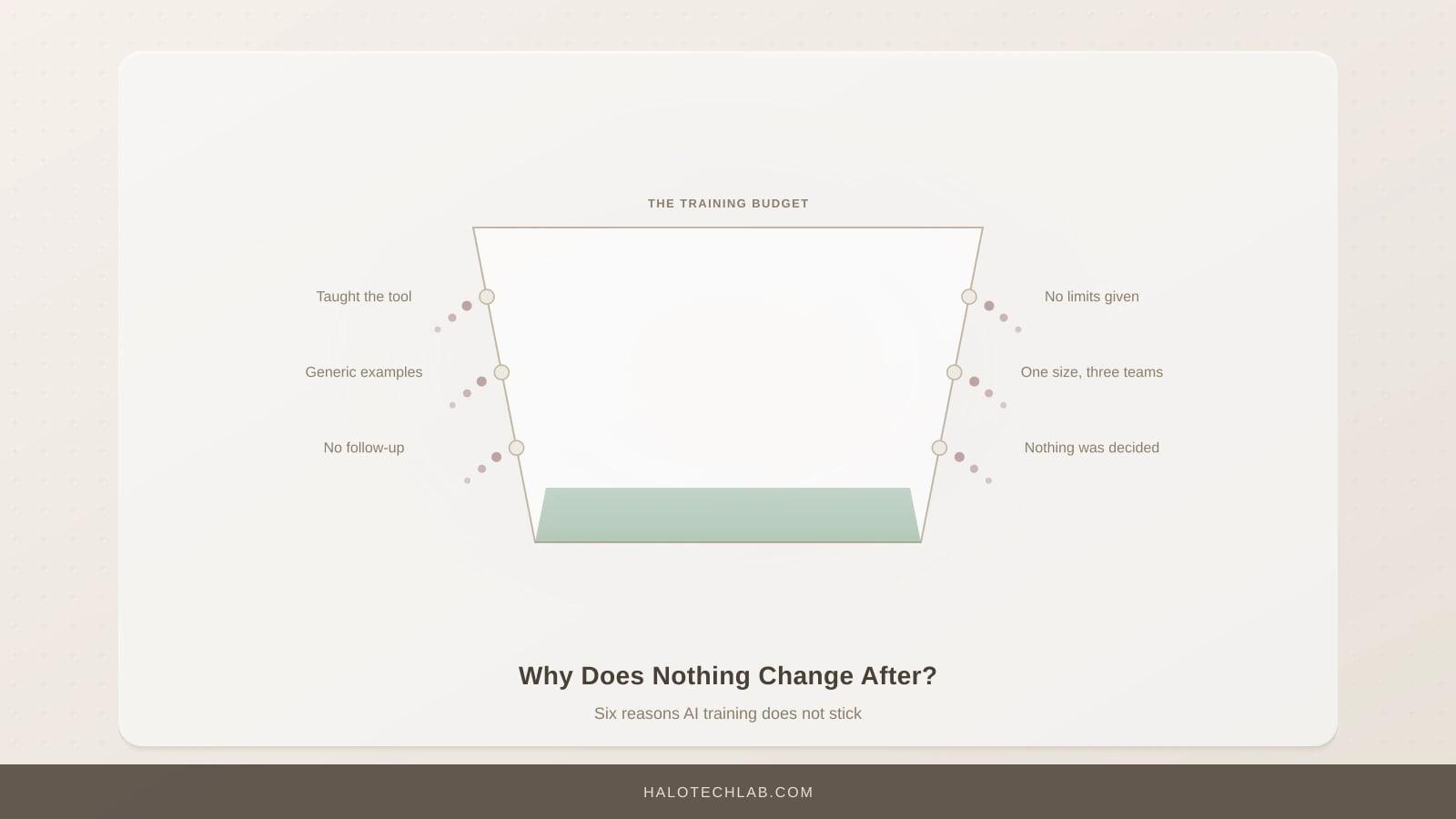
Everyone attended. The feedback scores were good. Three months later, two people use the tools properly, everyone else has gone back to how they worked before, and the person who authorised the spend has quietly concluded that AI is overhyped.
This is the most common outcome of AI training in UK businesses, and it is worth being precise about why, because the causes are consistent and most of them are fixable for no extra money.
This article is part of our guide to AI training for UK businesses.
Reason 1: it taught the tool
A session built around a specific product teaches people where the buttons are. Buttons move. Within a few months the interface has changed, a better tool exists, and the training has expired.
Worse, tool training gives people a procedure rather than a judgement. They can do the thing they were shown and nothing adjacent to it, because they never learned why any of it works.
Instead: teach the two ideas that do not expire. These systems predict plausible continuations rather than looking things up, which is why they are fluent and sometimes wrong. And whatever you type goes somewhere, governed by terms that differ by tool and tier. Those two ideas transfer to every product that will exist in five years.
Reason 2: the examples were not from your business
Generic examples produce generic understanding. A session demonstrating how to summarise a fictional meeting is interesting. A session summarising a real transcript from your own last management meeting is useful, and people remember it.
This is also where trust is won or lost. Show a real task from your business and the room engages. Show a stock example and half of them conclude, correctly, that the trainer does not know what they do all day.
Instead: collect three or four real tasks before the session. Anonymise where necessary. Work them live, including the parts where the output needs fixing.
Reason 3: nobody was told where it does not work
Training that presents AI as universally capable fails on first contact with a task it cannot do. The person concludes the tools are useless, or worse, that they personally are doing it wrong.
Instead: spend a deliberate portion of every session on the tasks where these tools are poor and the honest answer is not to use them. Arithmetic across a long document. Anything requiring knowledge of your specific business that has not been supplied. Anything where being 90 per cent right is worse than not doing it.
Counterintuitively this is what makes people trust the rest of the session. A trainer who tells you what a thing is bad at is a trainer worth believing about what it is good at.
Reason 4: there was no follow-up
The questions that matter do not arrive on the day. They arrive in week four, when someone tries something real and it half works.
If there is nowhere to take that question, one of two things happens. The person works around it badly, or they stop. Both look identical in a usage report: a spike, then a decline.
Instead: book the follow-up session before the first one happens. Three to four weeks later, an hour, agenda set entirely by what people have hit. It costs a fraction of the original session and it is where most of the actual learning occurs.
Reason 5: one session for three audiences
A room containing the finance director, a daily user and someone who will never touch it needs three different sessions. Run as one, it is too shallow for the first, too slow for the second and irrelevant to the third.
Instead: split. Everyone gets the fundamentals. Daily users get depth and hands-on time. Leaders get a separate session about decisions, liability and supplier questions, covered in AI literacy for non-technical leaders.
Reason 6: nothing had been decided
Training people to use AI before deciding which tools are approved, what may be put into them and who is accountable produces enthusiasm with nowhere legitimate to go.
What happens next is predictable. People use whatever they already had, on their own accounts, because nobody told them not to. That is shadow AI, and the training accelerated it.
Instead: decide first. A one-page AI use policy and a short list of approved tools takes an afternoon and makes the training actionable.
Reason 7: the resistance was managed rather than addressed
If part of the room believes this is about reducing headcount, the session is not really about AI and pretending otherwise wastes everyone's time.
Instead: address it directly, early, with a specific and honest answer about what is and is not changing. If jobs are changing, say so. People handle difficult information considerably better than they handle evasion, and they detect evasion reliably. See training a team that thinks AI is coming for their job.
What good looks like
A business of fifty people, done properly:
- One page agreed beforehand on approved tools and rules
- A two-hour all-staff session covering how these systems fail and what happens to what you type, with real examples from the business
- A half-day for the twelve people who will use it daily, on their own tasks
- A follow-up hour for those twelve, four weeks later
- A separate two-hour leadership session
- A named person who takes questions afterwards
Roughly £5,000 to £11,000 all in. The parts that cost nothing, deciding first, using real examples, booking the follow-up, and being honest about jobs, are the parts that determine whether the rest was worth paying for.
Key Takeaways
- Tool training expires with the tool. Teach why these systems fail and what happens to your data, because neither changes.
- Use real tasks from your own business. Stock examples tell the room the trainer does not know what they do.
- Spend deliberate time on what AI is bad at. It is what earns trust for the rest.
- Book the follow-up before the first session. The questions that matter arrive in week four.
- Decide your approved tools and rules first. Training without decisions accelerates shadow AI rather than reducing it.
Frequently Asked Questions
How much follow-up is enough?
For most businesses, one session three to four weeks after the initial training, then a named person available for questions. Heavier adoption warrants a light ongoing programme instead, which is compared against the alternatives in workshop, programme or course.
Our last training was fine but nothing changed. Was it wasted?
Partly, and it is usually recoverable more cheaply than repeating it. Run a short follow-up session driven entirely by what people have tried since, and make sure the tool and policy decisions have actually been made. The gap is frequently decision-making rather than knowledge.
Should we train people who say they will not use AI?
On the fundamentals, yes. They will encounter AI output produced by colleagues, customers and suppliers, and they need to know how to treat it. Whether they personally use a tool is a separate question from whether they understand what is arriving in their inbox.
Had AI training that did not stick? Talk to Halo Technology Lab. Our support and training service is built around your tasks, your rules and a follow-up session that is booked before we start.
Enjoyed this? Get the next one by email
Practical AI playbooks, build logs and tool teardowns. One email a week, free, unsubscribe in one click.
Related Articles
How to Measure Whether AI Training Actually Worked
Attendance and satisfaction scores tell you nothing. Four measures that do, how to capture a baseline before you start, and what a realistic return looks like.
Training a Team That Thinks AI Is Coming for Their Job
Resistance is usually a reasonable response to a badly handled rollout. How to run AI training when people are worried, and why pretending nothing will change makes it worse.
Workshop, Programme or Course? Choosing the Right Shape of AI Training
A half-day workshop, an ongoing programme and a self-serve course solve different problems. What each is good at, what each costs, and how to tell which one your team needs.