What a Legacy System Actually Costs You Every Year
Old systems rarely show up as a line on the P&L, which is why they survive. Here is how to put a number on what yours costs in staff time, lost work, risk and the things you cannot do.
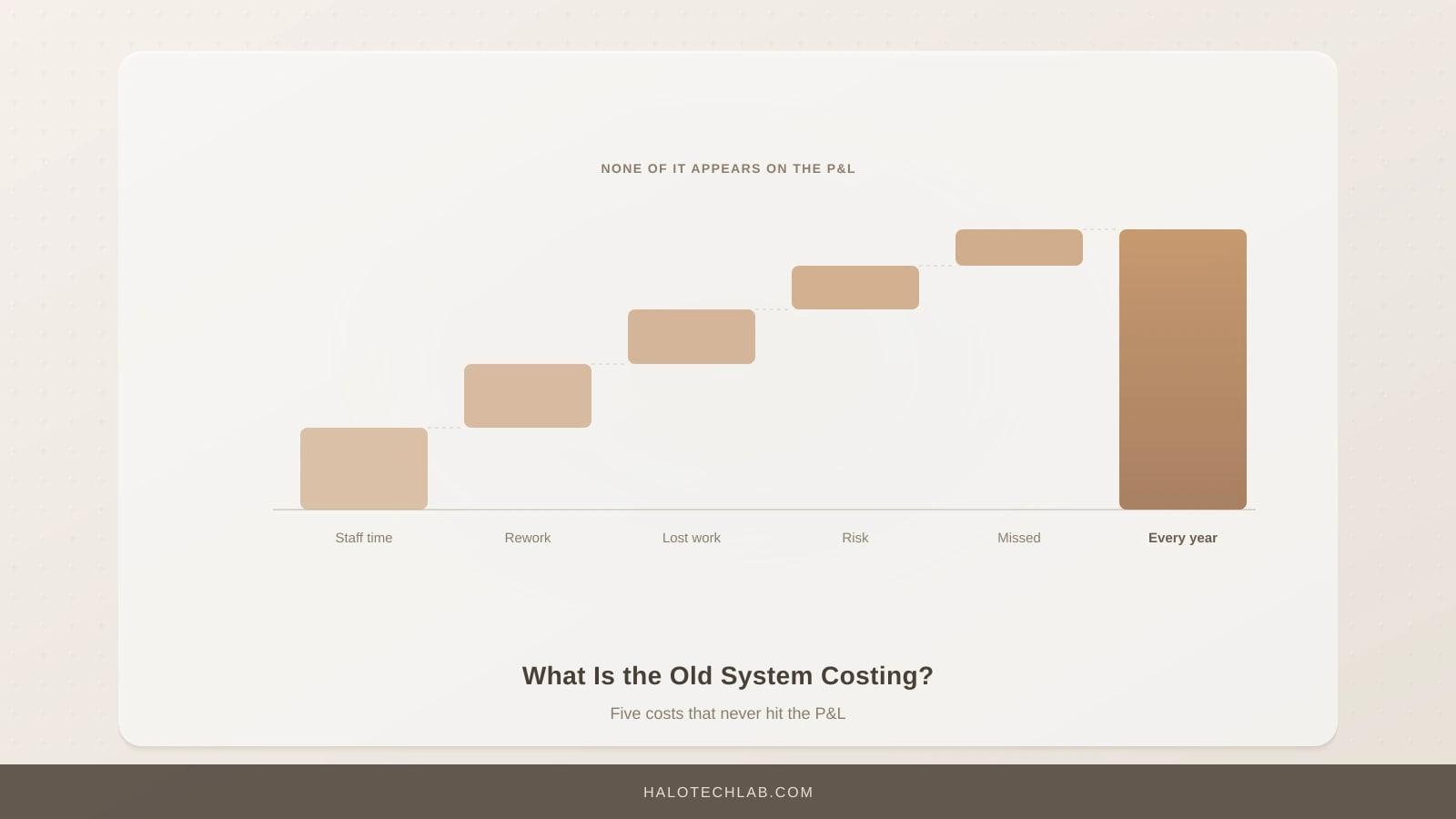
There is a reason old systems survive budget reviews that kill much cheaper things. A £40 monthly subscription appears on a statement where a finance director can see it. Eleven hours a week of someone rekeying data does not appear anywhere at all.
This article is about turning the second kind of cost into the first kind, so you can make the decision on numbers rather than instinct. Everything here is arithmetic you can do yourself in an afternoon with information you already have.
This article is part of our guide to modernising a legacy business.
The five costs, in order of size
In our experience the costs land in a consistent order, and it is not the order most owners expect. Licence and hosting costs, the ones people worry about, come last.
1. Rekeying and reconciliation
The largest cost in almost every case, and the easiest to measure.
Count the places where the same fact is entered more than once. For each, estimate minutes per occurrence and occurrences per week. Multiply by the fully loaded hourly cost of whoever does it, which for UK employees is roughly 1.3 to 1.5 times salary.
Worked example. A distribution business with eleven staff takes around 60 orders a week by email and phone. Each order is entered into a spreadsheet (3 minutes), then into the accounts package (4 minutes), then onto a picking list (2 minutes). That is 9 minutes per order, of which 6 is duplication.
60 orders x 6 minutes = 6 hours a week. At £22 an hour fully loaded, that is £132 a week, or £6,864 a year, to type things that were already typed.
2. Errors and the work they cause
Duplication produces errors at a fairly predictable rate. Somewhere between one and three per cent of manually retyped records contain a mistake, and the cost is rarely the mistake itself. It is the phone call, the credit note, the apology, and the hour someone spends working out what happened.
Same example. At 2 per cent, 60 orders a week produces roughly 62 wrong orders a year. If each costs an hour of someone's time to unpick plus an average £40 in goodwill, carriage or write-off, that is £22 + £40 = £62 each, or £3,844 a year.
3. Questions you cannot answer quickly
This one is real and owners consistently underestimate it. Pick the five questions you or your managers ask most often. Time how long each currently takes to answer properly.
If a manager spends two hours a week assembling numbers that a working system would produce instantly, at £35 an hour fully loaded that is £3,640 a year, before counting the decisions delayed while waiting.
4. Key-person risk
Harder to price, and the one that actually keeps owners awake.
A workable approach: estimate how many weeks the business would run at reduced effectiveness if the person who understands the system left tomorrow, then price those weeks at a realistic percentage of the gross profit they influence.
If a sales administrator's departure would cause six weeks at roughly 15 per cent reduced throughput, and the business does £30,000 of gross profit a month, that is 1.5 months x £30,000 x 15 per cent = £6,750 as a one-off exposure. It is not an annual cost. It is a liability sitting on the business that most balance sheets never show.
5. Licences, hosting and support
The visible cost, and usually the smallest. Old software is frequently cheaper than its replacement. This is precisely why the visible number misleads: replacing a £600-a-year package with a £2,400-a-year one looks like a £1,800 loss unless the four costs above are on the same page.
Putting it together
For the distribution business in the example:
| Cost | Annual |
|---|---|
| Rekeying | £6,864 |
| Errors and rework | £3,844 |
| Slow answers | £3,640 |
| Licences and support | £600 |
| Annual total | £14,948 |
| Key-person exposure | £6,750 (one-off) |
Against that, connecting the order intake to the accounts package and generating picking lists automatically would cost somewhere between £6,000 and £11,000 to build, plus around £1,200 a year to run and maintain.
Even at the top of that range, and even assuming it only removes 70 per cent of the duplication rather than all of it, the payback lands inside the first year. The method for this calculation is set out in how to calculate the ROI of automating a business process.
Three costs that are usually overstated
We would rather be even-handed about this, because the case does not need exaggerating.
"Lost sales." Frequently claimed, rarely evidenced. Unless you can point to specific enquiries lost for a specific reason, leave it out. A business case that rests on assumed revenue is the first thing a sceptical finance director attacks, and they are right to.
Security and compliance fines. Real, but usually small in expected-value terms for a business of this size. Worth fixing because it is cheap and the downside is fat-tailed, as AI security risks for small businesses explores, not because the expected cost is large.
Staff morale. Genuine, and it belongs in the case as judgement rather than arithmetic. Putting a fabricated number on it damages the credibility of the real numbers sitting above it.
The one number worth having
If you do nothing else, calculate the rekeying figure. It takes twenty minutes, it is almost impossible to argue with, and in most established businesses it is between £4,000 and £25,000 a year.
It is also the number that reframes the conversation. The question stops being "can we afford to change this" and becomes "we are already paying for the change every year, we are just not getting anything for it".
Key Takeaways
- Legacy systems cost hours rather than invoices, which is why they survive budget reviews that kill cheaper things.
- Rekeying is nearly always the largest cost and the easiest to measure. Count duplicated entries, multiply by fully loaded hourly cost.
- Use 1.3 to 1.5 times salary for UK fully loaded staff cost. Base salary understates it by around a third.
- Key-person risk is an exposure rather than an annual cost. Price it separately and do not bury it in the running total.
- Leave out lost sales unless you can evidence them. An inflated case is easier to dismiss than a modest one.
Frequently Asked Questions
Our staff say the current system is fine. Does that contradict these numbers?
Not really. People are good at absorbing friction and poor at noticing it, particularly when they have been doing something the same way for years. The test is not whether it feels fine, it is what the stopwatch says. Time one person doing the process for one week and compare it with their own estimate. The gap is usually large.
What if the replacement introduces new costs?
It will. Budget 10 to 20 per cent of build cost annually for maintenance, plus training time in the first quarter and a temporary dip in productivity while people adjust. Any case that shows no new costs has been written by someone selling something.
Is it worth doing this calculation if we have already decided to change?
Yes, for two reasons. It tells you which process to change first, which is the decision that matters most, and 7 business processes every SME should automate first is a reasonable starting list. And it gives you a baseline, so that in twelve months you can tell whether the money did what it was supposed to.
Want a second opinion on what your current setup is really costing? Talk to Halo Technology Lab. Our strategy and scoping service produces this calculation for your business, including the processes we think you should leave alone.
Enjoyed this? Get the next one by email
Practical AI playbooks, build logs and tool teardowns. One email a week, free, unsubscribe in one click.
Related Articles
Technology and Succession: Handing Over a Business That Runs on One Person's Head
Only 30% of family businesses survive the move to a second generation. Much of what is lost is knowledge nobody wrote down. How to get it out of one head before the handover.
Running Your Business on Spreadsheets: When It Is Fine, and When It Becomes a Risk
Spreadsheets are underrated, right up until they are dangerous. Seven signals that yours has quietly become critical infrastructure, and what to do about it without a rebuild.
Rip and Replace vs Modernise Around the Edges
Two ways to fix an ageing system, and they suit very different businesses. How to tell which one you need, what each really costs, and why the bigger option is usually sold harder.