Content Marketing Calendar for SMEs: What to Post and When
A practical content calendar framework for small businesses — what to publish, how often, and on which channels.
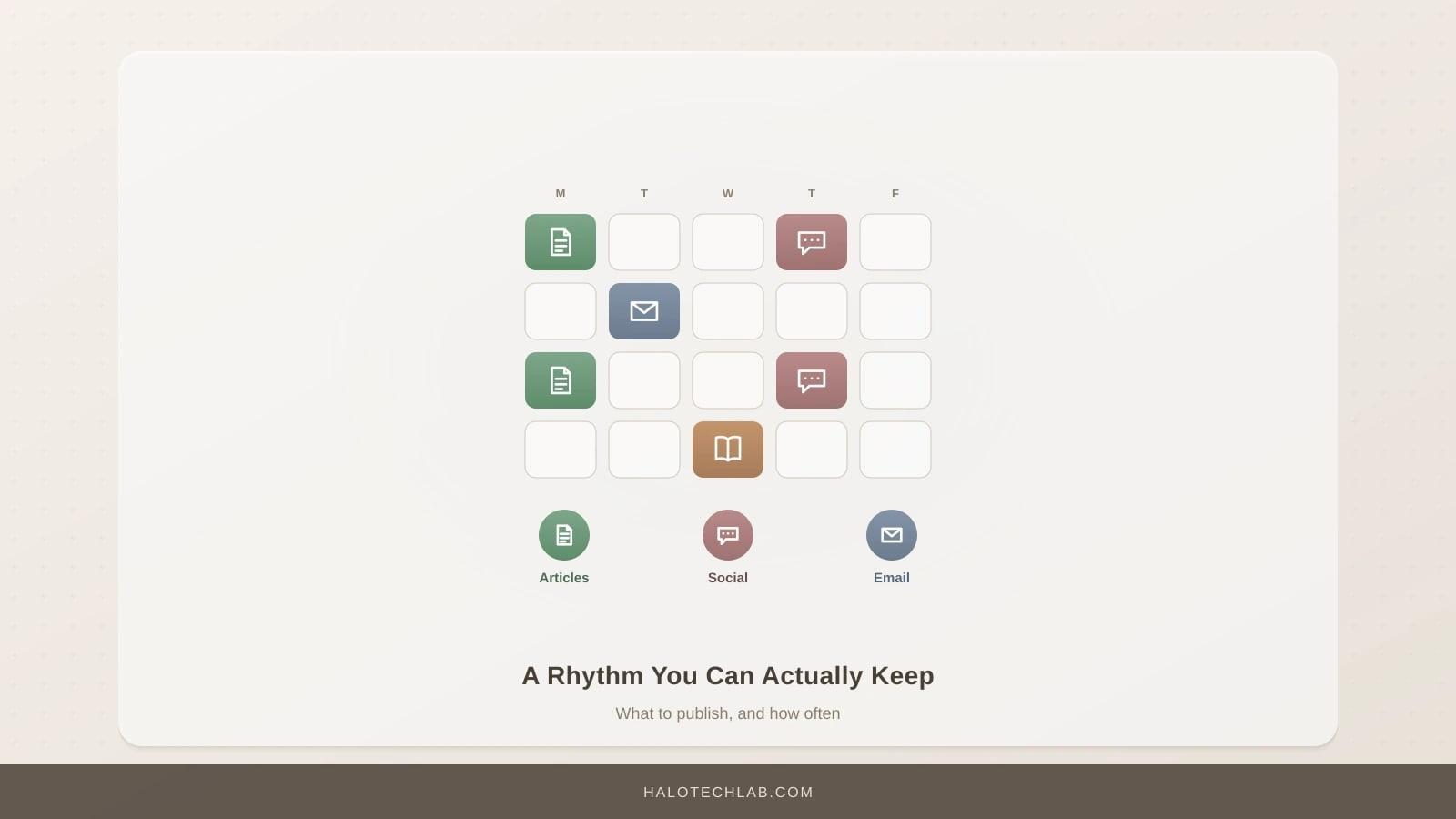
You know you should be posting content regularly. Every marketing article says so. But when you sit down on a Monday morning with a blank screen and a business to run, "create valuable content" feels about as helpful as "just be more productive."
The problem is not a lack of ideas. It is a lack of structure. A content marketing calendar transforms content from an ad-hoc chore into a manageable, repeatable system. And for UK SMEs competing for visibility in both Google and AI search, consistent content is no longer optional.
This article is part of our comprehensive guide to SEO, GEO, and AI search for UK small businesses.
The Ideal Monthly Content Cadence
Let us be realistic. You are running a business, not a media company. The cadence below is designed for a small team (or even a solo founder) to maintain without burning out.
Blog Posts: 2-4 Per Month
This is the backbone of your content strategy. Blog posts drive organic search traffic, build topical authority, and give both Google and AI search tools reasons to surface your website.
Week 1: A how-to guide or tutorial related to your core service. Example: "How to Choose the Right CRM for a Small Team."
Week 2: A thought leadership or industry commentary piece. Example: "Why UK SMEs Are Struggling with Digital Transformation in 2026."
Week 3: A case study or success story. Example: "How We Helped a London Accountancy Firm Automate 20 Hours of Weekly Admin."
Week 4: An FAQ or comparison piece. Example: "WordPress vs Custom Development: Which Is Right for Your Business?"
You do not need to follow this exact pattern every month. The key is variety. Different content types attract different types of searchers and perform differently in AI search results.
Social Media: 3-5 Posts Per Week
Social media does not directly improve your SEO, but it drives awareness, builds authority, and creates signals that AI search tools increasingly consider.
Monday: Share your latest blog post with a key takeaway.
Wednesday: A quick tip, industry observation, or behind-the-scenes look at your business.
Friday: Engage with your community. Share someone else's content with your perspective, respond to industry news, or ask a question.
Adjust the frequency based on your capacity, but consistency beats volume every time. Three posts per week, every week, outperforms a burst of ten posts followed by two weeks of silence.
For practical advice on automating the repetitive parts of social media, read our social media automation guide.
Email Newsletter: 1-2 Per Month
Email remains one of the highest-ROI marketing channels, particularly for B2B service businesses. A monthly or fortnightly newsletter keeps your business top of mind with existing contacts.
Keep it short. A brief introduction, links to your recent blog posts, one useful tip or resource, and a soft call to action. Five minutes to read, maximum.
Case Studies: 1 Per Month
Case studies are the most underrated content type for SMEs. They provide social proof, demonstrate expertise, and are exactly the kind of specific, factual content that AI search tools favour.
You do not need the client's permission to share every detail. Even an anonymised case study ("A London-based recruitment agency reduced their admin time by 60%") is valuable.
Content Types That Work for SMEs
Not all content is created equal. Here are the types that consistently perform well for UK small businesses.
How-To Guides
Step-by-step content that solves a specific problem. These are the workhorses of SEO content. They attract search traffic from people actively looking for answers, and they are frequently cited by AI tools.
Example: "How to Set Up Google Analytics for Your Small Business Website."
Comparison and "Versus" Posts
People searching for comparisons are usually close to making a decision. "Shopify vs WooCommerce for UK Businesses" or "Hiring a Developer vs Using a No-Code Tool" attract high-intent traffic.
These also perform well in AI search because they provide the structured, factual comparisons that AI tools love to summarise.
FAQ Content
Every question a client has ever asked you is a potential piece of content. Compile them into dedicated FAQ pages or individual blog posts. Use the actual question as your heading (H2 or H3) because this is exactly how people search, both on Google and in AI tools.
Case Studies and Success Stories
As mentioned above, case studies combine social proof with specific, detailed content. Structure them as: Challenge, Solution, Results. Include numbers wherever possible (percentages, time saved, revenue impact).
Industry Commentary
Sharing your perspective on industry trends, news, or changes positions you as a thought leader. This type of content attracts backlinks and social shares, both of which strengthen your overall search visibility.
How to Repurpose Content Across Channels
The secret to maintaining a consistent content calendar without exhausting yourself is repurposing. One piece of content should serve you in multiple places.
A blog post becomes:
- A LinkedIn post summarising the key points
- A series of social media tips (one per key takeaway)
- A section of your monthly email newsletter
- An answer to a question on your FAQ page
- A script for a short video or podcast episode
A case study becomes:
- A blog post with more detail
- A testimonial quote for your homepage
- A social media success story
- A slide in your sales deck
- A data point in a broader industry article
A webinar or presentation becomes:
- A blog post summarising the content
- A downloadable PDF guide
- Multiple social media posts with individual slides
- An email series covering each topic
The mindset shift is simple: never create content for just one channel. Every piece should work at least three ways.
Tools to Stay Organised
You do not need expensive software to manage a content calendar. Here are three tiers based on budget.
Free: Google Sheets or Notion
A shared spreadsheet with columns for date, content type, topic, status, and channel is all most small teams need. Notion offers a more visual approach with its database and calendar views, and the free tier is generous.
Affordable: Trello or Asana (Free Tiers)
For teams of two or more, a project management tool adds accountability. Create a board with columns for Ideas, In Progress, Review, and Published. Each card represents a piece of content.
Comprehensive: Buffer, CoSchedule, or Hootsuite
If you want scheduling, analytics, and calendar management in one place, these tools combine content planning with social media scheduling. Buffer starts free for up to three channels. CoSchedule offers a dedicated marketing calendar from around £20 per month.
A Sample Quarterly Content Plan
Here is a practical example for a UK web development agency. Adapt it to your industry.
Month 1: Foundation
- Blog 1: "5 Signs Your Website Needs a Redesign" (how-to)
- Blog 2: "What to Expect When Working with a Web Development Agency" (FAQ)
- Blog 3: Case study from a recent project
- Newsletter: Introduce the content series, link to blogs
- Social: Share each blog, plus 2 tips per week
Month 2: Authority
- Blog 1: "React vs WordPress: When to Upgrade" (comparison)
- Blog 2: Industry commentary on a current trend
- Blog 3: "How to Write a Website Brief" (how-to)
- Newsletter: Key insights from the month's content
- Social: Share each blog, repurpose case study as a success thread
Month 3: Conversion
- Blog 1: "How Much Does a Custom Website Cost in the UK?" (FAQ)
- Blog 2: Another case study, different industry
- Blog 3: "The ROI of Investing in a Professional Website" (data-driven)
- Newsletter: Quarterly roundup with a clear CTA
- Social: Share blogs, promote newsletter signup
Staying Consistent: The Real Challenge
The biggest risk with content marketing is not starting. It is stopping. Most businesses begin enthusiastically, publish for six to eight weeks, then trail off when results are not immediately visible.
Content marketing compounds. Your first blog post will not rank on page one. Your tenth might. Your thirtieth almost certainly will if you are targeting the right keywords and building backlinks.
Three strategies to stay consistent:
Batch your content creation. Dedicate one day per month to writing (or briefing) all your content for the next four weeks. It is far more efficient than trying to create ad hoc.
Lower the quality bar for first drafts. A published 7/10 article is infinitely more valuable than a perfect article that never gets written. You can always update and improve later.
Repurpose relentlessly. As outlined above, one piece of content should serve you in at least three places. This multiplies your output without multiplying your effort.
Key Takeaways
- A realistic content cadence for SMEs is 2-4 blog posts, 3-5 social media posts per week, 1-2 newsletters, and 1 case study per month.
- The most effective content types are how-to guides, comparisons, FAQ content, case studies, and industry commentary.
- Repurpose every piece of content across at least three channels to maximise your return on effort.
- Use free tools (Google Sheets, Notion, Trello) to plan and track your content calendar.
- Consistency matters more than volume. Publishing regularly over 12 months beats a burst of activity followed by silence.
- Batch content creation to make the process efficient and sustainable.
Frequently Asked Questions
How many blog posts per month do I really need?
Two is the minimum to see meaningful SEO results over time. Four is ideal if you can sustain it. The key is consistency rather than volume. Publishing two posts per month for a year (24 posts) will generate far more search traffic than publishing eight posts in one month and then nothing for the rest of the year.
What if I do not have time to write blog posts?
You have three options. First, dictate your ideas and have someone else write them up. Most business owners can talk about their expertise more easily than they can write about it. Second, hire a freelance content writer who specialises in your industry. Budget around £100-300 per post for quality UK freelance writing. Third, repurpose content you are already creating, such as client emails, proposals, or presentation slides, into blog format.
How do I come up with content ideas?
Start with the questions your clients ask you most often. Each question is a potential blog post or FAQ entry. Then check Google's "People Also Ask" boxes for your key search terms. Use tools like AnswerThePublic (free tier available) to discover what people are searching for in your niche. Finally, look at what your competitors are publishing and identify gaps you can fill.
If you need help building a content strategy that drives real search visibility for your business, get in touch with Halo Technology Lab. We help UK SMEs plan and execute content that performs in both traditional SEO and the new AI search landscape.
Enjoyed this? Get the next one by email
Practical AI playbooks, build logs and tool teardowns. One email a week, free, unsubscribe in one click.
Related Articles
Measuring Your Website's SEO Performance: Metrics That Actually Matter
Forget vanity metrics. These are the SEO numbers that actually indicate whether your strategy is working.
How to Get Backlinks for Your Small Business Website (Ethically)
Practical, ethical strategies for building backlinks that improve your search rankings without risking penalties.
How Google SGE Changes SEO for Small Businesses
Google's AI-powered search results are reshaping SEO. Here's what it means for your small business website.