Getting Found Online in 2026: SEO, GEO, and AI Search for UK Small Businesses
The landscape of search has changed. Here's how to get found by Google, ChatGPT, and AI assistants in 2026.
Have you noticed that when you search for something on Google lately, the results look completely different from a year ago? You are not imagining it. The way people find businesses online is undergoing its biggest transformation in over a decade.
If you run a small business in the UK, this is not a distant tech trend. It is happening right now, and it directly affects whether potential customers find you or your competitors.
This guide is your complete roadmap. We will cover traditional SEO, the new world of Generative Engine Optimisation (GEO), and practical steps you can take today, no matter your budget or technical skill level.
Traditional SEO Is Not Dead, But It Is Evolving
Let us start with the good news: everything you have done for SEO over the past few years still matters. Having a well-structured website, quality content, fast load speeds, and a solid backlink profile are all still essential foundations.
Google still processes over 8.5 billion searches per day. The UK alone accounts for hundreds of millions of those. People are still typing queries into search engines, and traditional organic results still appear on every results page.
What has changed is the landscape around those results. Google now places AI-generated summaries at the top of many searches. New AI search tools like ChatGPT, Perplexity, and Microsoft Copilot are pulling traffic away from traditional search. The goalposts have moved, even if the pitch is the same.
What Still Works in Traditional SEO
The fundamentals remain non-negotiable. Your website needs to be technically sound: fast loading times (under three seconds), mobile-friendly design, clean URL structures, and proper use of heading tags.
Keyword research is still valuable. Understanding what your potential customers actually search for, and creating content that answers those questions thoroughly, is the bedrock of discoverability. Tools like Google Search Console (free), Ahrefs, and SEMrush can show you exactly which terms are driving traffic to your site and where the opportunities lie.
Quality content still wins. Google's Helpful Content system rewards pages that are genuinely useful to real people, not pages stuffed with keywords to game the algorithm. If you write for your audience first and search engines second, you are already ahead of most competitors.
What Has Changed
The biggest shift is the rise of zero-click searches. According to research from SparkToro, over 60% of Google searches in 2025 ended without the user clicking through to any website. Google's featured snippets, knowledge panels, and now AI Overviews answer the question directly on the results page.
For UK small businesses, this means that ranking on page one is no longer enough. You need to think about how your content appears in those summary formats, not just in the traditional blue links.
What Is GEO (Generative Engine Optimisation)?
GEO is the practice of optimising your content so it gets cited, referenced, or recommended by AI-powered search engines and large language models.
Think of it this way: traditional SEO helps you rank in Google's list of links. GEO helps you get mentioned in an AI's answer.
When someone asks ChatGPT, "What is the best web development agency for small businesses in London?", the answer is generated by an AI pulling from various sources. GEO is the set of strategies that make your business more likely to be one of those sources.
This is not science fiction. It is happening millions of times per day, right now. And it is particularly important for UK service businesses, because AI search tools are increasingly being used for local recommendations and business comparisons.
How AI Search Engines Find Information
AI search tools work differently from traditional search engines. Google crawls the web, indexes pages, and ranks them based on hundreds of signals. AI models like GPT-4 and Claude are trained on vast datasets and can also access real-time web information through plugins and integrations.
When an AI generates a response, it synthesises information from multiple sources. The sources it tends to favour share certain characteristics:
- Authoritative and well-cited content. Pages that reference data, studies, and credible sources are more likely to be surfaced.
- Clear, well-structured writing. AI models parse content more effectively when it uses clear headings, short paragraphs, and logical organisation.
- Structured data. Schema markup helps both Google and AI tools understand what your content is about.
- Freshness. Up-to-date content with recent dates and current statistics is favoured over outdated material.
- Topical authority. Websites that cover a subject comprehensively across multiple pages (like this cluster of articles) signal expertise.
GEO vs SEO: What Is Different?
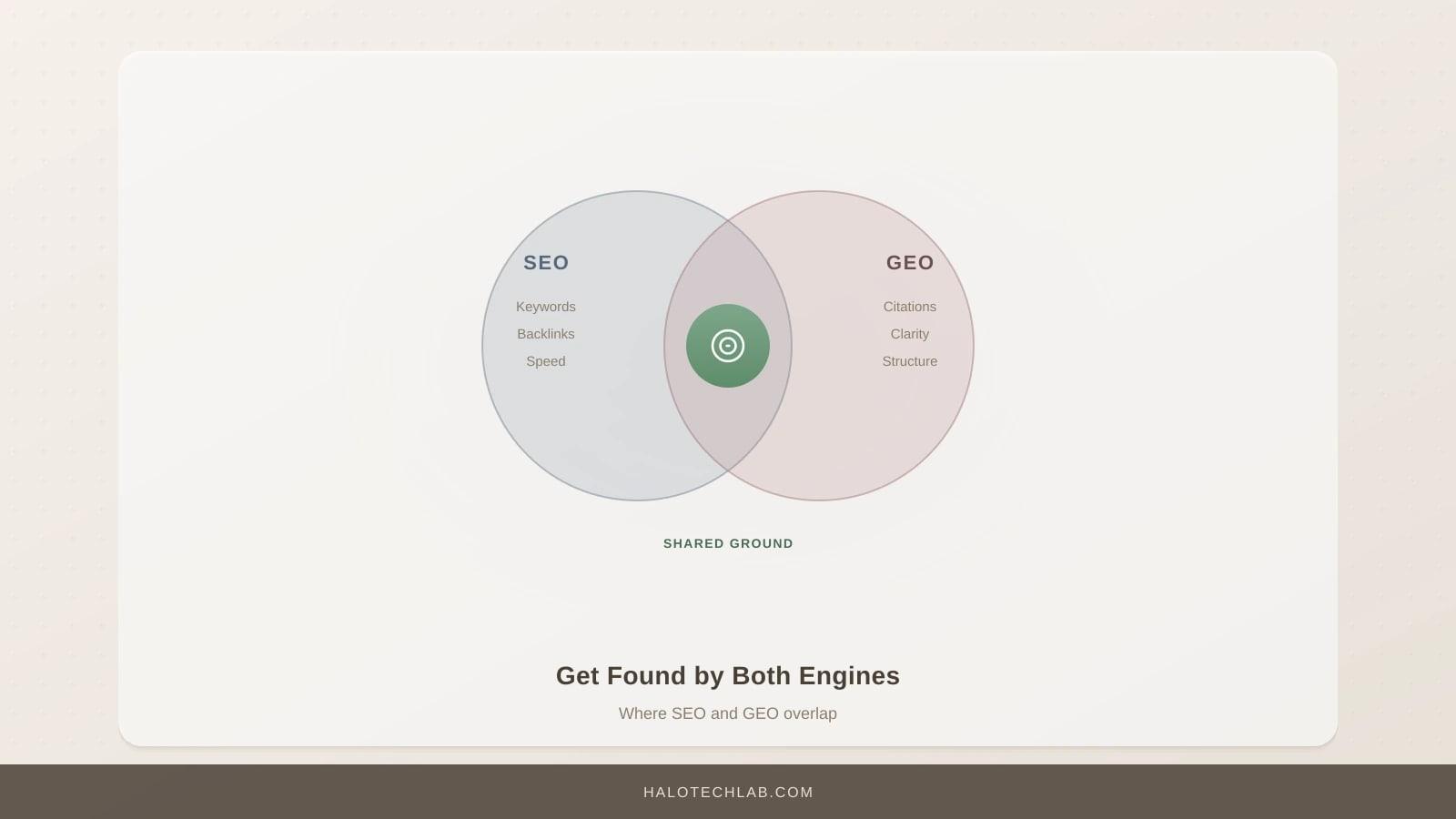
The core difference is intent and format. With SEO, you are optimising for a search engine to rank your page in a list. With GEO, you are optimising for an AI to cite your content in a generated answer.
In practice, this means:
For SEO, you focus on keywords, meta descriptions, title tags, and backlinks to climb the rankings.
For GEO, you focus on being the most comprehensive, accurate, and well-structured source on a topic, so that AI models recognise your content as authoritative and worth referencing.
The good news? Most GEO best practices also improve your traditional SEO. They are not competing strategies. They are complementary.
How AI Search Is Changing Discovery in the UK
Google AI Overviews (formerly known as Search Generative Experience or SGE) launched fully in the UK in late 2024. Since then, AI-generated summaries have appeared at the top of an estimated 30-40% of UK search queries.
For a detailed look at how this specifically impacts small business SEO, read our guide on how Google SGE changes SEO for small businesses.
Google AI Overviews
When you search for something like "best accounting software for UK freelancers," you will likely see an AI Overview at the very top of the results page. This is a paragraph (sometimes several) generated by Google's AI, summarising the answer and citing a handful of sources.
The impact on click-through rates has been significant. Some studies show a 20-40% drop in clicks to organic results for queries where AI Overviews appear. This does not mean organic search is dead, but it does mean you need to adapt.
How to get cited in AI Overviews:
- Create content that directly, clearly answers common questions in your field.
- Use structured data to help Google understand your content. Our structured data guide explains how.
- Include statistics, data points, and specific examples. AI Overviews tend to pull from content that provides concrete information.
- Build topical authority by publishing multiple related pieces of content (exactly what this article cluster does).
ChatGPT and Perplexity
Beyond Google, millions of people now use ChatGPT, Perplexity, and similar tools as their primary research method. When a potential client asks ChatGPT to recommend web developers in London, where does it pull its information from?
The answer is: from the web. ChatGPT's browsing capabilities and Perplexity's real-time search both crawl the internet. The content they surface tends to be:
- Well-established, authoritative pages with strong domain reputation.
- Content that is frequently cited or linked to by other sources.
- Pages with clear, factual, well-organised information.
- Content that matches the conversational style of the question.
For UK small businesses, this means your website content needs to do double duty. It needs to rank in Google and it needs to be the kind of content that AI tools want to reference.
Structured Data: The Secret Weapon for Both SEO and GEO
If there is one technical improvement that pays dividends for both traditional SEO and AI search visibility, it is structured data.
Structured data is code (specifically JSON-LD) that you add to your website to help search engines and AI tools understand exactly what your content is about. It is like adding labels to a filing system. The files are the same, but the labels make them infinitely easier to find and categorise.
We have written a complete plain-English guide to structured data for small businesses, but here are the essentials:
Key Schema Types for Small Businesses
- LocalBusiness — tells Google your business name, address, phone number, opening hours, and service area. Essential for local SEO.
- FAQPage — marks up your FAQ content so Google can display it as rich results. Also makes your content highly citable for AI tools.
- Article — helps search engines understand your blog posts, including author, publish date, and topic.
- BreadcrumbList — shows your site hierarchy in search results, improving click-through rates.
- Product / Service — if you list your services with pricing, this schema helps search engines display that information.
Why Structured Data Matters for AI Search
AI search tools are essentially trying to understand the web at scale. Structured data gives them a shortcut. Instead of parsing your entire page to figure out what you do, they can read your schema markup and know immediately that you are a web development agency in London, open Monday to Friday, specialising in full-stack development and AI integration.
This makes your content more likely to be surfaced in AI-generated answers, especially for specific, factual queries.
Content Strategy for Both Google and AI
Your content strategy needs to serve two masters now: the traditional Google algorithm and the AI models that increasingly mediate search.
Write for Humans, Structure for Machines
The best content strategy for 2026 is, frankly, the same as it has always been: create genuinely helpful content for your target audience. But the structure and format of that content matter more than ever.
Use clear headings and subheadings. Both Google and AI tools use heading hierarchy to understand your content structure. Use H2s for main sections and H3s for subsections.
Answer questions directly. Start sections with a clear, concise answer before expanding with detail. This makes your content ideal for both featured snippets and AI citations.
Include data and statistics. Specific numbers, percentages, and data points are far more likely to be cited by AI tools than vague generalities.
Update content regularly. Freshness signals matter for both Google rankings and AI tool preferences. Review and update your key pages at least quarterly.
Build Topic Clusters
Instead of publishing isolated blog posts, build interconnected clusters of content around core topics. This article is the pillar page of a cluster about SEO, GEO, and AI search for UK small businesses. It links out to detailed articles on:
- Structured data for small business websites
- Local SEO for London and South East service businesses
- Content marketing calendars for SMEs
- How Google SGE changes SEO
- How to get backlinks ethically
- SEO metrics that actually matter
Each of those articles links back here and to each other. This interlinking signals to both Google and AI tools that your site has deep expertise on this topic, making any individual page more likely to rank or be cited.
Content Types That Work for Both SEO and GEO
Not all content formats perform equally in the new search landscape. Here is what works best:
Comprehensive guides (like this one) that cover a topic from start to finish. These build topical authority and attract backlinks.
FAQ content that directly answers common questions. This is gold for both featured snippets and AI citations. Structure it with clear question headings and concise answers.
How-to content with step-by-step instructions. Both Google and AI tools love actionable, structured content.
Data-driven articles with original research, surveys, or analysis. These are highly citable and attract backlinks naturally.
Comparison and "best of" content that helps people make decisions. AI tools frequently surface these when users ask for recommendations.
For a practical framework on planning and publishing this content consistently, see our guide to content marketing calendars for SMEs.
What UK Small Businesses Need to Do Differently in 2026
Let us get practical. Here is a prioritised action plan based on your budget and technical ability.
If You Can Do One Thing: Claim and Optimise Your Google Business Profile
For local UK businesses, your Google Business Profile is your single most important digital asset. It feeds directly into Google Maps, local search results, and increasingly into AI-generated local recommendations.
Complete every field. Add photos regularly. Respond to every review. Post updates weekly. This alone puts you ahead of the majority of your local competitors.
For a detailed walkthrough, read our guide on local SEO for service businesses in London and the South East.
If You Have a Few Hours Per Month: Start Publishing Helpful Content
You do not need to publish daily. Two to four blog posts per month, focused on questions your customers actually ask, will build your topical authority over time. Our content marketing calendar guide gives you a month-by-month framework.
Write in plain English. Answer specific questions. Include data where you can. Update older posts when information changes.
If You Have Budget for Professional Help: Invest in Technical SEO and Structured Data
A professional audit of your website's technical SEO can uncover issues you would never spot on your own: slow server response times, broken internal links, missing alt text, duplicate content, and missing structured data.
Adding structured data to your site is a one-time investment that pays ongoing dividends. A developer or SEO specialist can implement LocalBusiness, FAQPage, Article, and BreadcrumbList schema across your site in a few hours.
At Halo Technology Lab, we build websites with structured data, performance optimisation, and SEO best practices baked in from the start. It is far easier (and cheaper) to build a site correctly than to retrofit it later.
If You Want to Stay Ahead: Build a GEO Strategy
The businesses that invest in GEO now will have a significant advantage as AI search continues to grow. This means:
- Building comprehensive content clusters (not isolated pages).
- Earning backlinks from authoritative sources. Our guide on how to get backlinks ethically shows you how.
- Implementing structured data across your entire site.
- Monitoring your visibility in AI search tools, not just Google rankings.
- Creating content that is factual, well-cited, and genuinely authoritative.
Measuring Success: How to Track Your Progress
The metrics that matter are shifting too. While traditional SEO metrics like keyword rankings and organic traffic remain important, you also need to consider:
- Brand mentions in AI responses. Search for your brand and your key services in ChatGPT, Perplexity, and Google AI Overviews. Are you being mentioned?
- Referral traffic from AI sources. Check your analytics for traffic from chat.openai.com, perplexity.ai, and similar sources.
- Featured snippet appearances. These are a strong indicator that your content is well-structured enough for AI citation.
- Rich result impressions. Google Search Console shows you how often your structured data generates rich results.
For a complete breakdown of which metrics to track and which to ignore, read our guide on SEO metrics that actually matter for small businesses.
Common Mistakes to Avoid
Ignoring AI search entirely. The businesses that treat this as a passing fad will be the ones scrambling to catch up in two years.
Abandoning traditional SEO for GEO. These are complementary strategies, not replacements. Traditional SEO is still where the vast majority of your search traffic will come from in 2026.
Chasing every new tool and platform. Focus on the fundamentals: great content, solid technical foundation, and structured data. These pay dividends regardless of which AI tool becomes dominant.
Trying to game AI models. Just as keyword stuffing stopped working for Google years ago, trying to manipulate AI citations with low-quality, repetitive content will backfire. Focus on genuine authority and helpfulness.
Neglecting your existing content. You probably already have pages that could perform much better with minor updates: refreshed statistics, added structured data, improved headings, and better internal linking.
The Bottom Line for UK Small Businesses
The search landscape in 2026 is more complex than it was five years ago. But the core principle has not changed: businesses that genuinely help their audience, and make that helpfulness easy for machines to understand, will be found.
You do not need to become an SEO expert overnight. Start with the basics: claim your Google Business Profile, create helpful content regularly, and implement structured data on your key pages. Then build from there.
The businesses that start now will compound their advantage. Every month of quality content, every page of structured data, every authoritative backlink builds on the last. In twelve months, you will be glad you started today.
Key Takeaways
- Traditional SEO is still essential in 2026, but the landscape is evolving with AI search tools and Google AI Overviews.
- GEO (Generative Engine Optimisation) is the practice of optimising your content to be cited by AI-powered search engines like ChatGPT and Perplexity.
- Structured data is the single most impactful technical investment for both SEO and GEO.
- Content strategy should serve both humans and machines: clear headings, direct answers, data, and regular updates.
- Topic clusters (interconnected content around a core theme) build topical authority that both Google and AI tools reward.
- Start with your Google Business Profile and helpful content. Add structured data and a GEO strategy as you grow.
- Measure success with both traditional metrics (rankings, traffic) and AI-specific metrics (brand mentions in AI responses, AI referral traffic).
Frequently Asked Questions
Is SEO still worth investing in for a small business in 2026?
Absolutely. Google still processes billions of searches daily, and organic search remains the highest-intent traffic source for most businesses. What has changed is that you now need to optimise for both traditional search results and AI-generated summaries. The investment in SEO has actually become more important, not less, because the competition for visibility is fiercer.
What is the difference between SEO and GEO?
SEO focuses on ranking your website in traditional search engine results (the list of blue links on Google). GEO focuses on getting your content cited or referenced by AI-powered search tools like Google AI Overviews, ChatGPT, and Perplexity. In practice, the two strategies overlap significantly. Good content, clear structure, and structured data benefit both.
Do I need to hire an expert for GEO, or can I do it myself?
Many GEO best practices are things you can implement yourself: writing clear, well-structured content, answering common questions directly, including data and citations, and publishing consistently. The more technical aspects, like implementing structured data and conducting technical SEO audits, may benefit from professional help. Our guide on structured data for small businesses is a good starting point for the DIY approach.
How long does it take to see results from SEO and GEO efforts?
Traditional SEO typically takes three to six months to show measurable results, sometimes longer in competitive markets. GEO results can be faster for some queries, as AI tools re-index content more frequently than Google's traditional crawler. The key is consistency. Businesses that publish quality content regularly and maintain their technical foundations see compounding returns over time.
Should I worry about AI search replacing Google?
Not in the short term. Google still dominates UK search with over 90% market share. However, the way people use Google is changing (AI Overviews, zero-click searches), and alternative AI search tools are growing rapidly. The smartest approach is to optimise for all of them simultaneously, which is exactly what a combined SEO and GEO strategy achieves.
If you are ready to improve your search visibility and prepare your business for the AI search era, get in touch with Halo Technology Lab. We build websites and digital strategies that are designed to perform in both traditional and AI-powered search, helping UK small businesses get found by the customers who need them most.
Enjoyed this? Get the next one by email
Practical AI playbooks, build logs and tool teardowns. One email a week, free, unsubscribe in one click.
Related Articles
The Data You Already Own: How UK SMEs Turn Decades of Records into Revenue
Your archive is not just history, it is the raw material for products you could sell. A complete guide to finding, valuing, cleaning and commercialising the data your business already holds.
AI Training for UK Businesses: What Your Team Actually Needs to Learn
Most AI training teaches tools. Tools change every six months. A complete guide to what to teach, who to teach it to, which format suits which team, and how to tell whether it worked.
The EU AI Act and UK Businesses: What Actually Applies to You
The UK has not adopted the EU AI Act, and it can still reach your business. A complete guide to which duties apply, when, what the penalties are, and what a sensible response looks like.