Structured Data for Small Business Websites: A Plain-English Guide
Schema markup helps Google and AI tools understand your content. Here's how to implement it without a developer.
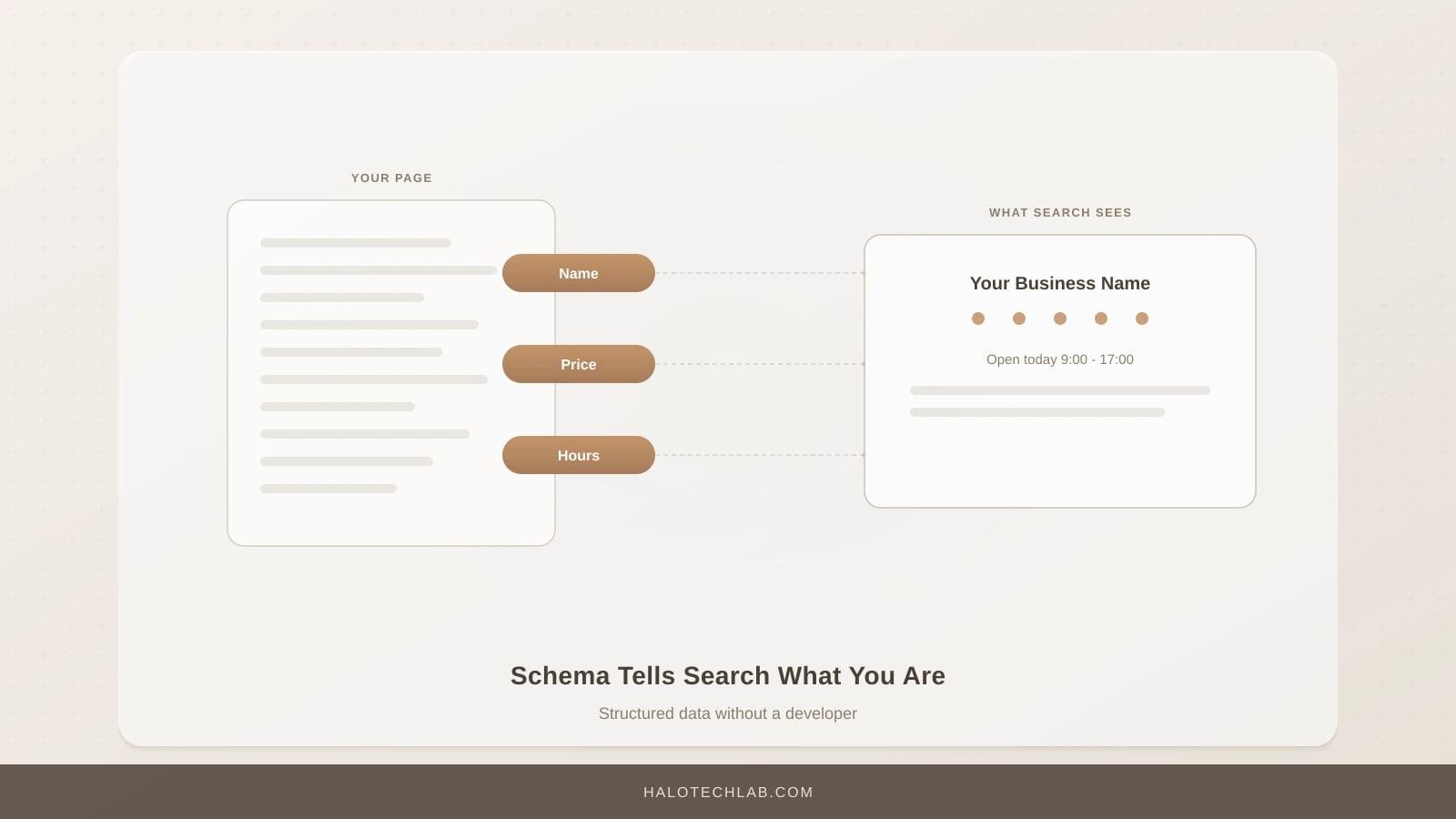
Have you ever wondered why some businesses show up on Google with star ratings, opening hours, and FAQ dropdowns right in the search results, while your listing is just a plain blue link? The answer, in most cases, is structured data.
It sounds technical, and the implementation does involve code. But the concept is surprisingly simple. And for UK small businesses competing for visibility in both traditional search and AI-powered search tools, it is one of the highest-return investments you can make.
This article is part of our comprehensive guide to SEO, GEO, and AI search for UK small businesses.
What Is Structured Data, Really?
Imagine you hand someone a printed menu from a restaurant. They can read it and understand it. Now imagine you hand the same menu to a robot. The robot can see the text, but it does not know which items are starters, which are mains, or what the prices mean.
Structured data is like adding labels to that menu so the robot can understand it. It is a standardised format of code that you add to your website's pages to tell search engines and AI tools exactly what your content represents.
The most common format is called JSON-LD (JavaScript Object Notation for Linked Data). It sits in the background of your web page, invisible to visitors, but highly visible to Google, Bing, ChatGPT, and Perplexity.
Why Should You Care?
Three reasons.
Rich results in Google. Structured data can unlock enhanced search listings: star ratings, FAQ accordions, price ranges, event dates, recipe cards, and more. These rich results have significantly higher click-through rates than plain listings.
Better AI search visibility. AI search tools parse structured data to understand your business quickly and accurately. If ChatGPT or Google AI Overviews need to recommend a web developer in London, structured data tells them exactly what you do, where you are, and what your specialities are.
Competitive advantage. Most small business websites in the UK have little to no structured data. Implementing it puts you immediately ahead of the majority of your local competitors in how search engines understand your site.
The Most Important Schema Types for Small Businesses
You do not need to implement every type of structured data that exists. For most UK small businesses, five types cover the vast majority of use cases.
LocalBusiness Schema
This is the most important schema type for any business that serves a local area. It tells search engines your business name, address, phone number, opening hours, service area, and more.
{
  "@context": "https://schema.org",
  "@type": "ProfessionalService",
  "name": "Your Business Name",
  "address": {
    "@type": "PostalAddress",
    "streetAddress": "123 High Street",
    "addressLocality": "London",
    "postalCode": "SW1A 1AA",
    "addressCountry": "GB"
  },
  "telephone": "+44-20-1234-5678",
  "openingHours": "Mo-Fr 09:00-17:30",
  "url": "https://yourbusiness.co.uk",
  "priceRange": "££"
}
This directly feeds into Google Maps, local search packs, and AI-generated local recommendations. If you implement nothing else, implement this.
FAQPage Schema
If you have a frequently asked questions section on your website (and you should), FAQ schema marks it up so Google can display the questions and answers directly in search results.
This is also incredibly valuable for AI search. When someone asks ChatGPT or Perplexity a question that your FAQ answers, well-structured FAQ content with schema markup is much more likely to be cited.
{
  "@context": "https://schema.org",
  "@type": "FAQPage",
  "mainEntity": [
    {
      "@type": "Question",
      "name": "How much does a website cost for a small business?",
      "acceptedAnswer": {
        "@type": "Answer",
        "text": "A professional small business website typically costs between £2,000 and £10,000 depending on complexity, features, and design requirements."
      }
    }
  ]
}
Article Schema
For your blog posts and content pages, Article schema tells search engines the title, author, publish date, and description. This helps your content appear with enhanced listings and signals freshness to both Google and AI tools.
{
  "@context": "https://schema.org",
  "@type": "Article",
  "headline": "Your Article Title",
  "author": {
    "@type": "Organization",
    "name": "Your Business Name"
  },
  "datePublished": "2026-03-22",
  "dateModified": "2026-03-22",
  "description": "A brief summary of the article."
}
Product and Service Schema
If you list your services or products with pricing, this schema helps search engines display that information in results. For service businesses, this can include service descriptions, pricing ranges, and availability.
BreadcrumbList Schema
Breadcrumb schema shows your site's page hierarchy in search results (e.g., Home > Services > Web Development). This improves click-through rates by giving searchers a clear picture of where the page sits within your site.
How to Implement Structured Data
You have three main options, depending on your technical comfort level.
Option 1: Use a Plugin or Built-In Tool
If your site runs on WordPress, plugins like Yoast SEO or Rank Math can generate structured data automatically. Shopify and Squarespace also have basic structured data built in.
The limitation is that these tools often generate only basic schema. For comprehensive coverage, you may need manual implementation.
Option 2: Use Google's Structured Data Markup Helper
Google provides a free tool at search.google.com/structured-data/markup-helper that walks you through tagging elements on your page. It then generates the JSON-LD code for you to add.
Option 3: Professional Implementation
For businesses that want comprehensive structured data across their entire site, a developer can implement it properly from the start. At Halo Technology Lab, we include structured data as standard in every website we build, because it is far easier to build it in than to add it later.
How to Test Your Structured Data
Once implemented, testing is straightforward.
Google's Rich Results Test (search.google.com/test/rich-results) — paste your URL and see which rich result types your page is eligible for. This is the most important test.
Schema Markup Validator (validator.schema.org) — checks your structured data for syntax errors and warnings.
Google Search Console — the Enhancements section shows you the status of all structured data across your site, including any errors that need fixing.
Test every page where you have added structured data. Fix any errors (shown in red). Warnings (shown in yellow) are less critical but worth addressing when you can.
The Impact on Rankings and AI Search
Let us be clear: structured data is not a direct ranking factor. Google has stated this explicitly. Having schema markup does not automatically push you up the rankings.
However, the indirect benefits are substantial.
Higher click-through rates. Rich results are more visually prominent and informative, attracting more clicks than plain listings. Higher click-through rates can, over time, positively influence rankings.
Better AI citations. AI tools are more likely to surface and cite content that they can parse accurately. Structured data makes your content machine-readable in a way that plain HTML does not.
Reduced ambiguity. When Google or an AI tool needs to determine whether your page is about "web development services" or "a blog post about web development," structured data removes the guesswork.
Future-proofing. As search becomes increasingly AI-mediated, machine-readable content will only grow in importance. Implementing structured data now positions you well for whatever comes next.
Key Takeaways
- Structured data is code that helps search engines and AI tools understand your website content, leading to rich results and better AI visibility.
- The five most important types for small businesses are LocalBusiness, FAQPage, Article, Product/Service, and BreadcrumbList.
- JSON-LD is the recommended format, and it sits invisibly in your page code.
- Test your implementation with Google's Rich Results Test and fix any errors.
- Structured data is not a direct ranking factor, but the indirect benefits (higher click-through rates, AI citations, reduced ambiguity) are significant.
- Most UK small business websites have little to no structured data, making this a genuine competitive advantage.
Frequently Asked Questions
Will structured data make my website rank higher on Google?
Not directly. Google has confirmed that structured data is not a ranking signal on its own. However, it enables rich results (star ratings, FAQ dropdowns, etc.) which attract more clicks. Higher click-through rates can indirectly improve your rankings over time. More importantly, structured data significantly improves your visibility in AI-powered search tools.
Is structured data difficult to add to my website?
The complexity depends on your website platform. WordPress users can use plugins like Yoast SEO or Rank Math for basic coverage. Custom websites require a developer to add JSON-LD code. The implementation itself is straightforward for a developer, typically taking a few hours for a standard small business site.
Do I need structured data on every page of my website?
No. Focus on your most important pages first: your homepage (LocalBusiness schema), your FAQ page (FAQPage schema), your blog posts (Article schema), and your service pages (Service schema). You can expand coverage over time, but these four will give you the majority of the benefit.
If you want structured data implemented properly across your website, get in touch with Halo Technology Lab. We build SEO-ready websites with structured data, performance optimisation, and AI search visibility baked in from day one.
Enjoyed this? Get the next one by email
Practical AI playbooks, build logs and tool teardowns. One email a week, free, unsubscribe in one click.
Related Articles
Measuring Your Website's SEO Performance: Metrics That Actually Matter
Forget vanity metrics. These are the SEO numbers that actually indicate whether your strategy is working.
How to Get Backlinks for Your Small Business Website (Ethically)
Practical, ethical strategies for building backlinks that improve your search rankings without risking penalties.
How Google SGE Changes SEO for Small Businesses
Google's AI-powered search results are reshaping SEO. Here's what it means for your small business website.