How Google SGE Changes SEO for Small Businesses
Google's AI-powered search results are reshaping SEO. Here's what it means for your small business website.
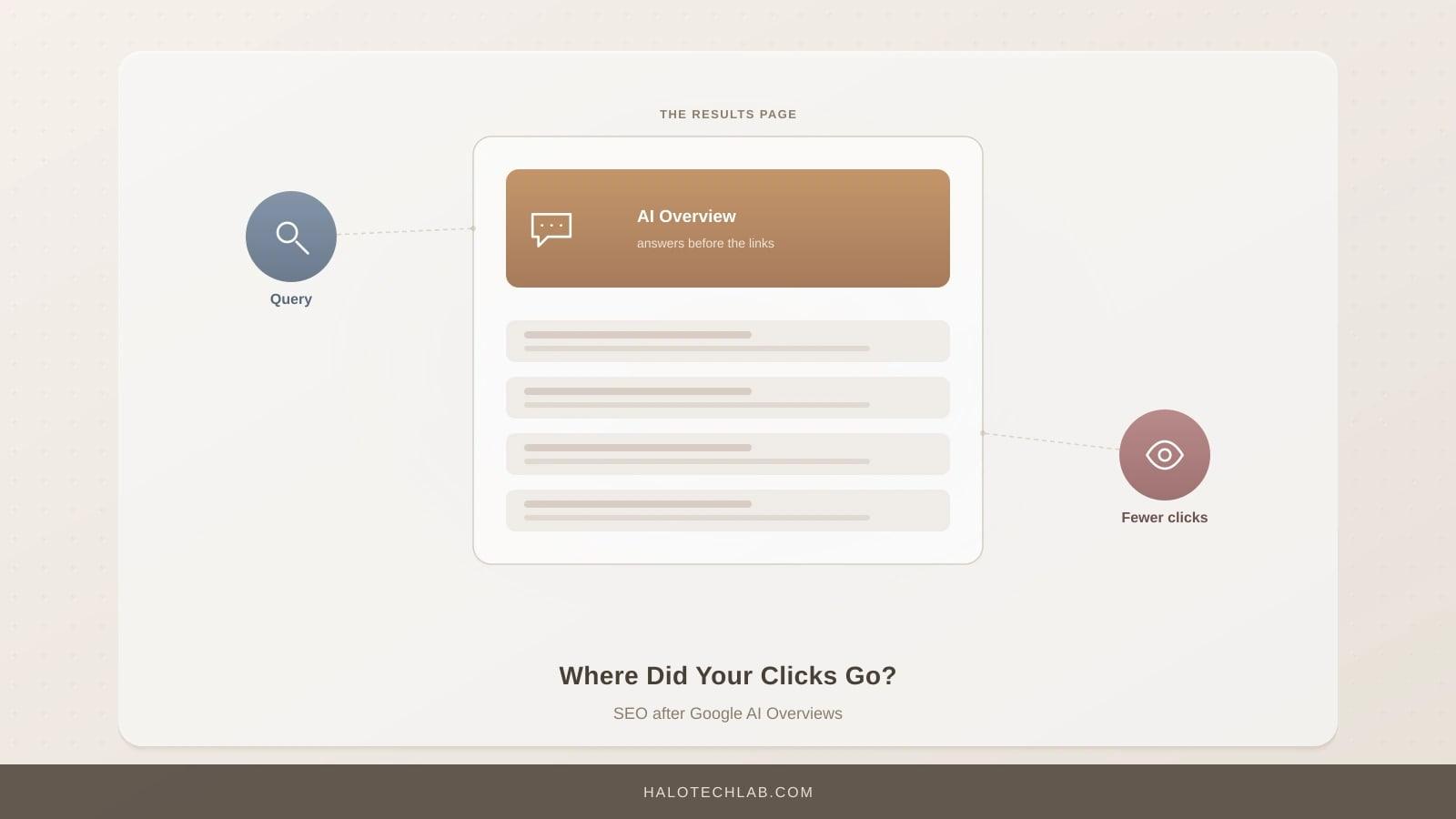
Have you searched for something on Google recently and noticed a large AI-generated summary sitting right above the traditional results? That is Google AI Overviews, formerly known as the Search Generative Experience (SGE). And it is fundamentally changing how people find businesses online.
If you rely on Google for any meaningful portion of your leads, enquiries, or sales, you need to understand what this means and how to adapt. The businesses that adjust now will thrive. Those that ignore it will gradually lose visibility to competitors who did not.
This article is part of our comprehensive guide to SEO, GEO, and AI search for UK small businesses.
What Google AI Overviews Actually Are
Google AI Overviews are AI-generated summaries that appear at the top of search results for many queries. They use Google's Gemini LLM (large language model) to synthesise information from multiple web sources into a single, coherent answer.
For example, if you search "how to choose a web developer for my small business," instead of just seeing a list of links, you now see a multi-paragraph AI-written answer at the very top of the page. Below that answer, Google cites the sources it drew from, typically three to five websites.
These AI Overviews appear for an estimated 30-40% of UK search queries, and Google is expanding their presence. For informational queries (how-to, what-is, best-of), they appear on the majority of results pages.
What They Replaced
Google has been moving toward answering questions directly on the results page for years. Featured snippets, knowledge panels, and "People Also Ask" boxes were all steps in this direction. AI Overviews are the most significant step yet, because they can synthesise information rather than simply pulling a snippet from a single source.
The traditional search results (the blue links) still appear below the AI Overview. But their position on the page, and therefore their click-through rates, have been pushed down.
The Impact on Click-Through Rates
This is the critical question for every UK small business: are people still clicking through to websites?
The honest answer is yes, but fewer of them.
Research from multiple SEO firms throughout 2025 showed that click-through rates for organic results dropped by 20-40% for queries where AI Overviews appeared. This does not mean organic traffic has dropped by that much across the board, because AI Overviews do not appear on every search. But for the queries they do cover, the impact is real.
The Zero-Click Problem
Zero-click searches, where the user gets their answer without clicking any result, have been growing for years. AI Overviews have accelerated this trend significantly. If Google's AI can answer someone's question directly, many users will never scroll down to the organic results.
For simple, factual queries ("What are HMRC's self-assessment deadlines?"), zero-click rates are extremely high. For complex, nuanced queries ("Which CRM is best for a 10-person recruitment agency?"), users still tend to click through for more detail.
What This Means for Your Business
If your website primarily ranks for simple, factual queries, you may see a decline in traffic. If your content addresses complex, nuanced topics that require detailed answers, you are better positioned.
The strategic takeaway: create content that goes deeper than an AI can summarise in a paragraph. Comprehensive guides, detailed case studies, interactive tools, and opinionated expert content are harder for AI to fully replace.
What Content Gets Featured in AI Overviews
Not all websites are equally likely to be cited as sources in Google's AI Overviews. Understanding what Google favours can help you position your content for citation.
Characteristics of Cited Content
Authoritative domains. Google tends to cite established websites with strong domain authority. This does not mean small businesses cannot be cited, but it does mean you need to build your site's authority through quality content and backlinks.
Well-structured content. Pages with clear headings, short paragraphs, bullet points, and direct answers to questions are easier for Google's AI to parse and cite. This aligns with good SEO practice generally.
Structured data. Schema markup helps Google understand your content at a granular level. Our structured data guide walks you through the implementation.
Comprehensive coverage. Google's AI tends to cite pages that cover a topic thoroughly rather than superficially. A 2,000-word guide that answers multiple related questions is more likely to be cited than a 300-word blog post.
Freshness. Content with recent publication or update dates is favoured, especially for topics where accuracy changes over time. Review and update your key content regularly.
E-E-A-T signals. Experience, Expertise, Authoritativeness, and Trustworthiness. Google's AI appears to weight content from authors and sites that demonstrate these qualities. Include author bylines, credentials, and real-world experience in your content.
What Content Gets Overlooked
Thin, generic content. Pages that offer surface-level information with no unique insight are unlikely to be cited.
Purely promotional content. Sales pages and product listings are rarely cited in AI Overviews for informational queries.
Outdated content. Pages with old dates and stale information are deprioritised.
Poorly structured content. Long walls of text without headings, lists, or clear organisation are difficult for AI to parse.
How to Adapt Your SEO Strategy
Here is a practical action plan for UK small businesses.
1. Embrace Generative Engine Optimisation (GEO)
GEO is the practice of optimising your content specifically for AI-powered search engines. While traditional SEO focuses on ranking in the list of links, GEO focuses on getting your content cited in AI-generated answers.
The good news is that GEO and SEO are largely complementary. The same qualities that make content rankable in traditional search (authority, structure, comprehensiveness, freshness) also make it citable by AI.
2. Target "AI-Proof" Queries
Some types of searches are less likely to be fully answered by AI Overviews, and therefore still drive strong click-through rates.
Complex comparisons. "Which project management tool is best for a creative agency?" requires nuance that AI summaries struggle to fully convey.
Location-specific queries. "Best web developer in Croydon" tends to produce map results and local listings rather than AI Overviews.
Transactional queries. "Hire a web developer London" and similar high-intent commercial queries are less likely to have AI Overviews.
Long-tail queries. Highly specific searches ("How to integrate Xero with my CRM for automated invoicing") often fall outside AI Overview coverage.
3. Create Content Worth Clicking
Even when AI Overviews are present, users still click through for certain types of content.
Original research and data. If your content contains data, case studies, or insights that cannot be fully captured in a summary, users will click.
Tools and templates. Interactive calculators, downloadable templates, and practical tools drive clicks because the AI cannot replicate the functionality.
Expert opinion and experience. Authoritative, opinionated content from a recognised expert encourages clicks for the full perspective.
Visual content. Detailed infographics, videos, and interactive elements are reasons to visit the page beyond what the AI summary provides.
4. Optimise for Citation
Structure your content to maximise the chances of being cited in AI Overviews.
- Start each section with a clear, concise answer to the question implied by the heading.
- Use lists and bullet points for key information.
- Include specific statistics and data points with sources.
- Implement structured data on every key page.
- Update content regularly to maintain freshness signals.
5. Diversify Your Traffic Sources
Relying entirely on Google organic traffic has always been risky. With AI Overviews potentially reducing click-through rates, diversification is more important than ever.
- Build an email list so you own the relationship with your audience.
- Invest in social media presence, particularly LinkedIn for B2B service businesses.
- Optimise for AI search tools beyond Google (ChatGPT, Perplexity, Microsoft Copilot).
- Develop referral partnerships with complementary businesses.
The Rise of AI Search Beyond Google
Google AI Overviews are just one piece of the puzzle. Millions of people now use ChatGPT, Perplexity, and Microsoft Copilot as their primary research tools, bypassing Google entirely.
These tools pull from different sources and use different criteria than Google. Being visible across all of them requires the kind of comprehensive, authoritative content strategy described in our pillar guide to SEO, GEO, and AI search.
The businesses that invest in quality content, structured data, and topical authority now will be the ones that remain visible regardless of which AI tool a potential customer uses to find them.
Key Takeaways
- Google AI Overviews appear on 30-40% of UK searches, pushing traditional organic results further down the page.
- Click-through rates have dropped 20-40% for queries where AI Overviews appear, accelerating the zero-click search trend.
- Content that is well-structured, comprehensive, fresh, and backed by structured data is most likely to be cited in AI Overviews.
- Focus on "AI-proof" queries: complex comparisons, location-specific searches, transactional intent, and long-tail keywords.
- Create content worth clicking: original research, tools, expert opinion, and visual content.
- Diversify your traffic sources beyond Google organic to reduce dependency on any single channel.
Frequently Asked Questions
Will Google AI Overviews completely replace organic search results?
No. Google still displays traditional organic results below AI Overviews, and for many query types (transactional, navigational, local), organic results remain the primary format. However, for informational queries, AI Overviews are increasingly the first thing users see, which affects how much traffic reaches your website from those searches.
Can small businesses compete with large brands in AI Overviews?
Yes, but it requires a focused strategy. Google's AI does not exclusively cite large brands. It cites the most relevant, well-structured, and authoritative content for a given query. A small business with deep expertise in a specific niche can absolutely be cited over a large brand with generic content. The key is specificity, depth, and structured data.
Should I stop investing in traditional SEO because of AI Overviews?
Absolutely not. Traditional SEO is the foundation upon which everything else is built. Strong technical SEO, quality content, and a healthy backlink profile improve your chances of being cited in AI Overviews as well. Think of GEO as an extension of SEO, not a replacement.
How do I know if AI Overviews are affecting my traffic?
Check Google Search Console for changes in impressions and click-through rates for your key queries. If impressions are stable but clicks have dropped, AI Overviews may be the cause. You can also manually search your target keywords in Google to see whether AI Overviews appear for them.
If you want to adapt your website and content strategy for the AI search era, get in touch with Halo Technology Lab. We build websites and content strategies designed to perform in both traditional Google search and the new world of AI-powered discovery.
Enjoyed this? Get the next one by email
Practical AI playbooks, build logs and tool teardowns. One email a week, free, unsubscribe in one click.
Related Articles
Measuring Your Website's SEO Performance: Metrics That Actually Matter
Forget vanity metrics. These are the SEO numbers that actually indicate whether your strategy is working.
How to Get Backlinks for Your Small Business Website (Ethically)
Practical, ethical strategies for building backlinks that improve your search rankings without risking penalties.
Content Marketing Calendar for SMEs: What to Post and When
A practical content calendar framework for small businesses — what to publish, how often, and on which channels.