Local SEO for Service Businesses in London and the South East
How to dominate local search results in London and the South East — Google Business Profile, reviews, and more.
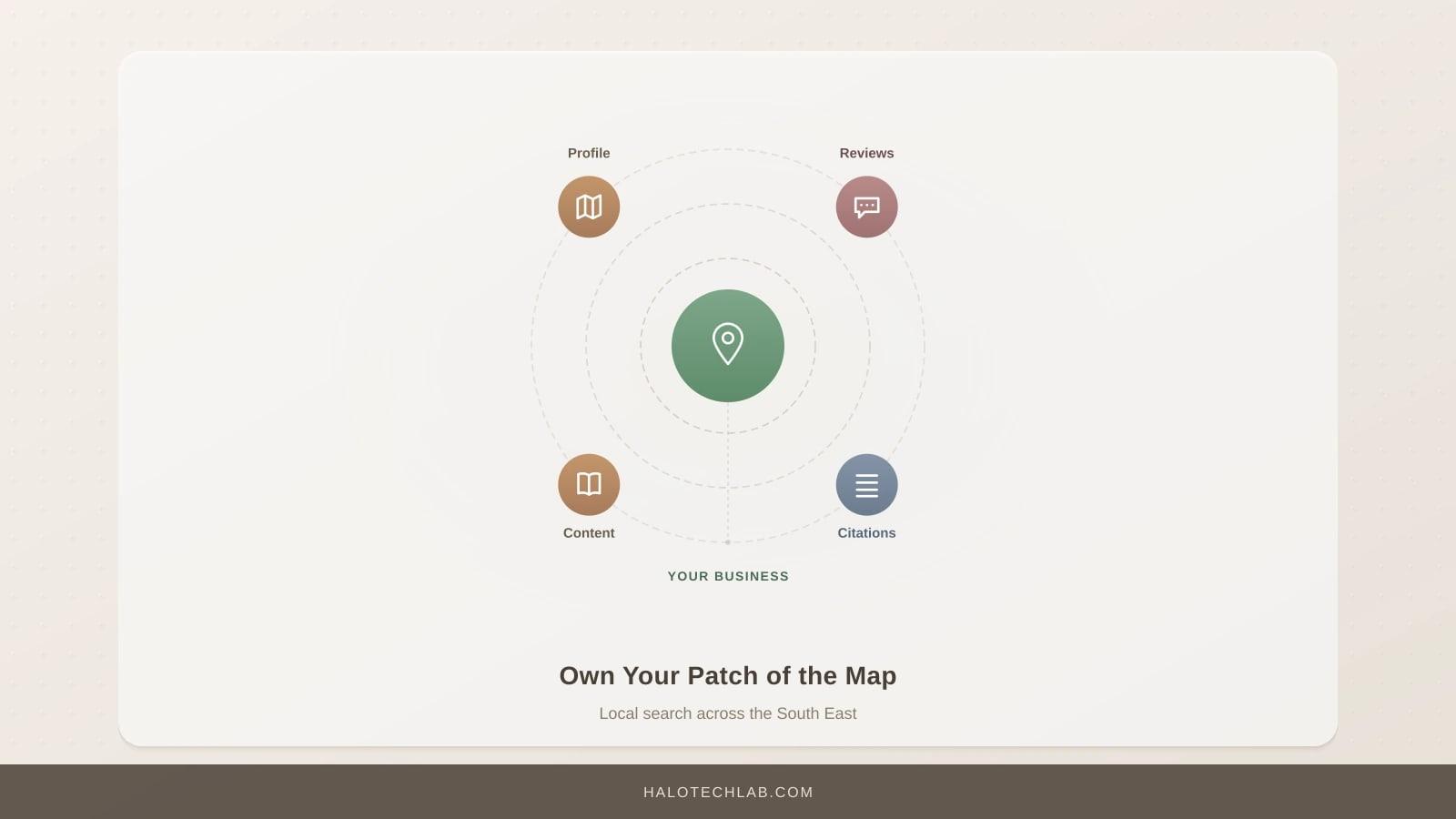
When was the last time you searched for a local service, say a plumber, accountant, or web designer, and scrolled past the first three results? Probably never. That is exactly why local SEO matters so much for service businesses.
If you run a service business in London or the South East, you are competing in one of the most digitally saturated markets in the UK. The good news is that most of your competitors are not doing local SEO well. A focused effort can put you ahead remarkably quickly.
This article is part of our comprehensive guide to SEO, GEO, and AI search for UK small businesses.
Google Business Profile: Your Most Important Local Asset
Your Google Business Profile (GBP) is the single most influential factor in local search rankings. It is what appears in the map pack, the three-listing box that dominates the top of local search results.
If you have not claimed your GBP yet, stop reading and do it now at business.google.com. If you have claimed it but have not touched it in months, treat this as your wake-up call.
How to Optimise Your Google Business Profile
Complete every field. Google rewards completeness. Fill in your business name (exactly as it appears on your signage and website), address, phone number, website, business hours, service area, business description, and every available attribute.
Choose the right primary category. This is crucial. Google offers hundreds of business categories. Your primary category should be the most specific match for your core service. A web development agency should choose "Web Designer" or "Software Company," not just "Technology Company." You can add secondary categories too, but the primary one carries the most weight.
Add photos regularly. Businesses with photos receive 42% more requests for directions and 35% more click-throughs to their website, according to Google. Upload high-quality images of your office, team, work, and projects. Aim for at least one new photo per week.
Post updates weekly. Google Business Profile has a "Posts" feature that most businesses ignore entirely. Use it to share updates, offers, events, and blog posts. It signals to Google that your business is active and engaged.
Enable messaging and Q&A. These features allow potential customers to interact with you directly from Google Search, and Google favours profiles that have them active.
NAP Consistency: The Foundation of Local Trust
NAP stands for Name, Address, and Phone number. It sounds mundane, but inconsistent NAP information across the web is one of the most common local SEO problems for UK businesses.
If your website says "Halo Technology Lab, 123 High Street, London," but Yell says "Halo Tech Lab, 123 High St, London," Google sees two potentially different businesses. This confusion dilutes your local search authority.
How to Fix NAP Consistency
Start by auditing your current listings. Search for your business name on Google and note every directory, social profile, and listing that appears. Then systematically update each one to match your Google Business Profile exactly.
Key places to check:
- Your website (header, footer, contact page)
- Google Business Profile
- Bing Places for Business
- Yell.com
- Thomson Local
- FreeIndex
- Yelp UK
- Facebook Business Page
- LinkedIn Company Page
- Industry-specific directories
Use the exact same format everywhere. If your GBP says "123 High Street," do not abbreviate it to "123 High St" elsewhere.
Local Citations: Building Your Digital Footprint
A citation is any online mention of your business name, address, and phone number. Citations are a key ranking factor for local search, because they help Google verify that your business is real, active, and located where you say it is.
The Most Important UK Citation Sources
General directories: Yell.com, Thomson Local, FreeIndex, Yelp UK, Scoot, and 192.com.
Industry-specific directories: These vary by sector. Solicitors should be on The Law Society directory. Accountants on ICAEW Find a Chartered Accountant. Builders on Checkatrade and MyBuilder. Identify the top directories in your specific industry and get listed.
Local directories: Many London boroughs and South East councils have business directories. Your local Chamber of Commerce likely has one too. These are often overlooked but carry strong local relevance signals.
Data aggregators: In the UK, the major data aggregators are TransUnion (formerly Callcredit), Data Axle, and Factual. Getting your data correct with these aggregators can cascade correct information to dozens of smaller directories automatically.
How Many Citations Do You Need?
There is no magic number, but consistency matters more than quantity. Start with the top 20-30 most relevant directories for your industry and location. Ensure your NAP information is identical across all of them. Then expand gradually.
Review Strategy: The London Advantage
Online reviews are a significant local ranking factor, and they are also the first thing potential clients look at when evaluating a service business. In London's competitive market, a strong review profile can be the difference between winning and losing a client.
How to Get More Reviews
Ask at the point of delight. The best time to ask for a review is immediately after you have delivered a great result. Send a follow-up email with a direct link to your Google Business Profile review page.
Make it easy. Create a short URL that goes directly to your review form. You can generate this from your Google Business Profile dashboard. Include it in your email signature, on invoices, and on your website.
Respond to every review. Positive reviews deserve a thank you. Negative reviews deserve a thoughtful, professional response. Google has confirmed that responding to reviews improves your local ranking.
Never buy or fake reviews. Google's algorithms are increasingly sophisticated at detecting fake reviews, and the penalties are severe, including complete removal from Google Maps.
How Many Reviews Do You Need?
Research by BrightLocal shows that the average UK business in the local map pack has around 40-50 Google reviews. If you currently have fewer than 20, make this a priority. Aim for a steady flow rather than a burst (which can look suspicious to Google).
Local Content: Speaking to Your Community
Creating content that is specifically relevant to your local area sends strong signals to both Google and AI search tools about your geographic relevance.
Types of Local Content That Work
Area-specific service pages. If you serve multiple areas, create dedicated pages for each. "Web Development in Croydon," "AI Consulting in the City of London," "Business Automation in Brighton." Each page should have unique content, not just the location name swapped out.
Local case studies. Write about projects you have completed for local businesses. Mention the area, the challenges specific to that market, and the results. These are powerful for both SEO and trust-building.
Local guides and resources. Content like "The Best Co-Working Spaces in Shoreditch" or "A Guide to Business Grants in the South East" attracts local links and establishes your expertise in the community.
Community involvement. Blog about local events you sponsor or attend, partnerships with other local businesses, or your perspective on local business trends. This creates natural local signals.
Schema Markup for Local Businesses
Structured data is particularly impactful for local SEO. The LocalBusiness schema (or a more specific subtype like ProfessionalService, LegalService, or FinancialService) tells Google exactly who you are and where you operate.
For a full walkthrough of implementing structured data, read our structured data guide for small businesses.
Key schema elements for local businesses:
- Business name, address, phone number (matching your GBP exactly)
- Opening hours (including special hours for holidays)
- Service area (for businesses that travel to clients)
- Geo coordinates (latitude and longitude of your business)
- Price range (helps Google understand your market positioning)
- Reviews and ratings (if you display them on your website)
Implementing this schema can unlock local rich results in Google, including your business details appearing directly in the search results panel.
Tracking Your Local SEO Progress
Local SEO results are measurable. Here is what to track:
Google Business Profile Insights: GBP shows you how many people found your listing, how they found it (direct search vs discovery), and what actions they took (website clicks, phone calls, direction requests).
Local keyword rankings: Track your position for key local search terms like "web developer London" or "AI consultant South East." Tools like BrightLocal and Whitespark are designed specifically for local rank tracking.
Review volume and rating: Monitor your total review count and average rating over time.
Citation accuracy: Periodically check that your NAP information is still consistent across your key directory listings.
Key Takeaways
- Your Google Business Profile is the single most important factor for local search visibility. Complete every field, add photos weekly, and post updates regularly.
- NAP consistency (Name, Address, Phone) across all directories is foundational. Audit and correct any inconsistencies.
- Build citations on the top 20-30 UK directories relevant to your industry and location.
- Actively pursue Google reviews by asking at the point of delight and making the process easy.
- Create locally relevant content: area-specific pages, local case studies, and community resources.
- Implement LocalBusiness schema markup to help Google and AI tools understand your business.
Frequently Asked Questions
How long does it take for local SEO to show results?
Most businesses see noticeable improvements within three to six months of consistent local SEO work. Some changes, like optimising your Google Business Profile, can show results within weeks. Building a strong citation profile and review base takes longer. The key is consistency. Local SEO is not a one-off project; it is an ongoing practice.
Do I need a physical office address for local SEO?
Not necessarily. Google allows service-area businesses (businesses that travel to clients) to hide their address on their Google Business Profile while still appearing in local search results. You set your service area instead. However, having a verifiable business address does strengthen your local signals.
Is local SEO different in London compared to other UK cities?
The principles are the same, but the competition is significantly fiercer. London has more businesses competing for the same local search terms, which means you need to be more thorough with your optimisation. On the positive side, London also has more niche and area-specific search opportunities (e.g., "accountant Canary Wharf" vs just "accountant London"), which allows you to target more specific terms with less competition.
If you need help improving your local search visibility in London and the South East, get in touch with Halo Technology Lab. We build websites with local SEO foundations baked in, from structured data to locally optimised content strategies.
Enjoyed this? Get the next one by email
Practical AI playbooks, build logs and tool teardowns. One email a week, free, unsubscribe in one click.
Related Articles
Measuring Your Website's SEO Performance: Metrics That Actually Matter
Forget vanity metrics. These are the SEO numbers that actually indicate whether your strategy is working.
How to Get Backlinks for Your Small Business Website (Ethically)
Practical, ethical strategies for building backlinks that improve your search rankings without risking penalties.
How Google SGE Changes SEO for Small Businesses
Google's AI-powered search results are reshaping SEO. Here's what it means for your small business website.