Article 50: When You Have to Tell People They Are Talking to AI
Since 2 August 2026 you must disclose AI interaction and label AI-generated content. What that means for your chatbot, your marketing copy and your customer emails.
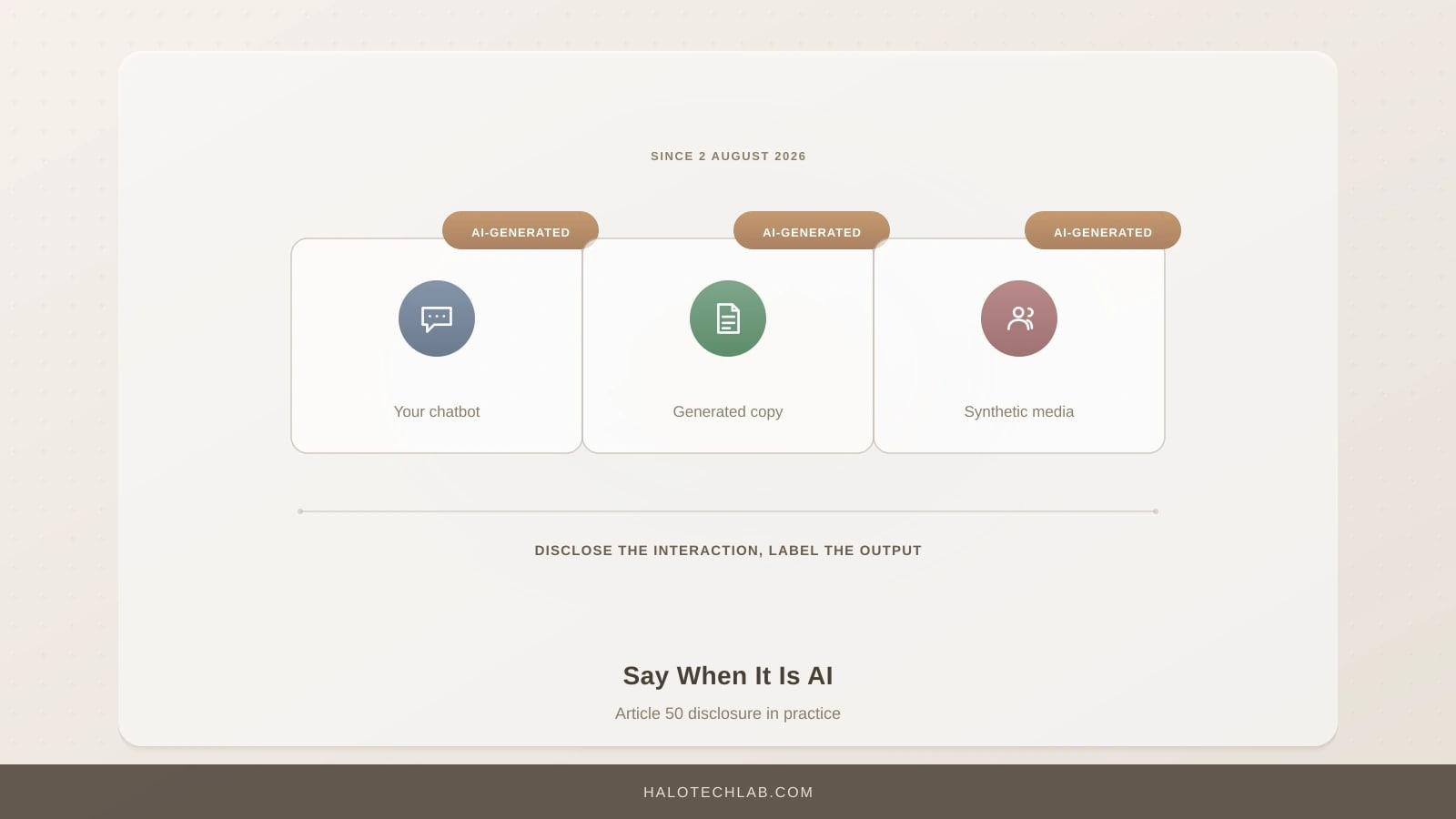
Since 2 August 2026, if a person is interacting with an AI system, they generally have to be told. If content has been generated or manipulated by AI, it generally has to be labelled. That is Article 50 of the EU AI Act, and unlike the high-risk rules that were pushed back to 2027, it arrived on schedule.
It is also the part most likely to affect an ordinary business, because it does not care whether your AI is sophisticated. It cares whether a human might be misled.
This article is part of our guide to the EU AI Act for UK businesses.
The four duties
Disclose AI interaction. Where a person interacts with an AI system, they must be informed, unless it is obvious to a reasonably well-informed person in the circumstances. Providers carry this duty; deployers carry the practical burden of making sure it actually happens on their site.
Mark synthetic content. Providers of systems that generate synthetic audio, image, video or text must mark outputs as artificially generated, in a machine-readable format where technically feasible.
Disclose deepfakes. Deployers of systems producing content that appreciably resembles real persons, objects, places or events must disclose that it is artificially generated or manipulated.
Disclose AI-written public-interest text. Text published to inform the public on matters of public interest must be disclosed as AI-generated, unless it went through human review with someone holding editorial responsibility.
What this means in practice
For most businesses the whole thing reduces to three checks.
Your chatbot. Does the first message make clear it is an automated assistant? A line saying so before the conversation starts is sufficient. A name like "Sophie" with a stock photograph and no disclosure is the case the rule was written for. Cost to fix: one afternoon.
Your marketing content. If a human reviews and takes responsibility for AI-assisted copy before it goes out, the public-interest disclosure duty generally does not bite. If you are auto-publishing generated articles with nobody reading them first, it does. Cost to fix: an editorial policy and someone's name against it.
Your images and video. AI-generated imagery that depicts real people, places or events needs disclosure. A generated abstract background does not. An AI-generated photograph of your premises that is not your premises does.
The last of these is where businesses most often find something uncomfortable when they look properly.
Where the "obvious" exception runs out
The exception covers situations where a reasonably well-informed person would already understand they are dealing with a machine. It is narrower than businesses would like.
A support widget captioned "AI assistant" is obvious. The same logic applies to internal knowledge chatbots used by staff. A conversational agent with a human name, a human photograph and a natural writing style is not, however clearly the technology is disclosed elsewhere on the website. The test is what the person in front of it understands, not what a diligent reader could have found out.
The practical rule: if you have designed it to feel like a person, you have removed your own exception.
Does this apply to a UK business?
Only if you are in scope of the Act, which requires placing AI on the EU market, output used in the EU, or an EU establishment. The five-question test settles it.
If you sell to EU consumers and run a chatbot, you are almost certainly caught. If you trade purely in the UK, you are not caught by Article 50, and UK AI regulation still applies, and UK consumer protection law still frowns on misleading people about whether they are talking to a person. The commercial case for disclosure holds either way: customers who discover they were misled do not become more loyal.
What we would actually do
Add a line to the chatbot. "Hello, I am an automated assistant. I can help with orders and delivery, and I will pass you to a colleague if you need one." Discloses, sets expectations, and reduces frustration.
Write down who is editorially responsible for published content. This belongs alongside your AI use policy. One sentence in a policy. It is the thing that keeps AI-assisted copy out of the disclosure requirement, and it is good practice regardless.
Audit your image library. Identify anything generated that depicts something real. This is usually the only part that takes real time.
Do not buy anything. There are vendors selling AI content watermarking and compliance tooling into this. For a business publishing normal marketing content with human review, it solves a problem you do not have.
Key Takeaways
- Article 50 applied from 2 August 2026 and was not deferred, unlike the high-risk regime.
- Four duties: disclose AI interaction, mark synthetic content, disclose deepfakes, disclose unreviewed AI text on matters of public interest.
- Human editorial review with a named responsible person generally takes AI-assisted marketing copy out of the disclosure duty.
- The "obvious" exception disappears the moment you design the AI to feel like a person.
- For most businesses this is an afternoon of work. Nothing here justifies buying a compliance product.
Frequently Asked Questions
Do we have to label AI-assisted copy that a person edited?
Generally no, provided a human carried out review and someone holds editorial responsibility for the publication. The duty targets unreviewed automated publication, not the use of AI as a drafting tool.
What about AI-generated images in marketing?
If the image depicts real persons, places or events in a way that could be mistaken for genuine, disclose it. Purely illustrative or abstract generated imagery does not carry the same obligation. The awkward middle ground is a generated image of a plausible-looking office presented as yours.
Our chatbot hands over to a human. When do we disclose?
At the start, and again at the handover, in the other direction. Telling someone they have moved from the bot to a colleague is both compliant and the single thing customers most want to know.
Is there a penalty for getting this wrong?
Transparency breaches sit in the general tier: up to EUR 7.5 million or 1.5 per cent of global annual turnover, whichever is higher. Enforcement is by member state authorities. The realistic risk for a small UK business is low, and the cost of compliance is low enough that the calculation is not close.
Want someone to check whether your chatbot and content meet the transparency rules? Talk to Halo Technology Lab. We will tell you what needs changing, and it is usually less than you expect.
Enjoyed this? Get the next one by email
Practical AI playbooks, build logs and tool teardowns. One email a week, free, unsubscribe in one click.
Related Articles
Turning Expert Knowledge into a Product You Can Sell Twice
Service businesses sell the same thinking again and again and only get paid for the hours. How to package what you know into something with margin, without cannibalising the day job.
Where Your Intellectual Property Actually Lives
It is rarely in the filing cabinet or the patent. It is in quotes, methods, corrections and the reasons behind decisions. How to find yours before the person holding it retires.
Dark Data: How to Audit What Your Business Is Already Storing
Fewer than 15% of organisations have catalogued even half their data. A practical one-week audit you can run yourself, and what to do with what you find.