AI for Professional Services: Saving Time on Repetitive Work
How law firms, accountancies, and consultancies are using AI to automate document review, research, and client communication.
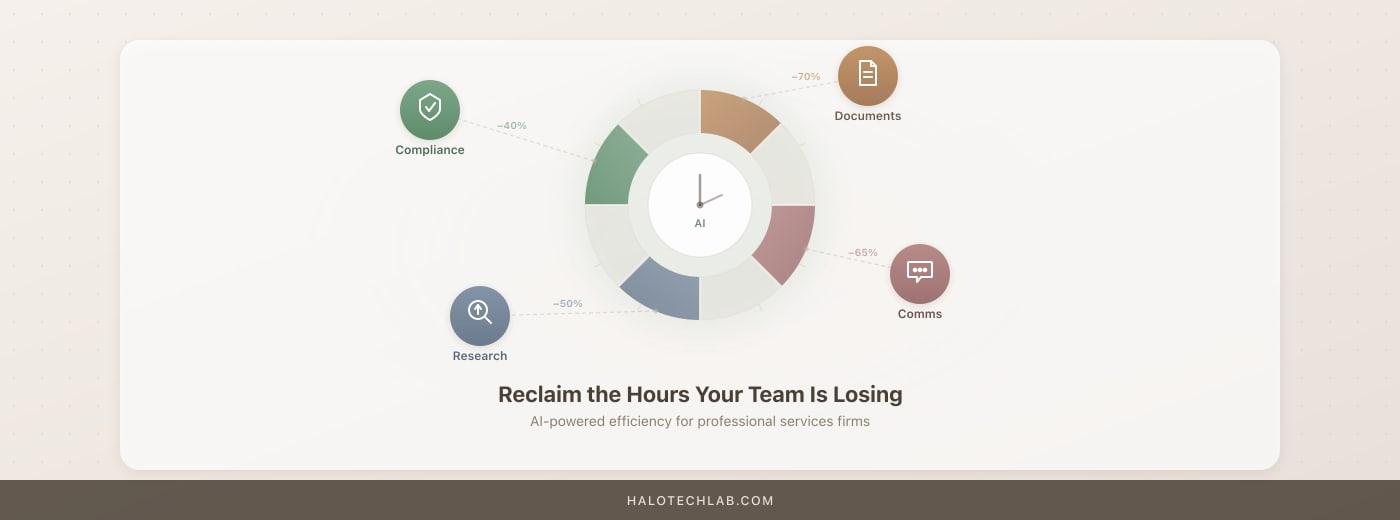
How much of your team's week is spent on work that feels important but adds no real value? If you run a law firm, accountancy practice, consultancy, or recruitment agency, the answer is probably more than you would like to admit.
Professional services firms sell expertise and time. Yet a staggering amount of that time disappears into document review, compliance checking, client chasing, and admin that could be handled faster and more accurately by technology. According to a 2024 Thomson Reuters report, solicitors spend up to 40% of their working day on tasks that do not require legal judgement.
AI is not here to replace your people. It is here to give them their time back. This guide explores how professional services SMEs across the UK are using AI to cut through repetitive work, and how your firm can do the same. For a broader overview of how AI fits into small business strategy, see our complete AI guide for UK SMEs.
Document Review and Contract Analysis
Every professional services firm drowns in documents. Solicitors review contracts clause by clause. Accountants wade through financial statements. Consultants comb through research reports. It is necessary work, but it is painfully slow.
AI-powered document review tools can scan hundreds of pages in minutes, flagging anomalies, extracting key terms, and highlighting clauses that deviate from standard templates. For a mid-sized law firm, this can reduce initial contract review time from hours to minutes.
The technology works by training language models on thousands of similar documents. The AI learns what "normal" looks like and alerts your team to anything unusual. Think of it as a very thorough, very fast junior associate who never gets tired and never misses a clause buried on page 47.
For accountancy firms, AI document processing can extract figures from invoices, receipts, and bank statements automatically, feeding them into your accounting software without manual data entry. Our document processing AI solutions show how this works in practice.
Client Communication Drafting
Your senior partners and directors are brilliant at advising clients. They are less brilliant at spending 90 minutes drafting a follow-up email that says essentially the same thing they have said a hundred times before.
AI writing assistants can draft client communications based on templates, previous correspondence, and case notes. A solicitor can review a draft letter in two minutes instead of writing one from scratch in twenty. An accountant can generate personalised tax deadline reminders for their entire client base in the time it takes to make a cup of tea.
The key word here is "draft." AI generates the first version. Your experts review, refine, and approve. The human judgement remains. The drudgery disappears.
This is not about sending generic, robotic emails to your clients. Modern AI tools can match your firm's tone of voice and tailor content to individual client circumstances. The result is communication that sounds like it came from your best writer, produced at the speed of your busiest one.
Research Automation
Whether you are a management consultant researching a new market, a recruitment agency mapping a talent landscape, or a solicitor checking case law, research eats time.
AI research tools can synthesise information from multiple sources in seconds. They can summarise lengthy reports, identify relevant precedents, and compile competitive analyses that would take a human researcher half a day.
For recruitment agencies, AI can scan thousands of CVs against job specifications, ranking candidates by relevance and flagging potential matches that a human recruiter might overlook. Early adopters report reducing time-to-shortlist by 60-70%.
Consultancies are using AI to analyse industry data, generate initial findings, and even draft preliminary recommendations. The consultant still leads the strategic thinking, but the groundwork is done before they sit down at their desk.
For firms that rely heavily on research and knowledge management, production-grade NLP systems like Inference Cloud — which builds semantic knowledge graphs and conversational search — show what is possible when AI is applied to large-scale information retrieval. On a lighter note, tools like Wisdom AI, an AI Chrome extension that summarises web content into shareable learning boards, can help individual professionals cut through information overload and extract insights faster.
Compliance Checking and Risk Management
Compliance is the silent time thief of professional services. Every firm must stay on top of regulations, and those regulations change constantly.
AI compliance tools can monitor regulatory updates in real time, cross-reference your processes against current requirements, and flag gaps before they become problems. For accountancy firms dealing with Making Tax Digital, anti-money laundering regulations, and constantly shifting HMRC guidance, this is transformative.
Law firms can use AI to check documents against regulatory requirements, ensuring nothing falls through the cracks. The technology does not replace your compliance officer. It gives them superpowers, catching issues that human review might miss across thousands of documents.
The cost of non-compliance is severe. A single GDPR breach can result in fines of up to 4% of annual turnover. AI compliance monitoring typically costs a fraction of what a single regulatory penalty would. Understanding automation fundamentals is the first step towards building a compliance framework that scales with your firm.
What the Numbers Look Like
Professional services firms adopting AI for repetitive tasks are seeing measurable returns:
- Document review: 50-80% reduction in initial review time
- Client communications: 60-70% faster drafting of routine correspondence
- Research tasks: 40-60% time saving on market and regulatory research
- Compliance monitoring: 30-50% reduction in compliance-related admin
- Data entry: Up to 90% reduction through automated extraction
For a 20-person firm where professionals bill at an average of £150-£250 per hour, reclaiming even five hours per person per week translates to significant additional capacity. That is either more billable work or the same revenue with less overtime.
Getting Started Without Disruption
The firms that succeed with AI are not the ones that try to transform everything at once. They pick one painful, repetitive process and fix it first.
Start by auditing where your team spends time on tasks that do not require their professional expertise. Time tracking data is gold here. Look for processes that are high volume, rules-based, and currently manual.
Common starting points by sector:
- Law firms: Contract review, due diligence document scanning, time recording
- Accountancies: Invoice processing, bank reconciliation, tax return data gathering
- Consultancies: Market research compilation, report formatting, data analysis
- Recruitment agencies: CV screening, candidate matching, interview scheduling
A phased approach works best. Pilot with one team or one process, measure the results over 8-12 weeks, then expand. Budget between £5,000 and £30,000 for an initial AI implementation depending on complexity. Our AI solutions for professional services page outlines what a typical engagement looks like.
The Human Element Matters Most
AI works best in professional services when it amplifies expertise rather than attempting to replace it. Your clients hire you for judgement, relationships, and deep knowledge. They do not hire you to type numbers into spreadsheets or reformat documents.
The firms that get this right treat AI as a tool that elevates their team. Junior staff spend less time on mechanical tasks and more time developing real expertise. Senior partners focus on high-value advisory work instead of admin. Everyone goes home on time more often.
If you are considering AI strategy for your firm, the starting point is always the same: identify the work your team should not be doing, and find a smarter way to handle it.
Key Takeaways
- Professional services firms lose 30-40% of productive time to repetitive tasks that AI can handle faster and more accurately
- Document review, client communications, research, and compliance checking are the highest-impact areas for AI adoption
- Start with one process, measure results over 8-12 weeks, then expand
- Budget £5,000-£30,000 for an initial AI implementation depending on scope
- AI amplifies expertise rather than replacing it, freeing your team for higher-value work
- The compliance cost of inaction may outweigh the investment cost of adoption
Frequently Asked Questions
Will AI replace solicitors, accountants, or consultants?
No. AI handles the repetitive, rules-based elements of professional work. It cannot replicate the judgement, empathy, and strategic thinking that clients pay for. Firms using AI effectively are not reducing headcount. They are increasing the value each person delivers.
How do we ensure client data stays secure when using AI tools?
Choose AI tools that offer enterprise-grade encryption, UK or EU data residency, and compliance with GDPR and professional regulatory standards (SRA, ICAEW, etc.). Never feed confidential client data into free, consumer-grade AI tools. A proper data privacy framework is essential before any AI adoption.
What is the typical return on investment for AI in professional services?
Most firms see ROI within 3-6 months. The primary return comes from time savings on repetitive tasks, which translates directly into either increased billable capacity or reduced overtime costs. A firm investing £15,000 in AI document processing that saves 10 hours per week at £200/hour recovers the investment in under 8 weeks.
Do we need technical staff to manage AI tools?
Not necessarily. Most modern AI tools for professional services are designed for non-technical users. However, you do need someone internally who owns the implementation, monitors quality, and manages the relationship with your AI provider. For guidance on planning your approach, read our AI project cost breakdown.
Ready to reclaim your team's time? Get in touch with Halo Technology Lab to explore how AI can streamline your firm's operations without disrupting what makes you great.
Enjoyed this? Get the next one by email
Practical AI playbooks, build logs and tool teardowns. One email a week, free, unsubscribe in one click.
Related Articles
How to Measure Whether AI Training Actually Worked
Attendance and satisfaction scores tell you nothing. Four measures that do, how to capture a baseline before you start, and what a realistic return looks like.
Training a Team That Thinks AI Is Coming for Their Job
Resistance is usually a reasonable response to a badly handled rollout. How to run AI training when people are worried, and why pretending nothing will change makes it worse.
Workshop, Programme or Course? Choosing the Right Shape of AI Training
A half-day workshop, an ongoing programme and a self-serve course solve different problems. What each is good at, what each costs, and how to tell which one your team needs.