If It Is Not Broken, Why Change It? The Real Cost of Standing Still
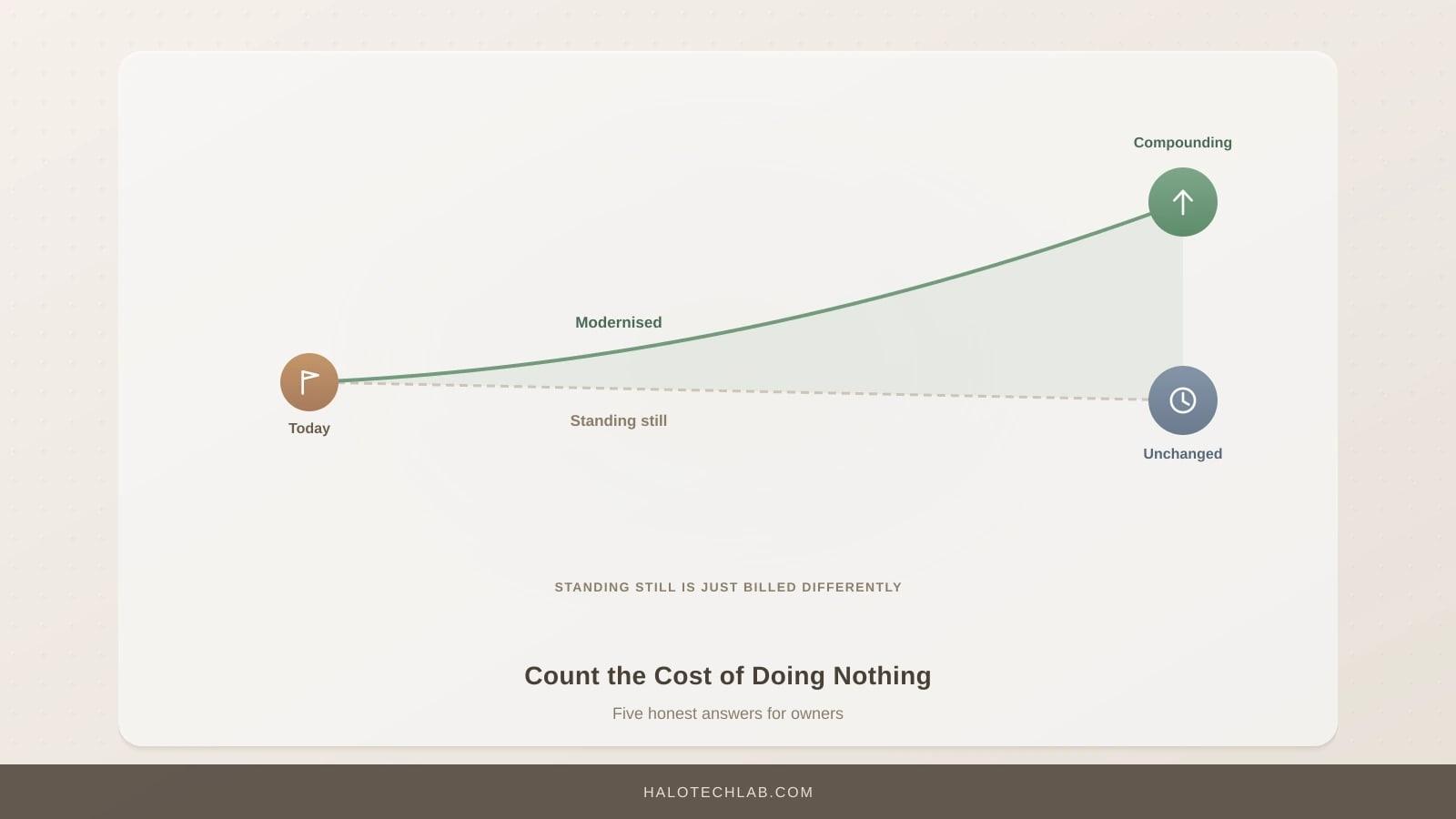
Standing still is not free, it is just billed differently. Five honest answers to the question every business owner asks before a modernisation project, including when the answer is to do nothing.
A butcher in Lancashire told us his order book had worked fine for thirty-one years. He was right. It had. Every order his shop had ever taken was in it, written in pencil, in his handwriting. The problem was not the book. The problem was that he was sixty-four, his daughter was taking over, and thirty-one years of knowing which restaurant wanted which cut on which day lived in a shed behind the shop.
"If it is not broken, why change it?" is a reasonable question, and it deserves a better answer than the one most technology firms give. The honest answer is that standing still is not free. It is just billed differently, in places that never appear on a profit and loss statement.
This article is part of our guide to modernising a legacy business.
Answer one: it is not broken, it is being held together
There is a difference between a system that works and a system that works because somebody is quietly propping it up.
Ask yourself who in your business would need to be called if a particular process went wrong on a Friday afternoon. If the answer is a name rather than a role, the system is not working. A person is working, and the system is taking the credit. That is fine until they are on holiday, off sick, or gone.
Answer two: the cost is real, it is just invisible
Old systems rarely generate an invoice. They generate hours instead, which is why they survive budget reviews that kill much cheaper things.
A sales administrator rekeying order details from email into a spreadsheet and then into an accounts package is costing you roughly the same as a software subscription, every single week, forever. Nobody ever approved that spend. It simply accumulated. We walk through how to put a figure on this in what a legacy system actually costs you every year.
Answer three: you are not falling behind, you are becoming harder to buy from
This is the part worth being precise about, because the "get left behind" line is used to sell a great deal of technology nobody needs.
You are probably not about to be wiped out by a competitor with better software. What happens is slower and more irritating than that. A customer asks for something in a format you cannot easily produce. A larger client asks a supplier due diligence question you cannot answer. A quote takes you three days and somebody else two hours. You do not lose the business dramatically. You lose it one small friction at a time, and you rarely find out why.
Answer four: the people you want to hire have opinions about this
A twenty-six-year-old who has used decent software everywhere else will form a view of your business in their first week, based on the tools you hand them.
This matters most in the businesses least likely to worry about it. If you are competing for staff with employers who look modern, and your onboarding involves a printed form and a shared drive called "SHARED NEW", you are making a statement about how the business is run. It may not be a true statement. It is still the one being received.
Answer five: sometimes the answer genuinely is to do nothing
We would rather say this plainly than have you find out after spending money.
If a process takes an hour a month, it does not need automating. If a system is ugly but stable, well understood by the people who use it, and not blocking anything you want to do next, leave it alone. Replacing working software with newer working software is not modernisation. It is redecorating, and it carries all the risk of a real project with none of the return.
The test is not "is this old". The test is: is this stopping us doing something we have decided to do? If nothing follows from the change, do not make it.
How to tell which answer applies to you
Three questions, answered honestly, will usually settle it.
What did we decide not to do last year because the systems would not support it? If the answer is nothing, you are probably fine. If you can name two or three things, the system is not neutral, it is a constraint.
What happens if the person who understands this leaves? Put a number on the disruption in weeks. Anything over four weeks is a risk, not an inconvenience.
Where does the same information get typed twice? Double entry is the clearest single signal that a business has outgrown its setup. It is also usually the cheapest thing to fix.
If all three come back clean, keep the order book. If any of them made you wince, that is the place to start, and only that place.
Key Takeaways
- "If it is not broken" is a fair question. The honest answer is that the cost of standing still is real but invisible, paid in hours rather than invoices.
- A system that only works because one person props it up is not working. It is a dependency wearing a system's clothes.
- Falling behind rarely looks dramatic. It looks like slower quotes, awkward questions you cannot answer, and business lost one friction at a time.
- Sometimes doing nothing is correct. If a change does not unlock a decision you have already made, do not make it.
- Start with double entry. Where the same information is typed twice is almost always the cheapest place to begin and the easiest to prove.
Frequently Asked Questions
How do I know whether this is genuinely urgent or just sales pressure?
Urgency should be tied to something specific: a person retiring, a client requirement you cannot meet, a system losing support, a decision you have already made that the current setup blocks. If nobody can name the thing that changes, there is no urgency, only a proposal.
We tried a big system change five years ago and it was a disaster. Why would this be different?
Because it does not have to be big. Most failed modernisation projects failed on scope, not technology. Fixing one process that costs you eight hours a week is a small, reversible, cheap thing to try, and it tells you far more about whether a supplier is worth trusting than a proposal ever will.
Our staff do not want anything to change. Does that matter?
Yes, and it is worth listening to rather than managing around. Staff resistance is usually specific: they have seen a change go badly, or they suspect the real goal is headcount. Ask them which part of their week they would most like to stop doing. You will usually get a better project out of that conversation than out of a strategy session.
Wondering whether your systems are genuinely holding you back or simply old? Talk to Halo Technology Lab. Our strategy and scoping service starts by working out what not to change.
Enjoyed this? Get the next one by email
Practical AI playbooks, build logs and tool teardowns. One email a week, free, unsubscribe in one click.
Related Articles
Technology and Succession: Handing Over a Business That Runs on One Person's Head
Only 30% of family businesses survive the move to a second generation. Much of what is lost is knowledge nobody wrote down. How to get it out of one head before the handover.
Running Your Business on Spreadsheets: When It Is Fine, and When It Becomes a Risk
Spreadsheets are underrated, right up until they are dangerous. Seven signals that yours has quietly become critical infrastructure, and what to do about it without a rebuild.
Rip and Replace vs Modernise Around the Edges
Two ways to fix an ageing system, and they suit very different businesses. How to tell which one you need, what each really costs, and why the bigger option is usually sold harder.